
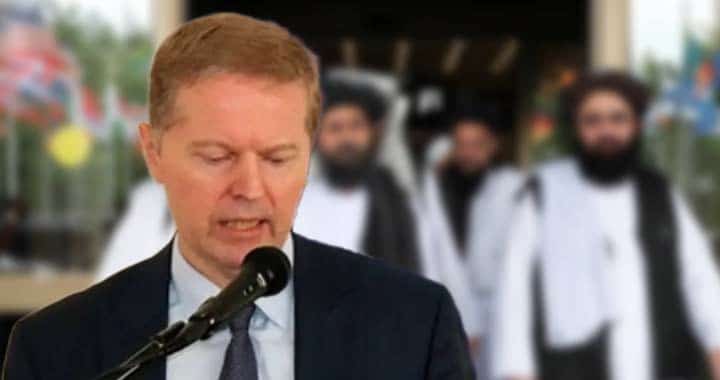
The European Union has firmly rejected any suggestion that its technical engagement with the Taliban over the return of Afghan migrants represents a step towards diplomatic recognition or normalisation of relations, reiterating that its dealings with the group remain strictly limited to practical and operational matters.
EU Special Envoy for Afghanistan Thomas Frellesen, in an interview with Radio Azadi published on Wednesday, November 25, made clear that there had been no move towards recognising the Taliban authorities or normalising relations with them. He stressed that technical cooperation on migration-related issues must not be interpreted as political acceptance or legitimacy for the group’s rule.
Addressing the June meeting between European Commission officials and a Taliban delegation in Brussels, Frellesen explained that the meeting had been arranged at the request of several EU member states to establish a coordinated European approach towards the return of Afghan migrants.
He clarified that the discussions focused exclusively on practical arrangements and the operational requirements of the readmission process.
According to Frellesen, the EU’s engagement framework permits limited technical and operational contacts with the Taliban but does not grant legitimacy to its authorities or signal any change in the bloc’s political position.
He also rejected any connection between technical cooperation on migrant returns and decisions by individual European countries concerning the operation of Afghan diplomatic missions. Responding to questions about Germany allowing Taliban officials to run Afghan diplomatic missions and reported French efforts in a similar direction, he maintained that these developments were separate from the EU’s technical engagement.
The EU envoy also addressed growing international concerns over the potential return of Afghan migrants to Afghanistan, particularly warnings issued by United Nations experts regarding the risks they could face.
Frellesen emphasised that all EU member states are obligated to comply with European and international law when considering deportations or returns.
He specifically highlighted the principle of non-refoulement, which prohibits the return of individuals to countries or territories where they face a real risk of serious harm.
He did not provide a specific estimate of the number of Afghan migrants expected to be returned, noting that, to his knowledge, the numbers involved so far had remained very limited.
Turning to the deteriorating situation of Afghan women and girls under Taliban rule, Frellesen reaffirmed that women’s rights remain among the European Union’s foremost priorities concerning Afghanistan.
He disclosed that the issue was the first matter he raised during his recent visit to Kabul and meetings with Taliban representatives.
The envoy also highlighted the EU’s role in drafting human rights resolutions on Afghanistan, including last year’s resolution that paved the way for establishing an independent investigative mechanism for the country.
The mechanism reflects continuing international efforts to address human rights concerns and strengthen accountability for violations in Afghanistan.
Frellesen further underlined that the European Union has maintained its presence in Kabul and provided more than €2 billion in assistance to the Afghan people over the past five years.
He stressed that the assistance has been guided by the principle of delivering humanitarian support through women and for women, reflecting the EU’s continued emphasis on protecting vulnerable communities despite the restrictions imposed by the Taliban.
The EU envoy also expressed concern over reports of a fivefold increase in opium production in Afghanistan.
He acknowledged that the Taliban’s prohibition on poppy cultivation had initially contributed to a substantial reduction in drug production, but warned that some of those gains were now being reversed.
The reported resurgence raises renewed concerns over Afghanistan’s narcotics situation and the potential consequences for regional and international efforts to combat drug trafficking.
Frellesen’s remarks reinforce the European Union’s distinction between maintaining necessary operational channels and extending political recognition to the Taliban.
While the bloc continues to engage on limited practical matters, including migration, humanitarian assistance and human rights, it has reiterated that such contacts do not amount to acceptance of Taliban governance.



