
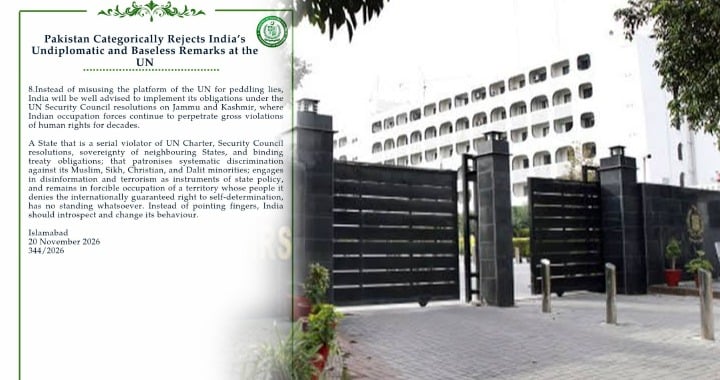
Pakistan has categorically rejected India’s undiplomatic, irresponsible and baseless remarks at the United Nations, describing them as a desperate attempt to divert international attention from India’s own record of violations of international law, interference in the internal affairs of neighbouring states and weaponisation of shared resources.
Responding to India’s remarks, the Ministry of Foreign Affairs said that the allegations were devoid of substance, deserved no consideration and had already been effectively rebutted by Pakistan’s representative during the same UN meeting. It said such rhetoric was characteristic of India’s habitual approach of resorting to unfounded accusations rather than addressing legitimate concerns through responsible diplomacy.
Pakistan strongly emphasised that India’s remarks constituted an unacceptable interference in its internal affairs and ran contrary to the fundamental principles and spirit of the United Nations Charter. Rather than responding to Pakistan’s legitimate concerns over India’s weaponisation of water resources, the Ministry said, New Delhi had resorted to unsubstantiated insinuations against Pakistan’s national institutions and leadership.
The Ministry further highlighted India’s hostility towards Pakistan’s efforts to develop its mineral resources, pointing to what it described as persistent attempts to undermine Pakistan’s stability and obstruct economic development. Pakistan has repeatedly presented evidence of Indian sponsorship and support for terrorist activities in Balochistan and Khyber Pakhtunkhwa, aimed at destabilising the country, disrupting development initiatives and depriving local populations of the economic benefits of their natural resources.
Referring to India’s growing domestic extremism, the Foreign Office said the country’s continuing transformation into a Hindutva-driven, extremist and fascist political order under a religious fundamentalist regime was widely recognised. It observed that India’s allegations and deliberate distortion of facts were merely an attempt to conceal its international isolation and divert attention from its internal challenges and discriminatory policies.
On the Indus Waters Treaty, Pakistan underscored that international law and the facts leave no room for ambiguity. The Ministry recalled that on August 31, 2026, the Court of Arbitration constituted under the Indus Waters Treaty unanimously ruled that the Treaty remained binding and fully in force, with no legal basis for its unilateral suspension or termination by India.
Pakistan maintained that India’s continued refusal to accept the ruling raised serious questions about its respect for international law, binding treaty commitments and the authority of international dispute-resolution mechanisms. Its unilateral attempt to place the Treaty in abeyance, the Ministry said, reflected an unacceptable attempt to weaponise shared water resources for political and strategic purposes.
The Foreign Office also urged India to stop misusing the United Nations platform to advance politically motivated allegations and instead fulfil its outstanding international obligations concerning Jammu and Kashmir. It called upon New Delhi to implement the relevant UN Security Council resolutions, which guarantee the Kashmiri people their right to self-determination, while drawing attention to the continued grave human rights violations committed by Indian occupation forces in the territory.
In its concluding remarks, Pakistan asserted that a state repeatedly accused of violating the UN Charter, disregarding Security Council resolutions, undermining the sovereignty of neighbouring countries and breaching binding international treaty obligations had no moral or legal standing to lecture others on these principles.
The Ministry also drew attention to India’s record of systematic discrimination against its Muslim, Sikh, Christian and Dalit minorities, as well as its alleged use of disinformation and support for terrorism as instruments of state policy. It further underscored India’s continued forcible occupation of Jammu and Kashmir and its denial of the Kashmiri people’s internationally recognised right to self-determination.
Pakistan made it clear that India could not conceal its own conduct by pointing fingers at others or using international forums to propagate baseless allegations. Instead, New Delhi must undertake serious introspection, respect international law, honour its treaty obligations, abandon its policy of hostility and fundamentally change its behaviour towards Pakistan and its neighbours.



