
Pakistan has categorically condemned Israel’s continued military aggression against Gaza, reaffirmed its unwavering commitment to the Palestinian cause, and reiterated its resolve to extend all possible humanitarian, educational and diplomatic support to the Palestinian people. Pakistan has also firmly rejected India’s baseless allegations at the United Nations, denouncing New Delhi’s persistent attempts to interfere in Pakistan’s internal affairs, malign its national interests and undermine regional stability.
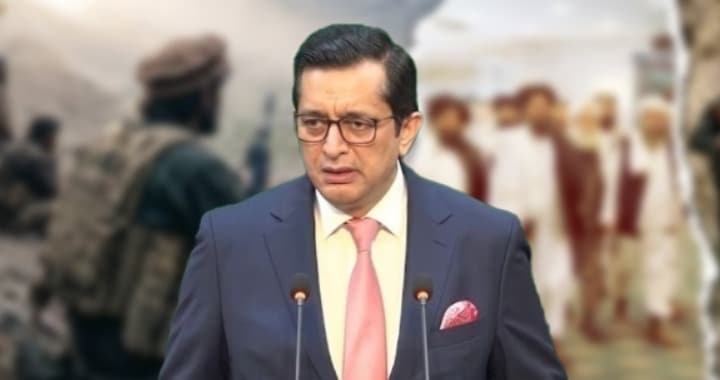
Addressing the weekly media briefing, Foreign Office Spokesperson Sajjad Haider Khan outlined Pakistan’s position on key regional and international developments, underscoring Islamabad’s principled foreign policy, its commitment to regional peace and its determination to counter terrorism and externally sponsored destabilisation.
Pakistan has strongly condemned Israel’s continued attacks on Gaza, reiterating that the killing of innocent Palestinians must end immediately. The Spokesperson stated that Pakistan, alongside 14 other countries, had issued a joint declaration condemning the Israeli attacks.
He reaffirmed that Pakistan’s position on Palestine remains principled and unequivocal, adding that Pakistan and Iran share a common position on the Palestinian issue. Pakistan’s participation in the Gaza Board of Peace was guided by its commitment to ending the bloodshed and advancing efforts to secure relief for the Palestinian people.
Pakistan will continue to support Palestinians through every possible avenue, including educational assistance for Palestinian students and other forms of humanitarian support.
Clarifying the photograph of Pakistan’s Ambassador to Geneva, Tahir Andrabi, alongside the Israeli Ambassador, the Spokesperson explained that Ambassador Andrabi serves as Chair of the Conference on Disarmament on a rotational basis. Newly appointed ambassadors routinely present their credentials to the presiding Chair. The Israeli Ambassador’s appearance was strictly within this established diplomatic procedure, and no separate formal meeting took place between the two ambassadors.
Pakistan has categorically rejected the remarks made by India’s Permanent Representative to the United Nations concerning Pakistan’s natural resources, describing them as an unacceptable intrusion into Pakistan’s internal affairs and a deliberate misuse of the UN platform to propagate disinformation.
The Spokesperson stated that India’s hostility towards Pakistan’s development and exploitation of its natural resources, coupled with its persistent efforts to foment instability in the region, is well known. India cannot conceal its own conduct by manufacturing allegations against Pakistan.
He further observed that India’s treatment of its own minorities raises serious questions about its human rights record. Rather than lecturing others, India must examine its domestic practices and address the systematic discrimination and mistreatment faced by minority communities.
Responding to questions about Indian propaganda displayed through large screens along the Azad Jammu and Kashmir side of the border, the Spokesperson highlighted India’s continuing repression in Indian Illegally Occupied Jammu and Kashmir (IIOJK), where fundamental freedoms, particularly freedom of expression, remain severely restricted.
Pakistan will continue to extend its unwavering political, moral and diplomatic support to the Kashmiri people in their legitimate struggle for the right to self-determination, in accordance with relevant UN Security Council resolutions.
The Spokesperson reiterated Pakistan’s serious concerns regarding terrorism emanating from Afghan territory, particularly the activities of the proscribed Balochistan Liberation Army (BLA).
He stated that the BLA is based in Kabul and enjoys Indian backing. Pakistan remains committed to restricting the activities of this terrorist organisation and confronting all threats to its national security.
Pakistan desires a peaceful, stable and prosperous Afghanistan. However, persistent security concerns relating to terrorist groups operating from Afghan territory are not confined to Pakistan; they are shared by other regional countries as well.
The Spokesperson emphasised that Afghanistan’s suspension from the Economic Cooperation Organization (ECO) remains in place. Any restoration of its membership would necessarily depend on addressing the legitimate security concerns of Pakistan and other member states.
Commenting on Pakistan’s non-participation in the recent ECO meeting, the Spokesperson clarified that, under the organisation’s mandate, the host country has the authority to determine which countries are invited to participate.
Nevertheless, Pakistan welcomed the objectives adopted at the meeting for cooperation through 2035, particularly in trade, energy and transport connectivity.
The Spokesperson also appreciated the recognition of the Islamabad Memorandum of Understanding in the joint declaration, noting that the document had been signed by both sides through mutual consent, although certain implementation challenges remain.
Pakistan remains committed to strengthening regional economic integration and advancing mutually beneficial cooperation among ECO member states.
Welcoming the Big Three meeting in Shenzhen, the Spokesperson described engagement among major powers as a positive development at a time of heightened geopolitical tensions. He stressed that dialogue and diplomacy remain essential to international peace and stability.
He reaffirmed that Pakistan maintains balanced and constructive relations with all major powers and will continue to pursue an independent, pragmatic and balanced foreign policy.
Pakistan is also continuing its diplomatic efforts to facilitate dialogue between Iran and the United States. In this context, the recent meeting between the Iranian Foreign Minister and Field Marshal Asim Munir was also highlighted.
Regarding the upcoming meeting on the Makkah Pact in Pakistan, the Spokesperson stated that participants would review progress achieved so far. Pakistan remains committed to implementing the agreement, which is not directed against any country.
Pakistan remains committed to expanding its political, economic and diplomatic engagement with ASEAN countries. The recent visit of Singapore’s Foreign Minister was described as an important step in strengthening these relations.
The Spokesperson highlighted Pakistan’s contribution to diplomatic capacity-building, noting that the Foreign Service Academy has trained approximately 1,600 diplomats from different countries, including 45 diplomats from ASEAN member states.
Pakistan also welcomed the Organisation of Islamic Cooperation’s statement on the deteriorating situation in Myanmar, reaffirming its support for international efforts aimed at addressing the crisis.
Highlighting Pakistan’s commitment to promoting religious tourism and interfaith harmony, the Spokesperson stated that approximately 2,700 Sikh pilgrims are expected to visit Pakistan, with several hundred already having arrived.
He also referred to a recent Buddhist delegation from Sri Lanka that visited sacred Buddhist heritage sites in Pakistan.
These initiatives reflect Pakistan’s commitment to protecting religious heritage, facilitating faith-based tourism and promoting mutual respect, tolerance and interfaith understanding.
On energy security, the Spokesperson stated that Pakistan continues to explore natural gas procurement from various international sources to meet its domestic energy requirements.
Responding to a question regarding the sentencing of Asif Merchant, he clarified that the Foreign Office had not received any request for consular access to date.
Pakistan’s foreign policy continues to be guided by its commitment to sovereignty, territorial integrity, international law, regional stability and peaceful coexistence.
Pakistan will neither compromise on the legitimate rights of the Palestinian and Kashmiri peoples nor remain silent in the face of external interference, disinformation or terrorism.
The international community must recognise that sustainable peace cannot be achieved through aggression, occupation, propaganda or the sponsorship of militant groups. It requires respect for international law, accountability, dialogue and a genuine commitment to resolving outstanding disputes.



