
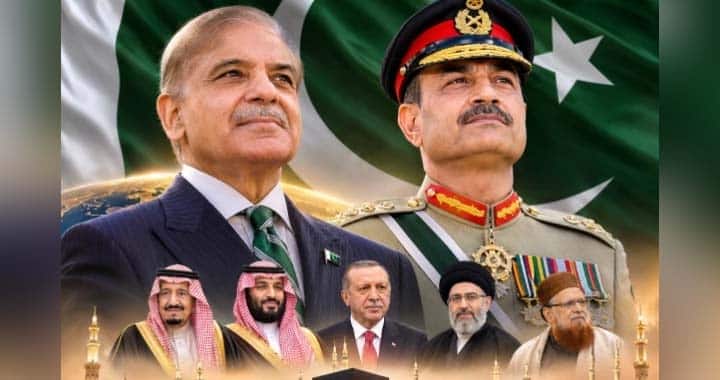
Pakistan has secured unprecedented global recognition as Prime Minister Shehbaz Sharif and Chief of Defence Forces and Chief of the Army Staff Field Marshal Syed Asim Munir have jointly secured the top position in the latest edition of The 500 Most Influential Muslims, placing Pakistan’s political leadership and military command at the forefront of the Muslim world.
The prestigious annual publication, compiled by the Royal Islamic Strategic Studies Centre (RISSC), an internationally recognised research institute based in Amman, Jordan, has, for the first time, introduced a shared first position featuring five prominent leaders from Pakistan, Saudi Arabia and Türkiye. The distinction also includes Saudi Arabia’s King Salman bin Abdulaziz Al Saud and Crown Prince Mohammed bin Salman, alongside Turkish President Recep Tayyip Erdoğan.
According to the publication, the historic joint ranking reflects the growing strategic cooperation among the three countries, particularly in the context of the Makkah Joint Defence Agreement. The report identifies the agreement as a significant development in collective Muslim-world security, bringing together Pakistan’s military capabilities, Saudi Arabia’s economic strength and Türkiye’s advanced defence technology and industrial capacity.
The publication describes this emerging strategic alignment as a major shift in cooperation among Muslim nations, highlighting a collective approach to mutual defence and regional security. The recognition places Pakistan prominently within an evolving framework of diplomatic, military and strategic partnerships across the Muslim world.
The report also provides an assessment of Pakistan’s diplomatic and economic landscape over the past year, acknowledging the country’s efforts to navigate economic stabilisation, mounting regional security challenges and complex relations with major global powers. It particularly highlights Islamabad’s regional diplomatic engagement and shuttle diplomacy in the Middle East aimed at promoting de-escalation, alongside efforts to manage domestic economic pressures, rising energy import costs and fuel conservation measures.
Beyond the top-ranked leaders, the publication has also recognised several other prominent Pakistani personalities for their influence and contributions. Renowned Islamic scholar Sheikh Muhammad Taqi Usmani has secured the seventh position, while Maulana Tariq Jamil has been ranked 32nd, further reflecting Pakistan’s contribution to Islamic scholarship and religious discourse at the international level.
Among other prominent global figures, Iranian Supreme Leader Ayatollah Mojtaba Khamenei has been placed fourth, followed by Jordan’s King Abdullah II at fifth. Qatar’s Emir Sheikh Tamim bin Hamad Al-Thani occupies the sixth position, while UAE President Sheikh Mohamed bin Zayed Al Nahyan has been ranked 12th.
The list also features prominent political leaders, religious scholars, influential personalities and public figures from across the Muslim world, including Palestinian President Mahmoud Abbas, Syrian Interim President Ahmed Al-Sharaa, football superstar Mohamed Salah and New York City Mayor Zohran Mamdani.
In its special recognition of individuals making exceptional contributions to humanity, the publication has named Palestinian paediatrician Dr Hussam Abu Safiya as Man of the Year, acknowledging his extraordinary commitment to his patients and his continued dedication to Gaza’s medical community amid the devastating humanitarian crisis.
Fatemeh Zahra Sheikhabadi, a survivor of the Minab school attack in Iran, has been named Woman of the Year. The publication recognises her courage in bringing the voices and experiences of children affected by the attack before the international community at the United Nations Human Rights Council in Geneva.
The annual rankings, which have been published since 2009, recognise individuals whose political leadership, scholarship, public service, social contributions and international influence have significantly shaped Muslim societies and the wider world.
Pakistan’s inclusion at the highest level of this year’s rankings marks a significant moment of international recognition for the country’s leadership and its growing strategic engagement with key Muslim nations. The shared top position of Prime Minister Shehbaz Sharif and Field Marshal Syed Asim Munir also places Pakistan at the centre of the publication’s recognition of emerging cooperation among influential Muslim countries.



