
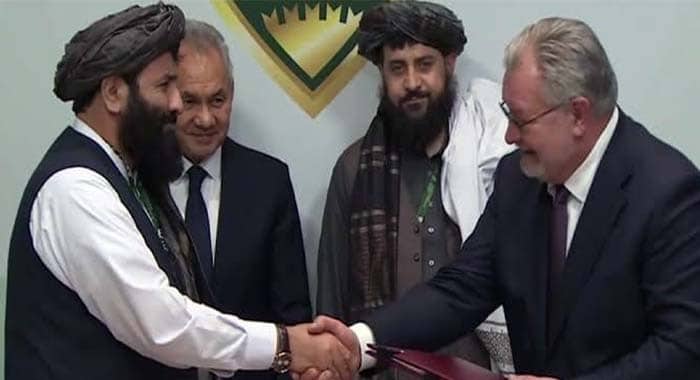
Russian Deputy Prime Minister Alexey Overchuk’s visit to Kabul on November 12, 2026, accompanied by a delegation of more than 70 Russian economic representatives, marks a significant expansion of Moscow’s political and economic engagement with the Taliban administration. The announcement of 15 economic agreements reportedly worth $103 million further underscores Russia’s determination to translate its political relationship with the Taliban into tangible economic and strategic influence.
However, behind the diplomatic meetings, economic announcements, and promises of expanded cooperation lies a much more important question: Are these agreements designed to improve the lives of the Afghan people, or are they primarily serving the geopolitical and economic ambitions of Moscow and the political interests of the Taliban?
Russia’s growing engagement with the Taliban must be understood within the broader context of its regional ambitions. Following its formal recognition of the Taliban administration in July 2025, Moscow has sought to strengthen its influence in Afghanistan through economic cooperation, security coordination, access to natural resources, and expanded regional trade networks.
For Russia, Afghanistan represents more than an economic opportunity. Its geographical position offers potential access to important regional markets and transit routes, while its natural resources provide opportunities for commercial investment. Security cooperation, particularly concerning the threat posed by ISIS-Khorasan and other extremist organisations, is another major consideration for Moscow.
Nevertheless, Russia’s strategic engagement with the Taliban should not automatically be interpreted as a commitment to democratic development, political inclusion, or the protection of fundamental freedoms in Afghanistan. Moscow, like other international powers, is pursuing its national interests, and those interests do not necessarily correspond with the aspirations of the Afghan population.
For the Taliban, expanding relations with Russia represents an important diplomatic and political advantage. It provides the administration with opportunities to reduce international isolation, attract foreign investment, expand commercial relations, and strengthen its position in regional diplomacy.
Yet diplomatic recognition and economic cooperation do not automatically translate into better governance or improved living conditions.
Afghan women and girls continue to face severe restrictions on education, employment, and participation in public life. Political representation remains severely limited, while the absence of an inclusive political system continues to raise serious concerns about the country’s future.
Against this background, the expansion of foreign economic relations raises a fundamental question: Can international partnerships genuinely contribute to Afghanistan’s development while the rights and participation of a substantial portion of its population remain restricted?
One of the most consequential aspects of Moscow’s growing engagement with Kabul is the prospect of Russian investment in Afghanistan’s mineral wealth and natural resources.
Afghanistan possesses considerable deposits of valuable minerals and other natural resources that could play an important role in economic reconstruction and long-term development. However, these resources must serve the interests of the entire nation rather than becoming instruments of political bargaining or exclusive commercial arrangements.
The Afghan people deserve clear answers regarding the terms of mining agreements, ownership arrangements, revenue distribution, environmental protections, and the long-term economic benefits of foreign investment.
Who will control these resources? Where will the revenues go? How many employment opportunities will be created for Afghan citizens? And what guarantees will ensure that the country’s national wealth is not exploited without public accountability?
Without transparency, independent oversight, and mechanisms to protect the public interest, foreign investment risks benefiting powerful political and commercial actors while ordinary Afghans remain excluded from the economic gains.
The announcement of 15 agreements worth $103 million may appear significant, but the actual value of these arrangements must be measured by their implementation and their impact on the Afghan economy.
Signing agreements is not the same as delivering investment, creating employment, or building sustainable industries.
If Afghanistan primarily becomes a destination for Russian products while its domestic manufacturing, agricultural production, and export capacity remain underdeveloped, the relationship could deepen economic dependence rather than establish balanced cooperation.
The real measure of success must be tangible improvements in people’s lives, including:
Sustainable employment opportunities for Afghan citizens.
Investment in domestic industries and productive infrastructure.
Increased Afghan exports and access to international markets.
Transparent management of natural resources and public revenues.
Improved living standards and broader economic opportunities.
Without these outcomes, economic agreements risk becoming diplomatic achievements on paper rather than meaningful progress for the Afghan population.
Moscow’s expanding engagement with the Taliban also carries broader geopolitical implications for China, Pakistan, Iran, and the United States.
Russia is seeking to strengthen its position in Central and South Asia, expand its commercial networks, and secure greater influence over regional economic and security arrangements.
China has its own strategic and economic interests in Afghanistan, particularly concerning regional stability, connectivity, and access to mineral resources. Pakistan remains an important neighbouring country because of its geographical position, trade routes, and regional security concerns. Iran also has significant economic and strategic interests in Afghanistan.
Consequently, Afghanistan risks becoming another arena of geopolitical competition, where foreign powers pursue influence through mining contracts, energy projects, trade agreements, infrastructure, and security cooperation.
The concern is not that Afghanistan should reject international investment or diplomatic engagement. Rather, the country must not become a platform for competing foreign interests while its own population remains excluded from decisions concerning its national future.
Russia has every right to pursue legitimate economic and strategic interests in Afghanistan. The Taliban administration may also seek international partnerships and economic opportunities. However, neither foreign governments nor the ruling authorities should be permitted to treat Afghanistan’s national wealth and future as matters belonging exclusively to political and commercial elites.
The Afghan people have an undeniable stake in decisions concerning their country’s natural resources, economic development, political future, and international partnerships.
Any genuine economic cooperation must be based on transparency, public accountability, fair distribution of benefits, respect for fundamental rights, and meaningful opportunities for Afghan citizens.
Afghanistan must not become a source of cheap raw materials for foreign powers, a marketplace for imported products, or a bargaining ground for geopolitical ambitions while its people remain deprived of their basic rights and opportunities.
The central question surrounding Moscow’s growing relationship with the Taliban is therefore not simply how many agreements have been signed or how much money has been announced. It is whether this cooperation will deliver lasting benefits to the Afghan people or merely strengthen the political and economic interests of those who control the country’s resources.
Afghanistan belongs to its people, not to the Taliban, not to foreign powers, and not to competing geopolitical interests. Its natural wealth must serve its citizens, its economy must create opportunities for its people, and its future must be determined with their rights and aspirations at its centre.



