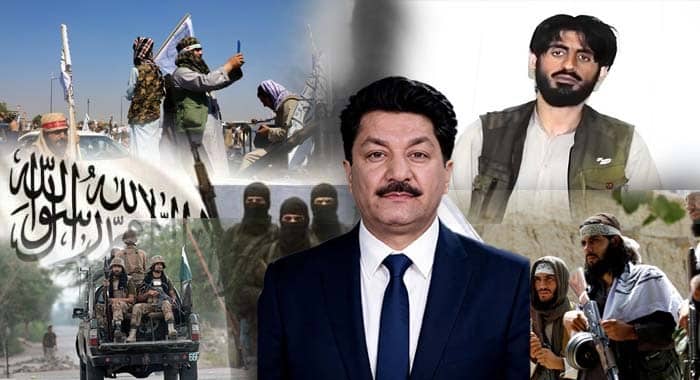
The latest evidence presented by Pakistani authorities has once again exposed the involvement of Afghan nationals and Afghan-based networks in terrorism inside Pakistan. The video confession of a captured terrorist, identified as Hikmatullah alias Hamza, provides another important piece of evidence about how suicide bombers are prepared, trained and dispatched to carry out attacks in Pakistan.
During a joint press conference, Additional Inspector General Abbas Ahsan and ARDC spokesperson Mahmood Jan Babar presented a video recording of the terrorist, who reportedly belonged to Afghanistan’s Paktia province. He disclosed how he was prepared as a suicide bomber at a religious seminary in Jalalabad and identified the people and places associated with his recruitment and training.
There is something particularly significant about this confession. Whenever terrorists enter Pakistan, carry out attacks and either escape or are eliminated, questions are raised about why they are not captured. However, when security agencies succeed in apprehending them and present their confessions before the media, these developments often receive considerably less attention. In many cases, the faces of captured terrorists and facilitators are concealed, making it difficult for the public to understand who they are and where they come from.
This time, however, the authorities have presented a captured individual whose account provides details about his background, training and involvement in preparing suicide bombers. Similar cases have emerged before. One of the individuals involved in the attack on the Rangers facility in Karachi also had links to Afghanistan. These are not isolated questions that can simply be dismissed.
Another important aspect of the latest confession is the terrorist’s accent. He speaks in a distinctly Afghan Pashto dialect rather than the Pashto commonly spoken in Khyber Pakhtunkhwa or Balochistan. His account also describes how he was treated after arriving in Pakistan, including the food, accommodation and hospitality extended to him. He said that it was only after experiencing this treatment that he realized Pakistan was also a Muslim country.
This revelation raises serious questions about the ideological indoctrination of young people recruited by terrorist organizations. What exactly are they taught in their training centers? What kind of narratives are planted in their minds to convince them that attacking Pakistan, its armed forces, police personnel and even worshippers is somehow justified?
When these individuals arrive in Pakistan, they encounter a reality entirely different from what they were taught. They see ordinary people conducting their businesses, visiting markets and living their everyday lives. They visit mosques and witness Muslims from different schools of thought offering prayers. They also see the funerals of soldiers and police personnel who sacrificed their lives fighting terrorism. They cannot remain unaware of the fact that Pakistan is an Islamic republic governed by a constitutional system in which the sovereignty of Allah Almighty is recognized.
They also see places of worship belonging to different religious communities. The attack on a church in Peshawar, for instance, demonstrated that terrorist violence has never spared even Christian places of worship. Such realities expose the distorted narratives used to brainwash recruits.
This is precisely the message that needs to reach the Afghan Taliban authorities. When foreign, non-Muslim forces were present in Afghanistan, the Taliban fought against them, describing their struggle as jihad and resistance against foreign occupation. Whatever their interpretation of that conflict, they eventually gained control of Afghanistan through negotiations, armed struggle and other political developments.
They are no longer merely an armed group waging guerrilla warfare. They are now the authorities governing a country and must act with the responsibilities that come with governing a state. If they continue allowing their territory to be used by terrorist organizations and refuse to address the security concerns of neighboring countries, they will deepen their international isolation and regional tensions.
The Afghan Taliban cannot simply deny the evidence emerging from Pakistan. They sometimes respond by pointing to the presence of Islamic State Khorasan Province (ISKP) in Afghanistan and alleging that Pakistani territory is being used against them. Pakistan has never claimed that ISKP does not operate inside the country. The banned Tehreek-e-Taliban Pakistan (TTP), the Gul Bahadur group, Balochistan Liberation Army and ISKP all have networks or operatives that pose security threats. ISKP has also carried out attacks inside Pakistan, and its leadership and planning networks have links extending beyond national borders.
The problem is that these terrorist organizations increasingly operate across nationalities and borders. Their recruitment is not necessarily restricted to Pakistani nationals. The captured individual has also claimed that he previously served in the Afghan National Army and received military and command training. After the Taliban takeover, he joined their ranks and subsequently became associated with terrorist activity.
This is another dimension that deserves attention. The Afghan National Army received training from the United States and other international partners. Following its collapse, some individuals with military training and combat experience may have moved into armed organizations. A person trained to fight but lacking opportunities or an alternative livelihood can become vulnerable to recruitment by terrorist networks.
The attack on the Razaq Cadet College in Razmak, North Waziristan, is another example of the cross-border dimension of terrorism, as the attackers were identified as Afghan nationals. Such cases demonstrate why the distinction between Pakistani and Afghan recruits within terrorist organizations cannot always be assumed.
We must also understand that suicide attacks are not spontaneous acts. A bomber does not simply arrive in an area, spot a mosque or police station and decide to detonate explosives. Such attacks involve extensive planning, reconnaissance, training and logistical arrangements.
The attack on Bannu Cantonment offers an example of this planning. A video released after the attack showed a model of the cantonment and explained how an explosive-laden vehicle would strike a particular wall, allowing other attackers to enter the compound. The video also identified residential areas, offices and sensitive locations that the attackers intended to target or use to hold people hostage. This level of preparation requires considerable time and coordination.
Suicide bombers are trained over weeks and sometimes months. They are shown maps, familiarized with targets and prepared psychologically for their missions. Their movement into Pakistan is also facilitated through networks operating on both sides of the border. They are not necessarily wearing suicide jackets when crossing into the country. Facilitators arrange their accommodation, transportation, food and other requirements before they are moved towards their intended targets.
The investigation into the attack on the Imam Bargah in Tarlai, Islamabad, also revealed the importance of these support networks, including where the suicide bomber stayed, who facilitated him and how he was prepared for the attack. Behind an individual bomber, there is often an entire network involving handlers, facilitators, explosives suppliers and planners.
The 2,600-kilometer Pakistan-Afghanistan border presents another challenge. Pakistan has fenced approximately 800 kilometers of the 1,229-kilometer border shared with Khyber Pakhtunkhwa, while substantial stretches remain difficult to secure. Terrorists, smugglers and other illegal networks are aware of the vulnerable crossing points and attempt to exploit them.
There are also occasions when clashes between Pakistani and Afghan Taliban forces along the border create opportunities for terrorist formations to attempt infiltration. Communication networks, sleeper cells and local facilitators can help coordinate these movements. This is why Pakistan’s security forces remain on high alert at border posts, checkposts, cantonments and other sensitive installations.
The latest case also demonstrates the importance of improving intelligence capabilities. The apprehension of a terrorist and the recovery of information about his network represent an important development in intelligence-led counterterrorism. However, there is still considerable room for strengthening intelligence gathering, coordination and preventive action.
The larger counterterrorism challenge in Khyber Pakhtunkhwa must also be understood in its political and socioeconomic context. The Governor’s Rule and the constitutional emergency measures introduced in the province have been linked to the need to address deteriorating security conditions. Whether the provincial administrative arrangement changes or remains the same, the objective must be identical: eliminating terrorism without allowing any room for failure or a return to the previous situation.
There are fundamental reasons why tribal districts have remained particularly vulnerable. Their proximity to Afghanistan is one factor, but years of neglect, inadequate development, limited educational opportunities, unemployment and poverty have also created conditions that terrorist organizations can exploit.
A young person who grows up without access to quality education, vocational training, employment or constructive recreational activities becomes more vulnerable to recruitment. Terrorist organizations exploit precisely these weaknesses, offering false ideological promises and drawing young people into violence.
This is why security operations must go hand in hand with development. The federal government’s direct funding of development projects in the 12 districts is important because these areas need sustained investment in education, infrastructure, employment and other public services.
There is enormous talent among the youth of the tribal districts. Whenever they receive opportunities to study, work and compete in larger cities, they demonstrate their abilities. What they need is access to opportunities and the support required to develop their potential.
Ultimately, Pakistan’s counterterrorism strategy must address both the immediate security threat and the conditions that allow terrorist organizations to recruit. Intelligence-led operations, stronger border management, dismantling terrorist networks, exposing cross-border facilitation and investing in neglected communities must proceed together. Only then can the youth be brought back towards constructive activities and the foundations of lasting peace be strengthened.