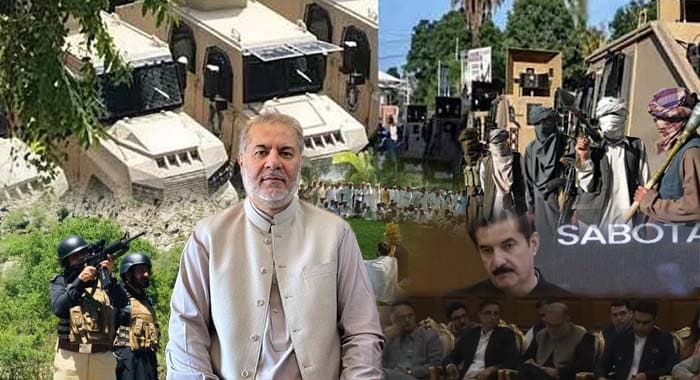
The Rs70 billion security funding plan announced for restoring peace in Khyber Pakhtunkhwa following a briefing at Governor House has raised expectations about strengthening the province’s counterterrorism capacity. However, the real test for the provincial administration will not simply be how much money it spends, but whether the funds are used transparently, reach the districts facing the greatest security challenges, and translate into a stronger, better-trained and better-equipped police force.
The briefing was the first comprehensive security briefing convened by the governor since the current administrative setup took shape. Home Secretary Abdul Rehman, Chief Secretary Dr. Fakhr-e-Alam Irfan, senior police and security officials, administrative secretaries and the governor’s advisers were among those present. The briefing examined the province’s security situation, the measures taken against terrorism, the reasons behind the continuing threat and the shortcomings affecting counterterrorism efforts.
One of the major points raised during the briefing was the alleged absence of political ownership of the counterterrorism campaign under the previous provincial government. It was stated that security forces, police and other law enforcement agencies had not received the political backing their efforts required. The previous provincial leadership was accused not only of failing to take ownership of the campaign but also of allowing a narrative to develop that undermined the efforts of security institutions.
The consequences, according to the briefing, were not confined to the former tribal districts. Terrorism spread into adjoining settled districts, creating a wider security challenge. Even Dera Ismail Khan, the home district of the previous provincial chief executive, could not remain insulated from the deteriorating situation.
The briefing also highlighted serious weaknesses within the police department. More than 10,000 police positions were said to be vacant, while only Rs1 billion of the Rs4 billion allocated for the police’s counterterrorism requirements had so far been released. The situation in the merged districts was described as particularly concerning.
Following the merger of the former tribal areas with Khyber Pakhtunkhwa in 2018, the existing Levies and Khasadar personnel were incorporated into the provincial police. However, the briefing acknowledged that many of these personnel lacked formal education and professional training. The merged districts also remained without adequate police infrastructure, including proper police lines, functional police stations, vehicles and modern weapons.
The Counter Terrorism Department (CTD) was another area of concern. Its presence was limited to 12 districts, while approximately 636 important positions across the provincial department remained vacant. Plans were presented to extend CTD coverage across all 34 districts, but the expansion will require more than an administrative announcement. It will need trained personnel, adequate funding, operational infrastructure and sustained institutional support.
The proposed Rs70 billion allocation is expected to come from different sources. The provincial government has earmarked Rs45 billion in its budget, while approximately Rs25 billion to Rs30 billion is expected from the Rs160 billion package announced by the prime minister for Khyber Pakhtunkhwa. The briefing also referred to around Rs90 billion spent on the police over the preceding decade and announced plans to invest a further Rs70 billion within 100 days.
This is where the real questions begin. How will the money be spent? Who will oversee procurement? What mechanisms will ensure transparency? And how will the administration determine which districts and police units have the most urgent requirements?
The proposed security plan includes purchasing vehicles, weapons, drones and other equipment, improving police training and increasing manpower. Two implementation phases were discussed, one covering 100 days and the other 180 days. The immediate phase is intended to address the most urgent police requirements, while the longer phase is expected to deal with broader institutional and infrastructural deficiencies.
However, money alone cannot resolve these shortcomings overnight. Recruitment itself takes time. Newly appointed personnel need several months of training before they can perform their duties effectively. Modern equipment also requires specialized skills. Operating drones, for instance, is not a routine policing task. Only personnel with the necessary technical knowledge can use them effectively. Providing equipment without preparing people to operate it would amount to spending public money without securing the intended operational benefit.
The current administration, governor and advisory council therefore face a major test of transparency, planning and execution. Since the provincial government has been replaced through the imposition of Governor’s Rule, public scrutiny of its performance will be particularly intense. The governor has also argued that the previous provincial government did not adequately pursue the province’s financial case with the federal government. Now that additional funds are expected, they must be directed towards the districts and sectors where the needs are greatest, taking into account the requirements of both police personnel and local communities.
Yet the larger security challenge in Khyber Pakhtunkhwa cannot be addressed through police funding alone. The province has faced militancy for nearly 24 to 25 years. The crisis began to intensify after the fall of the Taliban government in Afghanistan in 2001, when foreign militant groups moved into Pakistan and subsequent military operations were followed by attacks inside the country, including suicide bombings.
The adversaries confronting Pakistan today are experienced, trained and familiar with weaknesses within the system. Expecting the police to resolve such a deeply rooted security problem simply by providing them with vehicles, weapons and additional funding would be unrealistic.
What is required is coordination among the police, security forces and other law enforcement agencies, alongside the involvement of political parties. Counterterrorism must be treated as a national and provincial responsibility rather than the task of one political party or government department. Political disagreements should not be allowed to undermine the collective effort against terrorism.
There is also a need to employ options beyond military operations. Tribal elders and jirgas can play an important role in persuading armed groups to leave populated areas and stop threatening local communities. Governor Faisal Karim Kundi also indicated that tribal elders would be taken into confidence and approached to convey the concerns of residents to those spreading violence in their areas.
The message to such groups should be clear: their presence threatens local peace, discourages investment and prevents communities from returning to normal life. They should leave voluntarily. If these efforts fail, the state will have to clear the areas of their presence.
If jirgas and other efforts fail, intelligence-based operations remain an option. The government has made it clear that it does not intend to launch large-scale military operations that would cause widespread displacement. Instead, targeted intelligence-based operations are to be pursued against identified terrorist threats. This distinction is important for communities that still remember the displacement and disruption caused by previous military campaigns, particularly the major operation in North Waziristan in 2014.
The situation in Mir Ali, North Waziristan, also illustrates the difficulties confronting security agencies and local communities. The reported use of mosques by terrorists is particularly condemnable because these are communal places of worship, not private shelters for armed groups. Terrorists appear to be exploiting the sanctity of mosques and the fear of local residents to find places where they can remain concealed.
This is not an entirely new practice. Before previous military operations, terrorists occupied government schools in North and South Waziristan, using primary school buildings and campuses as their temporary bases. With those spaces no longer available to them in the same way, they appear to be exploiting other communal facilities.
Local residents are also caught in a difficult situation. In the past, some communities provided food and hospitality to armed groups, but repeated military operations have changed public attitudes. People fear that sheltering terrorists in their homes or hujras could expose their families and properties to security operations, searches and serious consequences. As a result, terrorists may seek refuge in places such as mosques, which belong to the entire community and are not controlled by any single individual.
The recently circulated video footage of terrorist patrols has further increased fear and anxiety among residents. This makes the involvement of tribal elders even more important. They can communicate with local communities, persuade armed groups to leave and help prevent the situation from escalating into another large-scale security crisis.
Another point requiring careful examination is the claim that terrorism has declined in the province. A temporary reduction in attacks should not automatically be interpreted as evidence that the threat has been eliminated or that the security situation has fundamentally improved. Terrorist groups may also be observing the new administrative setup, assessing its intentions and waiting to see how its security strategy unfolds. The real test will come when sustained operations and a comprehensive counterterrorism policy are put into practice.
Equally important is the restoration of public confidence through development. Projects initiated in different districts must continue, and local communities must be consulted about their genuine needs. Residents of the former tribal districts have long demanded roads, schools, colleges and basic development facilities. These demands should not be overlooked while discussing security.
There is a particularly damaging misconception that people in Khyber Pakhtunkhwa generally sympathize with terrorists or support their activities. This is simply not true. Having visited areas from Bajaur to South Waziristan, I have found that ordinary people do not want violence, confrontation with the state or a return to militancy. They want peace, education, roads, employment and development.
In fact, terrorist groups themselves have repeatedly complained about the lack of public cooperation in Khyber Pakhtunkhwa. They have faced resistance from residents in areas such as Dir and Swat, where local people have stood alongside the police against them. This rejection by communities has made it difficult for terrorists to operate with the support or acceptance they once sought.
The people of Khyber Pakhtunkhwa should therefore not be collectively portrayed as sympathetic to terrorism. Their demands are for a peaceful and developed province, and the state must recognize and strengthen that public sentiment.
Ultimately, the Rs70 billion security plan can become an important step towards improving the province’s counterterrorism capacity, but its success will depend on transparent spending, institutional reform, professional training, inter-agency coordination and public cooperation. Police strengthening, intelligence-based operations, tribal jirgas and sustained development must work together. No single measure can resolve a crisis that has persisted for more than two decades. The state needs a comprehensive strategy, and the people of Khyber Pakhtunkhwa must be treated as partners in restoring lasting peace.