
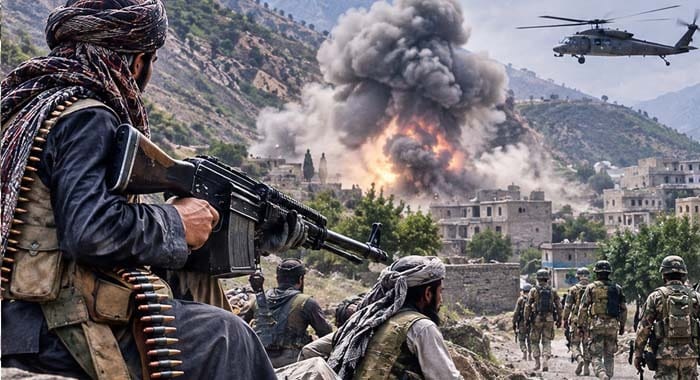
Anti-Taliban resistance groups significantly increased their claimed operations across Afghanistan in October, more than doubling their activity compared with September. The Afghan United Front (AUF), led by former 215th Helmand Corps commander Lieutenant General Sami Sadat, emerged as the most active group, while two new organizations announced their arrival on the battlefield towards the end of the month.
The resistance groups claimed a combined 82 attacks during October, involving improvised explosive devices (IEDs), indirect fire, ambushes and targeted assassinations. These operations reportedly killed 122 Taliban members and wounded 68 others. The attacks were claimed across 20 provinces, spanning Afghanistan’s southern, northeastern, central, western, northern, eastern and southeastern regions.
The Afghan United Front led the resistance activity, claiming 36 operations, more than three times the number attributed to the next most active group. Most of its attacks took place in Kandahar and Helmand. Sadat, who grew up in Helmand, is the only prominent anti-Taliban resistance leader whose organization has concentrated its campaign on challenging Taliban control in southern Afghanistan, the movement’s spiritual stronghold.
The AUF’s operational tempo was particularly evident on October 26, when it claimed seven attacks within 24 hours across Ghor, Badakhshan, Ghazni, Zabul, Kandahar and Parwan provinces. The geographically dispersed operations pointed to a level of coordination and planning extending well beyond a single region.
Ahmad Massoud’s National Resistance Front (NRF), one of the oldest and most established anti-Taliban organizations, claimed 11 attacks during the month. Its operations were reported in Badakhshan, Baghlan, Panjshir, Herat, Kandahar and Wardak. The figure also included attacks attributed to two NRF-affiliated formations, the Martyr Massoud Brigades and Panjshir Unit 01.
The Martyr Massoud Brigades, which announced their formation on September 12, claimed their first operation on October 24. The group said it targeted a Taliban vehicle in Panjshir province, killing four Taliban members and wounding two others.
In another significant operation, the NRF claimed responsibility for an October 4 attack that killed Safiullah Motawakel, the Taliban’s deputy intelligence chief for Faizabad in Badakhshan, along with two bodyguards. However, the group also suffered a major setback later in the month when the Taliban killed its commander Mirwais Khan in Paryan district of Panjshir on October 18.
Khan was the second NRF commander killed within three months. On August 19, the Taliban killed Hasib Panjshiri in northern Salang, an area of Parwan province north of Kabul. The losses underline the pressure facing the NRF even as it continues to claim operations in several parts of the country.
The Afghan Freedom Front (AFF), led by former Afghan National Army Chief of General Staff Yasin Zia, claimed 10 attacks in Badakhshan, Parwan, Kabul, Kapisa, Kunar, Logar, Nuristan and Takhar. One of its notable operations was an indirect-fire attack on Bagram Airbase on October 22, which the group said killed or wounded more than 10 Taliban members.
For the second consecutive month, the AFF also claimed sustained engagements in Kamdesh district of Nuristan province, which borders Pakistan. Its continued activity in the area may indicate an effort to preserve freedom of movement and develop logistical routes in a strategically sensitive border region.
The AFF also faced a split towards the end of October. On October 29, reports emerged that Abdul Sattar Husseini, a former member of parliament from Farah province, had left the organization with two other members to establish a separate group, the Afghan National Liberation Front (ANLF).
Just two days later, on October 31, the ANLF claimed its first attack, targeting the Taliban’s 203rd Mansouri Corps in Gardez, Paktia province. The group said two Taliban members were killed and another was wounded. It also adopted an emblem closely resembling that of the AFF, with the main distinction being its color scheme. The emergence of a separate organization from within the AFF further illustrates the fragmented structure of the anti-Taliban resistance, which has struggled to consolidate its activities under a united command.
Amrullah Saleh’s Green Unit, the military wing of the Green Trend led by the former Afghan first vice president and former National Directorate of Security chief, claimed eight attacks in Badakhshan, Panjshir, Bamiyan, Helmand and Herat. This was the group’s highest monthly total since it began conducting combat operations this year.
Among its notable claims was the downing of an Indian-made Cheetal helicopter in Panjshir, which allegedly injured both pilots. The Taliban rejected the account, maintaining that the aircraft had struck rocks while attempting to land at an unsuitable location. The competing versions left the circumstances of the incident disputed.
Several smaller resistance organizations also claimed operations during October, adding to the overall increase in activity.
The Afghanistan Republican Front (ARF), led by former Bamiyan governor Tahir Zamir, claimed nine attacks in Bamiyan, Sar-e Pol, Ghazni, Ghor and Kabul. On October 11, it claimed an IED attack on a Taliban patrol in Firozkoh, the provincial capital of Ghor, saying four Taliban members were killed and two wounded.
The Homeland Soldiers Front claimed its first attack since overrunning a Taliban district center in Yaftali Sufla, Badakhshan, in July. Its October 19 operation targeted the Taliban’s district governor in Kalfgan district of Takhar province.
The National Mobilization Front (NMF) claimed responsibility for the assassination of a senior Taliban prison official in Jalalabad, Nangarhar, on October 5. The Taliban confirmed the official’s death. Ten days later, Taliban authorities said they had killed the person responsible for the assassination in Dand Patan district of Paktia province.
The Freedom and Justice Movement (FJM), led by former Afghan National Army commander Hamed Saifi, claimed an October 22 attack on a Taliban outpost in Parwan province. The group said one Taliban member was killed and two others wounded.
The Afghan Liberation Movement claimed an ambush on a Taliban convoy on October 17. Towards the end of the month, another new organization, the National Ideal Front, announced its presence by claiming three attacks on October 31 in Ghazni, Baghlan and Helmand provinces. It said one Taliban member was killed and two others wounded.
The National Independence Front, which claimed its first attack on March 13, said it had carried out 14 operations during October. However, its claims were not included in the monthly tally because several attack videos posted by the group appeared to contain old footage, while a video accompanying its October 29 claim appeared staged. The group’s claims therefore remained outside the verified scope of the monthly assessment.
The entry of the AUF into the battlefield has substantially expanded the volume of claimed anti-Taliban operations. The ARF and Green Unit also recorded activity approaching the levels claimed by the more established NRF and AFF, indicating that the resistance landscape is becoming more active and increasingly diverse.
Yet the rise in claimed attacks does not necessarily translate into a unified or sustained military challenge to Taliban rule. The killing of another senior NRF commander, the split within the AFF and the emergence of additional organizations expose persistent weaknesses in coordination and organizational cohesion. October’s figures therefore reflect both an expansion in resistance activity and the difficulties facing groups seeking to turn scattered operations into a coherent campaign.



