
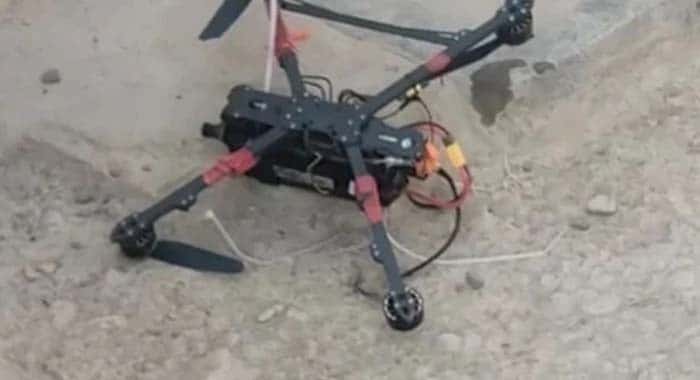
The failed attempt to strike a security checkpoint in Kharan’s Albat area with five drones offers a lesson that extends beyond the immediate success of the defensive response: the threat posed by terrorists is evolving, and protecting Pakistan’s security installations increasingly requires the ability to detect and defeat attacks that come from the air as well as the ground.
According to the security information provided, terrorists belonging to Fitna al-Hindustan attempted to target the checkpoint using low-grade drones. Security forces responded in time, shooting down all five before they reached their intended target. No casualties or property damage were reported.
The outcome was clear. The attack failed, the checkpoint was not struck, and the terrorists did not achieve their immediate objective. But the incident also raises important questions about the changing tactics of terrorist organizations, the vulnerabilities associated with small unmanned aircraft, and the measures needed to ensure that a successful interception today does not become a more difficult challenge tomorrow.
The significance lies not in treating every drone incident as a technological breakthrough, but in recognizing that even relatively basic aerial platforms can introduce a new dimension to terrorist attacks.
From Ground Assaults to the Aerial Threat
Terrorist organizations have traditionally relied on armed assaults, roadside explosives, ambushes, and attacks on checkpoints and security convoys. Small drones add another option to that repertoire. Depending on their capabilities and payloads, they can be used for surveillance, reconnaissance, or direct attacks, potentially forcing defenders to account for threats approaching from above.
This is not a hypothetical concern for Pakistan. Drone attacks against security personnel and police installations have emerged as a growing challenge in the country, particularly in Khyber Pakhtunkhwa. The experience demonstrates that commercially available technology can be adapted for hostile purposes without requiring the resources of a conventional military.
The five-drone attempt in Kharan therefore deserves attention as part of a wider security challenge. However, the available information does not establish whether the drones were coordinated as a swarm, carried explosive payloads, or used any advanced navigation systems. Those details should not be assumed. What is established is that five drones were directed toward a security checkpoint and that security forces intercepted them before they reached it.
That distinction matters. Effective analysis must recognize the threat without exaggerating the technology involved.
The Real Test Is Whether Pakistan Can Stay Ahead
Pakistan has already encountered the consequences of failing to prepare for the aerial dimension of terrorism. In 2025, drone attacks became a serious challenge for police in Bannu and surrounding districts, where terrorists used commercially available quadcopters against security personnel and installations. The experience exposed the difficulties of defending fixed positions against relatively inexpensive aerial platforms.
The lesson for Balochistan is not that the province faces precisely the same pattern of attacks, but that counterterrorism planning cannot afford to treat drone threats as an isolated or temporary problem.
The first priority is to make successful interception a repeatable capability rather than an exceptional outcome. The five drones were stopped in Albat, but sustained preparedness requires security installations to be equipped, trained, and organized to respond to evolving aerial threats. Detection, reliable communication, coordination between personnel, and appropriate counter-drone capabilities all have a role in that effort.
The second priority is intelligence. Shooting down an incoming drone prevents an immediate strike, but it does not necessarily reveal who launched it, where it originated, how it was acquired, or whether the same network is preparing another attack. Investigating recovered equipment, where available, and connecting intelligence across incidents can help authorities move beyond intercepting individual drones toward disrupting the terrorist networks behind them.
The third priority is adaptability. Terrorists can change their methods when a particular tactic becomes less effective. A failed attack may prompt them to alter their approach, while defensive improvements can make previous methods increasingly difficult to use. Security planning must therefore anticipate changing threats rather than assume that a successful response will permanently resolve the problem.
The United Nations Office of Counter-Terrorism has also identified the acquisition, weaponization, and deployment of unmanned aircraft as interconnected challenges. Its work highlights the need to understand not only how such systems are used in attacks, but also how terrorist organizations obtain them and develop the ability to deploy them.
For Pakistan, this means counter-drone preparedness should form part of a broader counterterrorism strategy, alongside intelligence-led operations, protection of security installations, and efforts to identify the networks enabling terrorist violence.
A Failed Attack Must Become a Lasting Security Advantage
The five drones that failed to reach their target represent a tactical success for security forces. The absence of casualties and property damage makes the outcome particularly important, because the attempted attack was stopped before it could produce the harm its perpetrators intended.
Yet the most valuable result would be to turn that success into a continuing advantage. Every intercepted threat should strengthen the understanding of how terrorists operate, expose weaknesses in their methods, and inform future defensive preparedness.
The incident does not, by itself, establish that Fitna al-Hindustan has developed sophisticated drone-warfare capabilities. Nor does it prove that all five drones were coordinated through advanced systems. What it demonstrates is more immediate: terrorists attempted to use multiple drones against a security checkpoint, and the attempt was foiled.
That is enough to warrant serious attention without exaggeration.
The drones never reached their target in Balochistan. The strategic objective now is to ensure that future attempts meet the same fate, while preventing terrorist networks from turning an emerging tactic into a more dangerous threat.



