
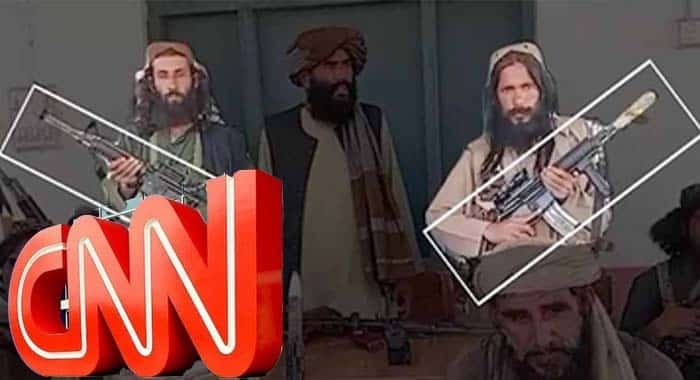
The title of CNN’s Armed and Unchecked in Pakistan raises an uncomfortable question: if advanced weapons abandoned in Afghanistan are now being used in terrorist attacks inside Pakistan, who allowed that threat to grow, and who has been confronting its consequences?
The documentary, presented by CNN correspondent Ivan Watson, examines how American-made weapons left behind following the United States’ 2021 withdrawal from Afghanistan have entered the hands of armed groups operating against Pakistan. Its reporting brings viewers close to the physical evidence, including US-marked rifles recovered after terrorist attacks, and to the security challenge these weapons create for Pakistani forces.
Yet the phrase “armed and unchecked” needs closer examination. The circulation of these weapons is a serious regional security failure. But the documentary’s own reporting shows that the threat has not gone unnoticed. Pakistani security institutions have recovered weapons, exposed their presence in terrorist arsenals and provided CNN access to evidence gathered in the aftermath of attacks. Pakistan has also repeatedly raised concerns about terrorist groups operating from Afghan territory.
The distinction matters: a threat can remain dangerous without being ignored, and exposing a problem is not the same as proving that those confronting it have failed to act.
A Weapons Legacy with Consequences for Pakistan
The American withdrawal from Afghanistan in August 2021 left behind a vast quantity of military equipment originally supplied to the former Afghan security forces. The subsequent Taliban takeover created a serious question over the control, storage and movement of those weapons. The consequences extend beyond Afghanistan’s borders.
The United Nations’ monitoring reports have documented concerns about the TTP’s access to advanced weapons and reported that Taliban commanders provided the group with weapons, including M4 carbines and M16A4 rifles equipped with advanced optics. Such equipment can give terrorist groups greater range, improved night-fighting capability and a more dangerous edge in attacks against security personnel.
CNN’s investigation brings this wider concern into sharp focus. In the Wana area, Pakistani military personnel showed the correspondent US-marked rifles recovered after a suicide truck bombing at a military cadet college. The documentary also examined the human cost of the changing battlefield, including the experiences of wounded Pakistani personnel.
These details are significant because they connect a distant policy decision to a direct security consequence. Weapons supplied to strengthen a former Afghan government’s forces have, in some cases, found their way into the hands of groups attacking Pakistan. The result is not an abstract dispute over military equipment. It is a challenge faced by Pakistani soldiers, police officers and civilians.
The Afghan Taliban Cannot be Separated From the Question
The issue cannot be reduced to the American withdrawal alone. The availability of abandoned weapons is one part of the problem; what happened to those weapons, who gained access to them and whether the authorities in Afghanistan prevented their transfer to terrorist groups are equally important questions.
The United Nations has reported concerns about Taliban support for the TTP and the group’s ability to operate from Afghanistan. Pakistan has repeatedly urged the Afghan Taliban authorities to prevent Afghan territory from being used for attacks against Pakistan. Kabul’s responsibilities do not disappear simply because the weapons originated with another government.
If the Afghan Taliban claim to exercise authority over Afghanistan, that authority must carry obligations. Preventing terrorist groups from acquiring sophisticated weapons, organizing across the border and launching attacks against a neighboring country is not an optional gesture of goodwill. It is a basic security responsibility.
The TTP, meanwhile, cannot be treated as an ordinary political actor. It is a banned terrorist organization whose campaign has targeted Pakistani security personnel, public institutions and civilians. Its access to modern weaponry intensifies the danger, but the underlying threat comes from the organization’s decision to pursue its objectives through violence.
Pakistan Did not Remain Silent
The documentary’s international value lies partly in bringing this evidence before a wider audience. But it would be wrong to suggest that the issue became visible only when an international broadcaster examined it.
Pakistan’s security forces have been fighting terrorist networks, conducting intelligence-based operations and recovering weapons used in attacks. Pakistani officials have repeatedly warned about the regional consequences of the weapons left in Afghanistan and the threat posed by terrorist groups operating across the border. The evidence shown to CNN was itself presented by Pakistani personnel, underscoring that the weapons had been identified and recovered rather than simply allowed to pass without notice.
This does not mean the danger has been eliminated. Terrorist networks adapt, weapons circulate and the security environment remains difficult. Acknowledging these realities is essential. But the continued existence of a threat should not be confused with the absence of a response.
From Exposure to Accountability
The next question is what the international community does with the evidence. Tracing weapons to their original supply chains is important, but the inquiry must continue through the channels by which they reached terrorist groups. That requires stronger weapons monitoring, credible action against cross-border networks and sustained pressure on the Afghan Taliban to prevent terrorist activity from Afghan territory.
The United States also has a legitimate responsibility to examine the long-term consequences of the equipment left behind during its withdrawal. That responsibility does not make Washington the sole actor accountable for every weapon subsequently transferred or used. It does, however, make transparency and lessons learned essential.
Armed and Unchecked in Pakistan highlights a real security problem. Its broader significance should be that the world looks beyond dramatic images of recovered rifles and examines the chain of decisions, failures and networks that put them into terrorist hands.
Pakistan has not been a passive spectator to this danger. It has borne the human cost, confronted the armed groups and repeatedly called attention to the threat. The challenge now is to ensure that international attention becomes practical accountability, rather than another brief moment of concern followed by silence.



