
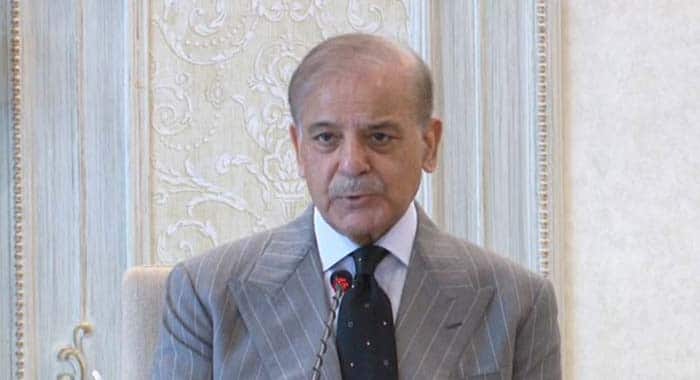
Prime Minister Shehbaz Sharif has defended the federal government’s decision to impose emergency measures and governor’s rule in Khyber Pakhtunkhwa, citing the deteriorating security situation and the need to prevent further violence and instability in the province.
Addressing a meeting of the Khyber Pakhtunkhwa Apex Committee at Governor House in Peshawar, the prime minister said the government had been compelled to take difficult decisions in response to the worsening law and order situation. He stressed that protecting the lives of citizens and restoring lasting peace remained the government’s foremost responsibility.
The high-level meeting was attended by Field Marshal Syed Asim Munir, Deputy Prime Minister and Foreign Minister Ishaq Dar, federal ministers and senior military leadership. Officials briefed the participants on the imposition of emergency measures in 12 districts of the province, while the sacrifices of those who lost their lives in the fight against terrorism were paid tribute.
Prime Minister Shehbaz Sharif said terrorism had been largely eliminated from Khyber Pakhtunkhwa by 2018, but alleged that the subsequent decision to bring militants back had severely undermined security and reversed earlier gains.
He argued that the resurgence of terrorism had imposed a heavy burden on the people of the province, who had already endured years of violence, displacement and economic hardship.
Recalling the human and financial costs of the conflict, the prime minister said approximately 80,000 people had lost their lives in the war against terrorism, while Pakistan had suffered economic losses amounting to billions of dollars. Shehbaz Sharif
He paid tribute to the sacrifices made by security personnel, women, children and ordinary citizens, saying that disregarding these sacrifices would constitute a serious disservice to the country. The prime minister criticised the previous provincial government led by Pakistan Tehreek-e-Insaf (PTI), alleging that education, healthcare, public welfare and security had not received adequate attention.
He claimed that approximately 5,000 police vacancies had remained unfilled during the previous provincial administration, while the Safe City project was left incomplete and insufficient attention was given to strengthening the Counter Terrorism Department and improving police training. According to the prime minister, these shortcomings weakened the province’s capacity to respond effectively to emerging security threats and contributed to the renewed challenge of terrorism.
He also questioned the utilisation of financial resources allocated to Khyber Pakhtunkhwa for counterterrorism efforts, arguing that the scale of funding and the sacrifices made by the province should have produced more sustainable security outcomes. Referring to the financial arrangements under the 2010 National Finance Commission (NFC) Award, Prime Minister Shehbaz Sharif said Khyber Pakhtunkhwa had received approximately Rs800 billion for counterterrorism-related efforts.
He noted that the provinces had recognised Khyber Pakhtunkhwa’s frontline role in the fight against terrorism and agreed that additional resources were necessary to support its security requirements. The prime minister expressed concern that terrorism had resurfaced despite the substantial financial allocations and the sacrifices made by the province’s population.
He emphasised the need for effective governance, stronger institutional capacity and proper utilisation of public funds to ensure that resources allocated for security translate into tangible improvements on the ground. Explaining the circumstances behind the federal government’s decision, Prime Minister Shehbaz Sharif said the government had made sustained efforts to stabilise the national economy over the preceding two and a half years.
He said political and military leadership had worked together to improve economic conditions and argued that the federal government could not allow Khyber Pakhtunkhwa to descend further into violence and instability.
The prime minister disclosed that consultations had taken place with the president on two occasions regarding the province’s deteriorating situation. He added that a political committee had also devoted 48 hours to negotiations before the government decided to proceed with what he described as difficult but necessary measures.
He maintained that the decisions taken in Khyber Pakhtunkhwa were permitted under the Constitution and the law, while reaffirming the federal government’s commitment to working alongside the military leadership to address the province’s challenges.
A consultative council comprising experts from different fields has also been established to develop practical strategies for improving conditions in the province. The prime minister also raised concerns about alleged corruption in several development projects in Khyber Pakhtunkhwa.
He cited an alleged Rs100 billion corruption case involving a clean-water project and referred to the Kohistan mega scandal, in which he alleged corruption amounting to Rs37 billion. He further alleged that contracts under the Pulsar Gold project had been awarded to favoured individuals.
The allegations were presented by the prime minister during the meeting. Their specific details, evidentiary basis and legal status were not provided in the information available. Addressing the meeting, Khyber Pakhtunkhwa Governor Faisal Karim Kundi said restoring peace and maintaining law and order were the province’s foremost priorities.
He stressed that the people of Khyber Pakhtunkhwa wanted peace and stability, adding that the Pakistan Army, Frontier Corps and police had made enormous sacrifices, including the loss of precious lives, in efforts to secure the province.
The governor emphasised that sustained federal support was essential to achieving lasting peace and ensuring continued progress. He identified the elimination of terrorists, their facilitators and their financial supporters as a priority, arguing that effective cooperation between the federal and provincial authorities was indispensable to counterterrorism efforts.
He also called for unity among all relevant institutions, saying that coordinated action was necessary to advance peace, stability and development. Field Marshal Syed Asim Munir attended the Apex Committee meeting alongside Deputy Prime Minister Ishaq Dar, federal ministers and senior military officials.
The briefing on emergency measures in 12 districts provided the participants with an overview of the situation and the government’s response. The meeting also honoured those who had sacrificed their lives in the fight against terrorism, recognising the continuing human cost of insecurity in Khyber Pakhtunkhwa.
The participation of senior civilian and military leadership underscored the importance of coordinated decision-making in addressing the province’s security challenges.
Concluding his remarks, Prime Minister Shehbaz Sharif reaffirmed the federal government’s determination to work with the military leadership to restore peace, prosperity and development in Khyber Pakhtunkhwa. He said the government would pursue measures to improve access to essential public services and bring basic facilities closer to the people.
Describing Khyber Pakhtunkhwa as the land of renowned Pashto poets Rahman Baba and Khushal Khan Khattak, the prime minister stressed that addressing the grievances and deprivation experienced by the province’s people was a responsibility of the state.
He maintained that lasting stability would require not only effective security measures but also improved governance, stronger public institutions, development opportunities and better access to essential services.
The government’s stated objective is to restore peace and stability in Khyber Pakhtunkhwa through coordinated security efforts, institutional cooperation and measures aimed at improving the lives of the province’s people.



