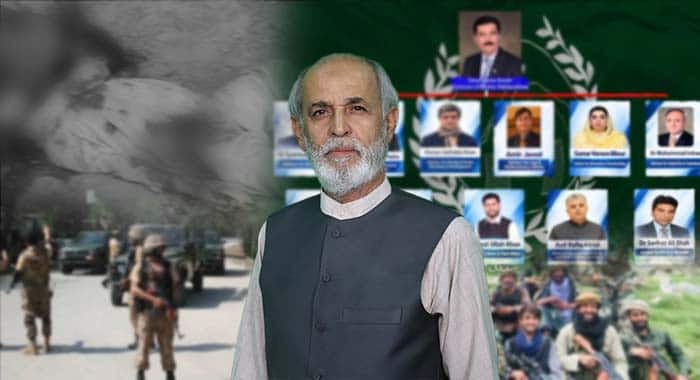
Pakistan and Afghanistan are confronting a critical moment in their security and political trajectories. A recent security operation in Matani and surrounding areas of Peshawar, reportedly resulting in the killing of six militants, including a figure described as a commander-in-chief, has once again highlighted Pakistan’s continuing struggle against militancy. Meanwhile, the debate over Governor’s Rule in Khyber Pakhtunkhwa (KP), questions about the future of Pakistan Tehreek-e-Insaf (PTI), and reports of renewed resistance against the Taliban in Afghanistan reveal a wider regional crisis in which security, politics, and governance remain deeply interconnected.
The central question is whether these developments will produce lasting change or repeat the familiar cycle of military operations, political confrontation, and renewed instability. According to reports, security forces conducted an operation in Matani and surrounding areas of Peshawar, killing six alleged terrorists, including a senior figure described as their commander-in-chief.
The operation is significant because Matani has experienced militant activity since approximately 2004–2005. Its proximity to historically sensitive areas, including Darra Adam Khel, has made the surrounding region strategically important. Over the years, militants have reportedly targeted tribal elders and political and social leaders who opposed their presence. Security operations were also conducted in the area around 2009–2010, yet militant networks have repeatedly demonstrated their ability to regroup.
This history raises an uncomfortable question: why has sustained security pressure not eliminated the threat permanently? The killing of a senior commander, if independently verified, could disrupt militant leadership, communication, and operational planning. However, eliminating individuals does not necessarily dismantle the networks that sustain terrorism. Recruitment, financing, logistical support, intimidation, and weak local governance can allow armed groups to re-emerge.
The wider security situation reinforces this concern. Recent violence in Bajaur reportedly claimed the lives of three people, including two brothers. The broader security picture also includes incidents and concerns in Peshawar, Bannu, and North Waziristan. These developments demonstrate why success must be measured by more than the number of militants killed. The real test is whether communities become safer, local institutions regain authority, and residents can live without fear of targeted violence.
Pakistan’s counterterrorism strategy must therefore combine intelligence-based operations with effective policing, protection for vulnerable communities, judicial accountability, and sustained civilian administration. Without these measures, even successful operations risk becoming temporary victories in a prolonged conflict.
The security situation has intensified debate over Governor’s Rule in Khyber Pakhtunkhwa. Questions remain about how long the arrangement might continue, what decisions could follow, and who might eventually lead the province. The debate has also raised questions about an administrative division involving 12 districts, a separate administrative setup, and the establishment of a council. The precise legal basis, mandate, and relationship of these arrangements with existing provincial institutions require clarification.
Pakistan’s history offers important lessons. The political upheavals associated with 1977 and 1999, together with successive constitutional changes and the devolution of authority under the 18th Amendment, demonstrate the continuing struggle to balance federal authority, provincial autonomy, and political stability. Supporters of extraordinary administrative arrangements may argue that exceptional security challenges demand stronger central coordination. Yet Governor’s Rule cannot, by itself, resolve militancy or eliminate political grievances.
If prolonged without clear objectives, constitutional accountability, and a credible transition plan, it could deepen public resentment and undermine confidence in democratic institutions. The government must explain what the arrangement is intended to achieve, how success will be measured, and when normal political governance can resume. Ultimately, the issue is not simply who governs KP, but whether the governing arrangement can improve security without creating further political uncertainty.
Another major question concerns whether Sohail Afridi or another political leader could emerge as the next head of the provincial government. The debate over PTI’s political trajectory reflects broader concerns that partisan confrontation and political loyalties can overshadow KP’s urgent security and governance needs. These are political assessments rather than established explanations of events. Nevertheless, the underlying challenge is clear: the province needs leadership capable of prioritising public safety, economic recovery, education, healthcare, and effective administration over perpetual political conflict.
Criticism of PTI’s handling of militancy deserves serious examination, particularly regarding its past engagement with the Tehreek-e-Taliban Pakistan (TTP). However, responsibility must be assessed through verifiable evidence, documented decisions, and policy outcomes rather than political accusations alone. Whether PTI returns to power or another party assumes leadership, the challenge remains the same. The next administration must develop a credible counterterrorism strategy, cooperate effectively with federal institutions, strengthen civilian governance, and rebuild public trust. A change of government without a change of strategy will accomplish little.
The relationship between PTI and the TTP remains one of the most contentious issues in Pakistan’s security debate. It raises important questions about negotiations with militant groups, the consequences of policy decisions, and the responsibility of political and state institutions for their security outcomes. The wider discussion has also drawn attention to the role of former intelligence chief General Faiz Hameed and the involvement of Pakistani political representatives in contacts with Taliban authorities in Afghanistan.
Previous PTI-led administrations pursued engagement with Afghan Taliban representatives. The reported contacts included a delegation associated with Barrister Saif during the period of Ali Amin Gandapur’s leadership and an earlier delegation sent under Mahmood Khan. Accounts of these visits describe meetings with Taliban representatives in Kabul. Such contacts must be assessed in their proper context. Engagement with the Afghan Taliban is not automatically evidence of an operational relationship with the TTP, a separate militant organisation. Similarly, negotiations with the TTP do not, by themselves, establish that a political party supported its ideology or activities. The essential question is whether the policies pursued at the time achieved their stated security objectives.
Negotiations can be a legitimate instrument of conflict management when they produce enforceable ceasefires, disarmament, and a reduction in violence. They become counterproductive when armed groups exploit them to reorganise, expand their influence, or escape accountability for attacks. Pakistan must evaluate past engagement with the TTP through evidence and outcomes. Were ceasefires enforceable? Were militants required to disarm? Were affected communities adequately protected? Did negotiations produce a lasting reduction in violence?
These questions deserve transparent answers, regardless of which political party or institution was involved. The debate must also avoid turning complex security failures into partisan slogans. A serious assessment should examine the decisions made, the information available at the time, the results achieved, and the consequences for communities living under the threat of militancy.
Across the border, Afghanistan continues to face uncertainty under Taliban rule. Reports discussed in connection with recent developments included claims by the United Front, led by Sami Sadat, that attacks in Helmand province had killed six Taliban personnel five in one location and one in another. The group also claimed to enjoy public support in Kandahar, although that assertion requires independent verification.
In Baghlan, a strategically important northern province near the Salang corridor, reports indicated that the Taliban had claimed to kill resistance commander Mirwez Khan. The discussion also referred to a National Resistance Front claim that four people had been killed in an earlier incident, alongside reports of resistance activity in Badakhshan and unrest in Kunar. These developments suggest continuing opposition to Taliban rule, but individual attacks do not necessarily establish the strength, popular legitimacy, or long-term prospects of resistance movements. The future of Afghanistan will depend not only on the military capabilities of competing groups but also on their ability to articulate a credible political vision. Security, political inclusion, fundamental rights, economic opportunity, and meaningful representation will remain central to the country’s long-term stability.
Former Afghan leader Abdul Rashid Dostum, who was reported to be in Turkey, reportedly described Afghanistan as a battlefield for international powers. He argued that decisions concerning the country were increasingly being made by external actors rather than Afghans themselves. Dostum called for Afghans to unite and criticised political divisions that developed under successive administrations, including those associated with Hamid Karzai, Ashraf Ghani, Professor Rabbani, Mujaddedi, and Dr Najibullah. He also alleged that international intelligence agencies had contributed to these divisions.
These are Dostum’s reported assessments and should not be treated as independently established conclusions. Nevertheless, his remarks highlight a persistent question about Afghanistan’s political history: how have domestic divisions and international rivalries affected the country’s ability to establish a stable political order? Afghanistan has repeatedly experienced the consequences of competing regional interests, foreign intervention, internal factionalism, and struggles over political legitimacy. Its future cannot be secured through military dominance alone.
Dostum also reportedly expressed concern that the human rights and religious rights of Afghan citizens were not receiving adequate attention, describing the situation as threatening. The protection of fundamental rights must remain central to any discussion of Afghanistan’s future. Political inclusion, access to education, economic opportunity, and meaningful participation in public life are essential to building a more stable society.
From Matani and surrounding areas of Peshawar to Baghlan and beyond, the region’s challenges are interconnected by a common concern: military operations can weaken armed groups, but lasting security depends on institutions capable of preventing their return. For Pakistan, the debate over PTI and the TTP must move beyond political accusations towards a serious examination of past negotiations, policy decisions, and their consequences. The future of Governor’s Rule in KP must be judged by its constitutional legitimacy, its impact on public safety, and its ability to restore effective governance. For Afghanistan, reports of resistance activity and warnings about international interference underline the continuing struggle over political authority, representation, and the rights of ordinary citizens.
The reported killing of six militants in Matani may mark an important operational achievement. Its long-term significance, however, will depend on whether the surrounding areas become safer and whether the state can prevent militant networks from returning. The most difficult question facing Pakistan is not merely how the TTP regained its capacity to threaten security, but what role past political decisions, negotiations, and policy miscalculations played in shaping today’s reality.
Answering that question requires evidence, transparency, and accountability not political point-scoring. Until the region confronts the causes of recurring instability alongside its immediate security threats, tactical victories and political rearrangements will continue to face the same test: whether they can produce lasting results for the people whose lives are most affected.