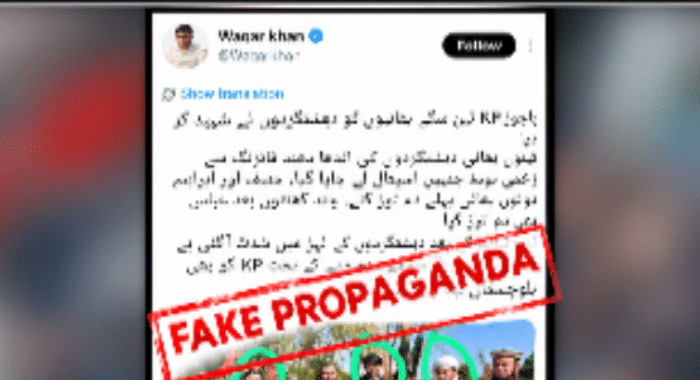
A misleading social media narrative is being circulated by accounts alleged to be affiliated with Pakistan Tehreek-e-Insaf (PTI), claiming that three brothers were killed by Fitna al-Khawarij (FAK) in Bajaur and attempting to link the incident to the deteriorating security situation in Khyber Pakhtunkhwa and the imposition of Governor’s Rule. The narrative presents an inaccurate account of the incident and draws an unsupported connection between a local criminal incident and the province’s broader security challenges.
According to the information available regarding the incident, three brothers identified as Hanifullah, Ibrahim, and Abbas were shot dead in the Khar area of Bajaur district. The incident has been attributed to personal enmity, rather than an act of terrorism. On the basis of these reported facts, describing the killings as an attack carried out by Fitna al-Khawarij is misleading and risks creating a false impression about the circumstances surrounding the tragedy.
Misrepresentation of Facts and the Spread of Misinformation
The circulation of an inaccurate account of a fatal incident is a matter of serious concern. By presenting the killings as a terrorist attack without substantiated evidence, the social media posts risk distorting public understanding, causing unnecessary alarm, and undermining informed discussion of security-related matters.
Incidents involving loss of life demand responsible reporting, sensitivity towards affected families, and a clear distinction between criminal violence arising from personal disputes and attacks that are established to be terrorist acts. Such distinctions are essential to maintaining factual accuracy and preventing the spread of unverified allegations.
The available information indicates that the Bajaur incident stemmed from personal enmity. No substantiated evidence has been provided in the information reviewed to establish that Fitna al-Khawarij was responsible for the killings. Accordingly, claims attributing the incident to the group should not be presented as established fact.
Unsupported Link to Governor’s Rule
The attempt to connect the Bajaur killings with Governor’s Rule in Khyber Pakhtunkhwa is equally misleading. The reported circumstances of the incident point to a personal dispute, not a demonstrated terrorist operation or an event established to have resulted from a change in the province’s administrative arrangements.
Establishing a causal relationship between a government policy and an individual criminal incident requires credible evidence, a clear factual basis, and an assessment of the relevant circumstances. Merely placing the incident alongside political claims about Governor’s Rule does not establish that one caused the other.
The timing of an incident, or its circulation alongside political commentary, cannot by itself demonstrate a causal connection. Any assertion that Governor’s Rule is responsible for this particular incident must therefore be supported by verifiable evidence rather than political interpretation or speculation.
It is also important to distinguish between criticism of public policy, which is a legitimate part of democratic discourse, and the presentation of unsubstantiated allegations as facts. Public debate about security and governance should be informed by reliable information, not by the selective presentation or mischaracterisation of individual incidents.
The Need for Responsible Reporting on Security Matters
Khyber Pakhtunkhwa has faced serious security challenges, and the issue of public safety requires sustained attention, credible information, and responsible public engagement. However, the seriousness of these challenges makes factual accuracy more important, not less.
Misclassifying a criminal incident as terrorism can create confusion about the nature of a security threat, distort public perceptions, and divert attention from the actual circumstances that require investigation. Similarly, attributing individual incidents to political or administrative decisions without establishing a factual connection can contribute to misinformation and unnecessarily intensify political tensions.
Media organisations, political representatives, social media users, and public commentators all have a responsibility to verify claims before sharing them, particularly when those claims concern fatalities, terrorism, or public security. Information should be assessed against credible reporting and relevant official statements wherever available.
The families of the deceased also deserve dignity and respect. Their loss should not be used to advance claims that have not been adequately substantiated. Responsible public communication requires sensitivity towards victims and their families, as well as a commitment to distinguishing verified facts from political assertions.
Conclusion
The key facts available regarding the incident in Khar, Bajaur, identify personal enmity as the reported motive behind the shooting deaths of Hanifullah, Ibrahim, and Abbas. The claim that Fitna al-Khawarij carried out the killings is not substantiated by the information provided, while the attempt to attribute the incident to Governor’s Rule lacks an established evidentiary basis.
The public is urged to exercise caution when encountering politically charged posts about terrorism and security incidents, verify information through credible sources, and avoid sharing claims that have not been independently confirmed.
Facts must take precedence over political narratives. Sensitive incidents involving loss of life should be reported with accuracy, responsibility, and respect for the affected families. Public discourse on security and governance must be grounded in evidence, not speculation or the misleading use of tragic events for political purposes.