
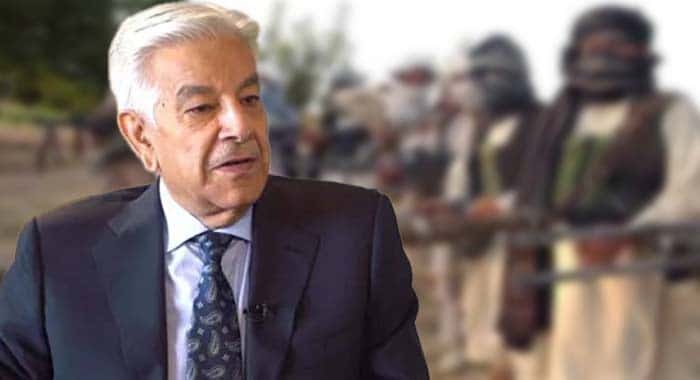
Defence Minister Khawaja Asif has said the deteriorating security situation in Khyber Pakhtunkhwa left the federal government with no option but to consider imposing an emergency, arguing that the fight against terrorism requires a united national response rather than political point-scoring.
Speaking in the National Assembly, Asif said the government had attempted to resolve the crisis through negotiations before reaching the decision, demonstrating considerable flexibility in the process. However, he maintained that the prevailing circumstances had made emergency measures unavoidable.
The defence minister criticized the Pakistan Tehreek-e-Insaf (PTI), saying political parties should not overlook their past decisions and mistakes while presenting themselves as blameless. He urged lawmakers to examine their own political records when discussing the country’s security challenges.
PTI’s Past Government and the Return of Terrorists
Referring to the PTI’s previous tenure in power, Asif claimed that the return of terrorists had been supported in the same National Assembly in the presence of former army chief General Qamar Javed Bajwa and former Inter-Services Intelligence (ISI) chief Lieutenant General Faiz Hameed.
He also referred to the return of captured Indian Air Force pilot Abhinandan Varthaman, arguing that national security decisions and their political implications should be discussed in light of past events rather than selectively recalled.
Asif said PTI had governed Khyber Pakhtunkhwa for nearly 13 years and should therefore be held accountable for its provincial governance and policy choices, particularly as the province continues to face serious security and administrative challenges.
He argued that political parties must acknowledge their past mistakes instead of portraying themselves as free of responsibility for the country’s current difficulties.
Negotiations and Political Confrontation
The defence minister also criticized the PTI over the facilities provided to its founder, Imran Khan, in prison. He said Pakistan Muslim League-Nawaz (PML-N) leaders had also faced hardships during their periods of imprisonment but had not resorted to protests at D-Chowk or violence to secure their release.
Referring to recent negotiations, Asif said the government had tried to find a political solution and shown flexibility in efforts to build consensus on various issues.
He maintained that counterterrorism should have been the central objective of the negotiations, arguing that political engagement should prioritize measures to restore security rather than remain focused on partisan disputes.
His remarks placed the ongoing political confrontation within the broader debate over responsibility for the worsening security situation in Khyber Pakhtunkhwa, where counterterrorism remains a major challenge.
Taliban Criticism and the Need for National Unity
Addressing criticism by the Taliban over the emergency decision and the deployment of troops in certain areas, Asif said the identity of those opposing the Pakistani state was clear.
He accused the Taliban of being responsible for the killing of Pakistani citizens, including children, and stressed that political differences should not prevent parties from supporting the state in its fight against terrorism.
The defence minister argued that the threat posed by terrorists demanded a unified national response, with political parties setting aside their differences to support counterterrorism efforts and protect citizens.
He also questioned the performance of the Khyber Pakhtunkhwa government, alleging that political considerations had received greater attention than the province’s security and administrative problems.
Asif called for a coordinated strategy involving the federal and provincial governments and all political parties, emphasizing that eliminating terrorism and safeguarding national security required collective action.
His address underscored the growing political dispute over responsibility for Khyber Pakhtunkhwa’s security crisis, with the federal government arguing that emergency measures and a unified counterterrorism approach were necessary to confront the threat.



