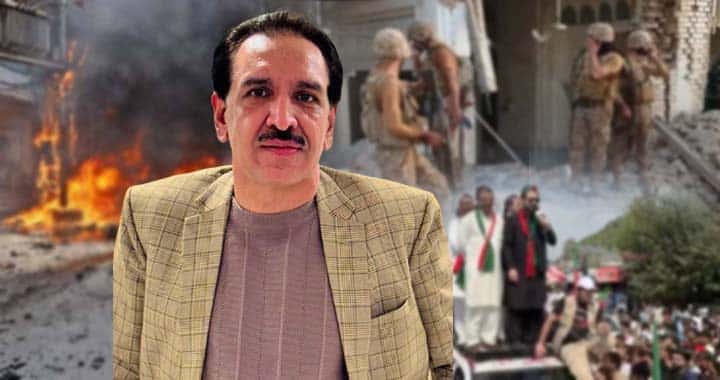
Aqeel Yousafzai
Kohat is not merely another name added to Pakistan’s long list of terror attacks. It is a painful reminder that when political leadership, security institutions and governments fail to speak with one voice, the vacuum is eventually filled by violence. The tragedy demands something far more meaningful than condolences, condemnations and inquiry reports: it demands ownership.
The tragic incident in Kohat has once again brought the deteriorating security situation in Khyber Pakhtunkhwa into the national spotlight. The attack, which was claimed by the Hafiz Gul Bahadur group, has deepened concerns about the increasingly tense security environment in the province and particularly across the southern districts. What makes the situation even more alarming is that the Kohat incident did not occur in isolation. It came amid a series of attacks and security operations reported across Kurram, Hangu, Kohat and adjoining areas.
The geography itself tells an important story. Kohat, Hangu and Kurram are not disconnected points on a map. They form part of a strategically sensitive belt linking settled districts with areas that have historically been affected by militancy and cross-border insecurity. When violence begins appearing repeatedly across this belt, it should not be treated as a collection of unrelated incidents. It should be understood as a broader security challenge requiring a coordinated response.
The most disturbing question, therefore, is not simply who carried out the Kohat attack. The deeper question is: who is taking ownership of the security of the people of Khyber Pakhtunkhwa? That question becomes unavoidable when political stakeholders appear more occupied with competing narratives than with developing a common response to the threat.
The argument made in the discussion surrounding the Kohat tragedy is straightforward: when political stakeholders do not take ownership of the security of their people, or of the defence of the state, the consequences eventually become visible in the form of repeated attacks, fear and bloodshed. Whether one agrees with every political criticism made in that discussion or not, the underlying question deserves serious attention.
A government cannot be judged only by its ability to administer budgets, appoint officials or issue statements. The most fundamental responsibility of government is to protect its citizens. And Khyber Pakhtunkhwa is once again asking whether that responsibility is being fulfilled. In the 75 hours surrounding the latest wave of violence, attacks and security operations were reported in Kurram, Hangu, Kohat and neighbouring areas. The Hafiz Gul Bahadur network has historically operated in the broader tribal belt, while the wider militant environment also involves TTP factions, Al-Qaeda, Islamic State-Khorasan and other armed groups.
That is why the argument that the Kohat attack was completely unexpected is difficult to sustain. The security environment has been deteriorating for some time. Militancy has evolved, organisations have reorganised and different groups have developed overlapping networks and capabilities. The threat is no longer confined to one particular location or one particular organisation. This is precisely why Pakistan needs to move beyond reactive counterterrorism. A successful operation against militants is important, but it does not by itself eliminate the threat. If one group is weakened while another recruits, finances, trains and reorganises, the cycle simply continues. The state must therefore ask not only how many militants were eliminated, but also how many potential attackers were prevented from becoming militants in the first place.
One of the most painful aspects of the recent violence is the apparent imbalance in public attention between the deaths of security personnel and the deaths of militants. Before the Kohat suicide attack, an improvised explosive device targeted a Frontier Corps vehicle in the region. Six security personnel were killed and several others injured. On the same day, security forces reportedly killed eight militants.
The point raised in the discussion is worth examining. When security forces conduct an operation and militants are killed, official statements frequently highlight the success. Yet when security personnel themselves die in attacks, their sacrifice can sometimes receive comparatively less attention beyond formal condolences. That cannot become normal. A soldier or police officer who leaves home for duty and never returns has made the ultimate sacrifice for the state. His family does not receive him back. His children grow up without a father. His parents lose a son. His wife becomes a widow.
The language used to describe such deaths should therefore never reduce them to statistics. Pakistan’s security personnel are not simply numbers in an operational briefing. They are human beings whose families carry the consequences of their sacrifice for decades. The state must honour that sacrifice not merely with words but through institutional protection, compensation, education for children, healthcare for families and transparent implementation of martyr packages.
But the tragedy becomes even more heartbreaking when innocent civilians are killed. The people attending prayers in Kohat did not choose a war. They did not decide Pakistan’s policy toward Afghanistan. They did not formulate counterterrorism strategies. They did not negotiate with militant organisations. They were simply citizens exercising their right to worship. What is the fault of a child? What is the fault of an elderly person who goes to a mosque to pray? What is the fault of a family whose only mistake was being present at the wrong place at the wrong time? There can be political disagreements about governments, military strategies, diplomatic policies and negotiations.
There can be disagreements about how Pakistan should deal with Afghanistan. There can even be disagreements about the policies of the security establishment. But none of these disagreements can provide a moral justification for deliberately targeting ordinary people. Militant organisations may have their own stated objectives, ideological explanations and political grievances. Those claims can be analysed and debated. But the killing of civilians cannot be transformed into legitimate political resistance merely by giving it a political label. The people of Khyber Pakhtunkhwa deserve better than becoming casualties in someone else’s political project.
The Kohat tragedy has also raised questions about emergency medical preparedness. The District Headquarters Hospital reportedly faced limitations in routine facilities compared with the Combined Military Hospital. After a mass-casualty incident, however, the question should not be which hospital is better equipped. The question should be whether the province has a coordinated system capable of responding immediately to a large-scale attack. Mass-casualty preparedness is not something that can be improvised after an explosion.
Hospitals need emergency plans. Blood supplies need to be available. Trauma surgeons and emergency physicians need clear protocols. Ambulance services must know where casualties should be taken. Civilian and military hospitals must be able to coordinate. Communication between district administration, police and medical authorities must work within minutes rather than hours. If an inquiry is genuinely being conducted into the Kohat incident, these questions should form part of it. An inquiry that merely determines what happened but does not determine why the system was vulnerable and how it will be strengthened is incomplete.
The provincial response has included an order for an inquiry and a request for a report. That is an administrative step. But an inquiry report cannot become a substitute for action. Pakistan has produced countless inquiry reports over the decades. The real challenge has often been implementation. What did the report discover? Which official institutions were responsible?
Were intelligence warnings ignored? Were security arrangements adequate? Was there a communication failure? Were police facilities properly protected? Were emergency services prepared? Were families treated fairly after the tragedy? And most importantly, what will change? If the same weaknesses remain after the report is submitted, then the inquiry becomes little more than paperwork.
The people of Kohat do not need another file. They need reassurance backed by visible institutional reform.
The criticism directed in the discussion toward political parties including PTI, PML-N, PPP and nationalist political groups reflects a broader frustration: terrorism should not become another instrument of political point-scoring. Every political party has the right to criticise the government. Opposition parties have a responsibility to question those in power.
Governments have a responsibility to defend their record. But terrorism requires something different. It requires political maturity. Khyber Pakhtunkhwa cannot afford a situation in which one political camp blames another after every attack, while the federal government points toward the province, the province points toward Islamabad, and everyone eventually issues another condemnation.
The militants do not care which party is holding a press conference. They exploit gaps between institutions. That is why political competition must stop at the point where national security and civilian lives are at stake. There must be a minimum national consensus that terrorism is not a party issue. It is a state issue.
Another extremely serious issue raised in the discussion concerns the families of police martyrs. There are allegations that some families may have been improperly deprived of parts of their compensation and that certain police officials may have demanded money from the heirs of deceased personnel. These are allegations and must be investigated rather than presented as established facts without evidence.
But the principle is beyond debate. A family that has lost a police officer should never have to fight the state to receive the compensation promised to it. If corruption is found, those responsible must face the law. The system should also be redesigned to reduce opportunities for exploitation. Compensation payments should be transparent, digitally traceable and accompanied by clear information about entitlements. A martyr’s widow should know exactly what she is entitled to receive. A martyr’s children should know what educational support is available. Parents should not have to repeatedly visit government offices simply to receive money earned through their son’s sacrifice. The state asks these officers to place their lives on the line. It must not abandon their families after they are gone.
The responsibility does not end with the provincial government. The federal government has an important role in national security, counterterrorism, border management and relations with Afghanistan. That is why federal leadership cannot remain distant from a province experiencing repeated attacks. Senior federal officials should visit affected areas, meet families, engage police officers and speak directly with local communities. Leadership is not demonstrated only from Islamabad through television statements.
Sometimes leadership means sitting with grieving families in Kohat. Sometimes it means visiting Bannu. Sometimes it means travelling to Hangu or Kurram. Sometimes it means standing beside police officers who know that they may be targeted simply because they wear a uniform. Presence matters.
No serious discussion of militancy in Khyber Pakhtunkhwa can ignore Afghanistan. Pakistan has repeatedly raised concerns that militant groups are using Afghan territory to plan or facilitate attacks against Pakistan. Afghan authorities have rejected accusations that they deliberately allow such attacks.
This disagreement has become one of the central challenges in Pakistan-Afghanistan relations. Recent international reporting has also drawn attention to the continued presence and reorganisation of militant networks in Afghanistan. The Washington Post has reported on Al-Qaeda’s continued activity, including training infrastructure and its connections with other militant organisations. The report also discussed concerns about TTP camps and militant activity in Afghanistan. The implications extend beyond Pakistan.
If terrorist organisations are able to recruit, train, finance and reorganise in a permissive environment, the threat can eventually become regional and international. That is why Pakistan’s diplomatic efforts with Kabul matter. So do international diplomatic channels involving countries such as Qatar, Türkiye and Saudi Arabia.
Pakistan and Afghanistan have already used diplomatic channels involving Türkiye and Qatar to address tensions. Such engagement is important because diplomacy provides a mechanism for resolving disputes without allowing every disagreement to escalate into confrontation. But dialogue cannot simply become an endless cycle of meetings. It must address concrete issues. If Afghan authorities commit that Afghan soil will not be used against Pakistan, there should be mechanisms to verify that commitment.
If Pakistan raises evidence of militant activity, that evidence should be examined through recognised channels. If militants are identified, there must be meaningful action. Otherwise, every new attack will simply restart the argument. Diplomacy works best when it produces commitments that can be monitored.
Another important warning from the discussion is the re-engagement of organisations such as Al-Qaeda and Islamic State-Khorasan alongside TTP-linked groups. This is potentially more dangerous than focusing on one organisation alone. Terrorist networks can exchange expertise. They can share recruitment methods. They can provide training. They can develop financial connections.
They can exchange technological knowledge. They can cooperate tactically even when they disagree ideologically. The international community has a direct interest in preventing this kind of militant ecosystem from becoming entrenched.The lesson of history is clear: terrorist organisations rarely disappear simply because their leadership is targeted.
They adapt. They fragment. They change names. They recruit new generations. They exploit political instability. They wait for security gaps. Therefore, Pakistan’s counterterrorism strategy must be designed for a networked threat rather than a single enemy.
The interview also referred to international concerns that the continuing development of militant networks could eventually produce an attack with consequences beyond the region. The comparison with 9/11 should not be used casually. Today’s geopolitical and security environment is different from that of 2001. Nevertheless, the underlying warning deserves attention: when extremist organisations are allowed to rebuild training, recruitment and financing capabilities, the consequences can extend far beyond the territory in which those networks operate.
Pakistan should therefore not wait for the international community to rediscover the terrorism threat after another catastrophic event. Preventive diplomacy and counterterrorism cooperation are cheaper—in lives and resources than responding after a major international tragedy.
Khyber Pakhtunkhwa requires political consensus on security. Not a temporary agreement lasting until the next television programme. Not an agreement that disappears when parties return to political competition. A genuine consensus should cover the protection of police stations, intelligence sharing, emergency preparedness, border security, counterterrorism operations, compensation for victims and diplomatic engagement with Afghanistan.
The federal and provincial governments do not need to agree on every political issue. They do not need to stop competing electorally. They do not even need to share the same political ideology. But they must be able to agree that a civilian in Kohat has the same right to security as a civilian in Lahore, Islamabad or Karachi. A police officer in Hangu deserves the same institutional protection as a police officer anywhere else in Pakistan. And a martyr’s family deserves the same dignity regardless of the political party in power.
Ultimately, the Kohat tragedy brings Pakistan back to the same question that has haunted Khyber Pakhtunkhwa for years: where is the ownership? Ownership does not mean taking credit.
It means accepting responsibility. It means accepting that if a security gap exists, someone must be responsible for fixing it. It means that if a hospital is inadequately equipped, someone must answer for it. It means that if intelligence is not reaching the right institution, the system must be corrected. It means that if a martyr’s family is denied its legitimate compensation, someone must intervene.
It means that if militants are repeatedly crossing borders or operating from sanctuaries, the state must develop a coherent diplomatic, intelligence and security response. And it means that when civilians are killed, their deaths must not disappear beneath the noise of political arguments. The children and elderly people killed in Kohat were not participants in a political dispute.
They were citizens. The police officers who died were not political actors. They were serving the state. Their families should not have to listen to another round of accusations between politicians while waiting for justice.