
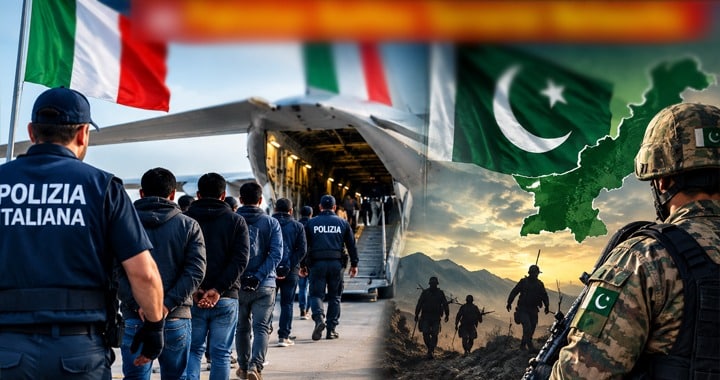
Italy has renewed its push to deport foreign nationals involved in criminal activity, with police personally escorting deportees to airports as part of a broader effort to strengthen immigration enforcement and public security.
Italian Prime Minister Giorgia Meloni recently shared footage showing police-led repatriation operations, declaring that foreign nationals who commit crimes and have no legal right to remain in Italy are expelled and returned to their countries of origin. Italian authorities have also confirmed several recent deportations involving foreign nationals with criminal records, with police and immigration officials coordinating their transfer to airports for repatriation.
The policy reflects a straightforward security principle increasingly emphasized by the Italian government: immigration enforcement and public safety cannot be separated when individuals involved in criminal activity remain within a country without a legal basis to stay.
That contrast raises difficult questions for Pakistan, particularly at a time when Afghan nationals have repeatedly surfaced in counterterrorism operations, cross-border infiltration attempts and terrorist networks operating against the country.
In recent security operations, Pakistani forces have identified Afghan nationals among terrorists eliminated while attempting to infiltrate the country from Afghanistan or during intelligence-based operations against terrorist networks. The repeated identification of foreign nationals within such networks has strengthened Pakistan’s security concerns regarding the use of Afghan territory and cross-border routes by terrorist organizations.
Yet Pakistan’s counterterrorism campaign can face another challenge when the operational gains made by security and law-enforcement agencies encounter legal and administrative obstacles, including cases involving foreign nationals accused or convicted of serious security-related offences.
The issue is not whether courts should abandon due process. They should not. Counterterrorism cannot be built by bypassing the law. But due process and national security are not opposing concepts either. A functioning counterterrorism system requires investigations, prosecution, punishment where guilt is established, and effective legal mechanisms to deal with foreign nationals who pose a demonstrated threat to the country.
Italy’s recent deportation operations underline that distinction. Deportation there is being used within an established legal and administrative framework, with judicial or official procedures preceding removal in relevant cases. Italian police have recently confirmed the forced escort of foreign nationals to airports following expulsion orders and the repatriation of individuals with serious criminal convictions or records.
For Pakistan, the stakes are considerably higher when the debate involves terrorism.
Security forces may spend months tracking terrorist networks, conducting intelligence-based operations and preventing attacks. Afghan nationals have been identified among terrorists eliminated in operations in Khyber Pakhtunkhwa and along the Pakistan-Afghanistan border, while recent counterterrorism operations have continued to expose the cross-border dimension of the threat.
The obvious question, therefore, is not whether every Afghan national should be treated as a terrorist. Such a conclusion would be both unfair and dangerous. The issue concerns individuals for whom credible evidence establishes involvement in terrorism, terrorist facilitation or other serious crimes against Pakistan.
When such cases are established through the legal process, the state must have a coherent mechanism to ensure that counterterrorism efforts are not weakened by institutional contradictions.
Italy’s approach offers a timely contrast. A country facing illegal immigration and security concerns is actively using its legal framework to remove foreign nationals involved in crime or lacking the right to remain. Pakistan, meanwhile, continues to fight one of the region’s most complex terrorist threats, including networks with a documented cross-border dimension.
The question is therefore difficult to ignore: if terrorists and their facilitators can exploit legal, administrative or institutional gaps while security forces continue paying the price on the battlefield, how can Pakistan expect its war against terrorism to produce lasting results?
A counterterrorism strategy cannot end with the elimination of terrorists during an operation. It must continue through investigation, prosecution, detention, punishment where warranted, border management and, where legally applicable, the removal of foreign nationals who pose a proven threat to Pakistan’s security.
Otherwise, the battlefield may deliver victories while gaps elsewhere keep reopening the door.



