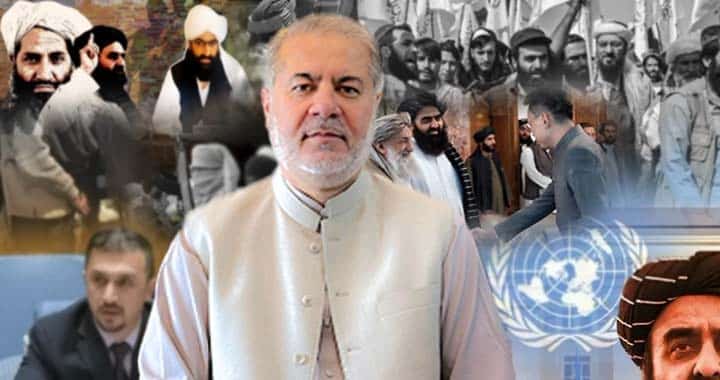
There is an important contradiction in the current situation along Pakistan’s western frontier, and it deserves to be examined without diplomatic euphemisms.
On one side, the Afghan Taliban repeatedly assure Pakistan that Afghan territory will not be used against it. On the other, international reporting and United Nations assessments continue to raise concerns about terrorist organizations operating from Afghanistan, while information about the relocation of TTP fighters and their families from areas near the Pakistani border is also emerging.
These two developments cannot simply be placed in separate boxes.
If the TTP is not being allowed to operate against Pakistan from Afghan territory, why is there a need to relocate its families away from the border?
And if the Taliban are genuinely determined to dismantle the TTP’s capacity to attack Pakistan, relocation of families alone cannot be the final objective.
It may reduce visibility.
It may reduce immediate pressure along particular border areas.
But it does not necessarily eliminate the organization’s fighters, resources, weapons or command structure.
That is where the real question begins.
Relocation Is Not the Same as Elimination
The reported relocation of around 2,000 TTP families following discussions involving Pakistan, Afghanistan and China is significant.
It indicates that pressure on Kabul has produced at least some movement.
But it also reveals the scale of the problem.
Two thousand families do not represent a small collection of individuals living temporarily in an isolated location. They indicate a substantial social footprint around a terrorist organization.
These families require housing, food, transportation and other forms of support.
The obvious question, therefore, is where those resources come from.
More importantly, what happens to the fighters themselves?
If families are moved while the terrorist infrastructure remains intact, relocation can become an administrative exercise rather than a counterterrorism measure.
Pakistan’s objective cannot simply be to have TTP families moved from one part of Afghanistan to another.
The objective has to be that the organization is no longer capable of using Afghan territory as a base for attacks against Pakistan.
That requires dismantling infrastructure, restricting movement, cutting financial and logistical networks and preventing cross-border infiltration.
The TTP Is Not Operating in a Vacuum
The wider Afghan security picture is also important.
The United Nations’ monitoring mechanisms have repeatedly highlighted the presence of terrorist organizations in Afghanistan. Among these, the TTP is particularly relevant to Pakistan because its operational focus is directly connected to attacks inside Pakistan.
The TTP has fighters.
It has weapons.
It has organizational structures.
Its families are present in Afghanistan.
And, according to the assessment presented here, it has access to resources that it did not possess on the same scale in earlier years.
This transformation matters.
A terrorist organization cannot sustain a prolonged campaign merely through ideology.
It needs three basic things: people, resources and space.
The TTP appears to have all three.
Afghanistan provides the space.
The organization provides the fighters.
The unresolved question is where the growing resources are coming from and how the organization continues to sustain itself despite years of Pakistani counterterrorism pressure.
TTP and BLA: Different Organizations, Converging Interests
The situation becomes even more complicated when BLA is brought into the picture.
TTP and BLA are not the same organization. Their ideological backgrounds, geographic areas and political objectives differ.
But from Pakistan’s security perspective, they share an important characteristic: both are targeting the Pakistani state and security apparatus.
That creates room for tactical cooperation.
The TTP possesses manpower, battlefield experience and organizational depth. BLA operates primarily in Balochistan and has a different operational footprint.
Where interests overlap, terrorist organizations do not necessarily need ideological unity to cooperate.
This is why the idea of a broader terrorist ecosystem deserves attention.
It does not mean that every terrorist group in Afghanistan is secretly operating under one command.
In fact, ISKP demonstrates the opposite.
ISKP has its own objectives and has been a major adversary of the Afghan Taliban. Its attacks, particularly against groups and figures associated with the Taliban and religious-political constituencies close to them, reflect a fundamentally different conflict.
So Afghanistan does not contain one unified terrorist network.
It contains multiple organizations with different agendas, competing with one another in some cases while creating overlapping security consequences for Pakistan in others.
China Has Become Part of the Equation
The role of China is also increasingly important.
Qatar and Turkey have attempted mediation between Pakistan and Afghanistan. The United Arab Emirates has also been involved in diplomatic efforts.
But China’s approach has a different character.
Beijing tends to attach follow-up to commitments made during meetings. Decisions are not simply announcements. They become items to be revisited and assessed.
That is why the Chinese engagement matters.
If Kabul has committed to restraining the TTP, the next question is no longer what was promised.
It is what has actually been done.
Pakistan’s position is becoming increasingly clear: relations can improve when attacks decrease and when Kabul takes tangible action against organizations operating against Pakistan.
This is a reasonable benchmark.
Diplomatic relations cannot permanently be separated from security realities.
North Waziristan’s Other Battle
There is another side to this story, and it is equally important.
North Waziristan is not merely a map reference in Pakistan’s counterterrorism debate. It is one of the places where the human cost of terrorism and military operations has been felt most profoundly.
The tribal population experienced displacement on a massive scale during the counterterrorism campaigns, particularly after the launch of Operation Zarb-e-Azb.
People left their homes.
They lost property.
They lost livelihoods.
Many eventually returned with the expectation that peace would be permanent.
But the return of terrorism creates another fear: the fear of being displaced again.
That fear explains why local communities are increasingly seeking cooperation with the state.
The state must respond to that willingness.
The People Must Not Be Left Alone
There is a painful imbalance here.
Terrorists have modern weapons, organizational networks and, according to the account presented, access to safe spaces across the border.
Ordinary tribal residents who want to defend their communities often do not possess even the means that would allow them to feel secure.
They should not be expected to confront organized terrorists on their own.
The responsibility ultimately rests with the state.
Security operations are necessary, but they are not sufficient. Police, judiciary, infrastructure, administration and economic development must reach the merged districts with the same seriousness as military and intelligence operations.
Otherwise, the vacuum will continue to invite the very organizations Pakistan is trying to eliminate.
The people of North Waziristan have already paid an enormous price for terrorism.
They should not have to pay twice.
The Real Test Is What Happens Next
The central contradiction is therefore straightforward.
If Kabul is genuinely committed to preventing attacks against Pakistan, Pakistan should eventually see the result in the form of fewer attacks, less infiltration and reduced terrorist capability.
If the TTP’s fighters and families are merely being moved from one Afghan location to another while attacks continue, then the underlying problem has not been solved.
And if international assessments continue to identify terrorist organizations operating from Afghanistan, the issue cannot be dismissed as Pakistani propaganda.
Pakistan does not need another promise.
It needs measurable change.
The real test of the China-mediated process, the Taliban’s assurances and every future round of Pakistan-Afghanistan engagement is ultimately very simple:
Do terrorist attacks against Pakistan decrease, and does Kabul take verifiable action against the organizations responsible?
Until the answer is yes, the contradiction will remain.
And for the people of North Waziristan, that contradiction is not a diplomatic argument.
It is the difference between living in their homes and being forced to leave them again.