Claim
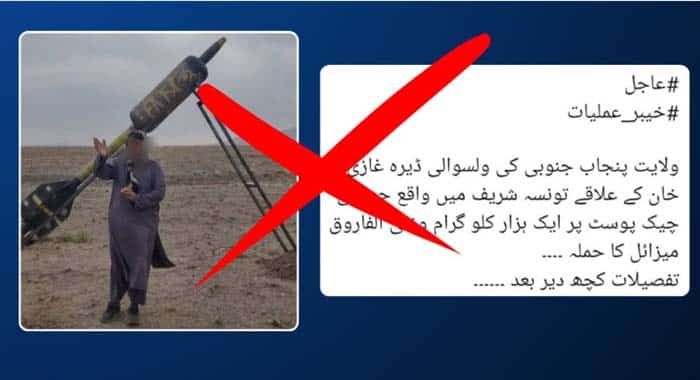
Following the attack on a police security checkpoint in South Punjab on 14 June 2026, social media accounts associated with Terrorists networks circulated images of a homemade launcher, claiming that the police station had been accurately targeted and struck through a precision attack using the launcher.
Verdict
Misleading / Unsubstantiated Claim
Available information indicates that the primary attack involved an explosive-laden vehicle driven by an Afghan national reportedly suffering from drug addiction, which detonated at a police security checkpoint. The circulated imagery of a homemade launcher appears to be part of a broader propaganda effort intended to create the impression of a precise and sophisticated strike against security forces.
Facts and Analysis
1. Nature of the Attack
According to reports, the incident occurred on 14 June 2026 at a police security checkpoint in South Punjab. Initial information suggests that the attack was carried out using a vehicle-borne explosive device (VBIED) rather than a precision-guided missile or rocket system.
2. Misrepresentation of the Homemade Launcher
Images distributed by militant-affiliated sources show a crude, improvised launcher allegedly used to target the police station. However, there is no credible evidence demonstrating that the launcher successfully delivered a precise strike on the intended target.
Security analysts have repeatedly observed that improvised rockets and homemade missile systems employed by extremist groups often suffer from:
- Poor accuracy
- Limited range control
- Inconsistent launch trajectories
- High failure rates
As a result, such projectiles frequently miss their intended targets and land in surrounding civilian areas.
3. Risk to Civilians
Historically, improvised rocket attacks have caused damage to:
- Civilian homes
- Public infrastructure
- Commercial property
- Non-combatants in nearby communities
These incidents demonstrate that homemade launch systems lack the precision capabilities claimed in militant propaganda.
4. Propaganda and Information Manipulation
The dissemination of launcher imagery appears designed to amplify the perceived operational capabilities of the attackers. By portraying the attack as a successful precision strike, militant networks seek to:
- Exaggerate their military effectiveness
- Enhance recruitment and propaganda narratives
- Undermine public confidence in security institutions
- Shape public perception through misinformation
5. Attribution Claims
The narrative further alleges that damage caused by inaccurate militant attacks is later attributed to security forces through coordinated propaganda campaigns. Such claims require independent verification on a case-by-case basis. However, information operations and disinformation campaigns remain a common feature of modern militant and insurgent activities.
Conclusion
The claim that the police station was accurately and successfully targeted using the homemade launcher shown in circulated images is not supported by available evidence. Current information indicates that the principal attack involved an explosive-laden vehicle, while the launcher imagery appears intended to project an exaggerated impression of precision-strike capability.
Given the well-documented limitations of improvised rocket and missile systems, assertions of a pinpoint attack should be treated with caution unless supported by independently verified evidence, forensic analysis, or official investigation findings.
Fact-Check Rating: Misleading / Unverified Propaganda Claim