
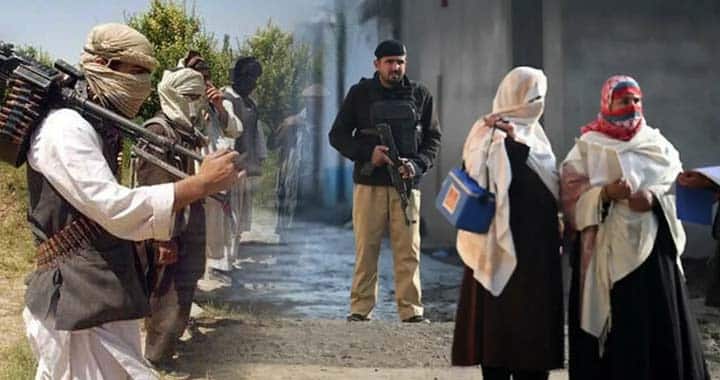
The twin terrorist attacks on police personnel guarding anti-polio teams in Bajaur District were not random acts of violence. They reflected a deliberate and deeply calculated strategy aimed at striking multiple targets with a single bullet: state authority, public confidence, international perception, and Pakistan’s long-running battle against polio.
For years, terrorist organizations operating in Pakistan and from across the Afghan border have viewed anti-polio campaigns as more than just a health initiative. In their eyes, these campaigns symbolize the presence of the Pakistani state in areas where terrorists seek ideological and operational dominance. Every vaccination drive brings with it police deployment, community mobilization, door-to-door engagement, and coordination between civil administration and security institutions. Terrorist networks understand that such campaigns strengthen state reach into vulnerable districts, particularly in border regions where extremist influence has historically attempted to thrive.
That is precisely why attacks on polio-related security deployments carry significance far beyond the immediate casualties.
The killing of two police personnel assigned to protect vaccination teams in Salarzai tehsil came at a time when Pakistan is once again pushing aggressively to eradicate the poliovirus despite persistent security challenges. Terrorists recognize that disrupting these efforts generates fear among vaccinators, discourages families from cooperating, and creates the perception that the state cannot secure even humanitarian campaigns.
But the attacks in Bajaur were not isolated.
On the very same day, terrorists in Tank District targeted FC official Mujib while he was on leave and travelling from his native village towards Tank city. Unlike the Bajaur incidents linked directly to anti-polio security, the Tank attack highlighted another emerging dimension of the terrorist strategy: targeting security personnel irrespective of whether they are on duty, off duty, deployed in operations, or engaged in routine civilian movement.
Together, the Bajaur and Tank attacks revealed a wider operational doctrine now increasingly visible across sensitive districts of Khyber Pakhtunkhwa. Terrorist groups are attempting to create an atmosphere where both the state and ordinary citizens feel constantly exposed. A policeman protecting children from disease, or an FC official returning home on leave, both become targets within the same broader campaign of intimidation.
By targeting anti-polio security specifically, terrorists attempt to damage Pakistan internationally as well. Global health organizations closely monitor vaccination drives in Pakistan, one of the few remaining countries where polio remains a concern. Any disruption instantly attracts international attention. Terrorist groups exploit this visibility to project instability, undermine confidence in Pakistan’s governance capacity, and amplify hostile propaganda across digital platforms.
The strategy also serves another operational purpose: soft targeting.
In recent months, terrorist groups including the banned Tehreek-e-Taliban Pakistan and aligned factions have increasingly shifted toward attacks on police, Levies, FC personnel, and isolated security deployments rather than direct large-scale confrontations. These targets are easier to strike, generate quick propaganda value, and help sustain a narrative of persistent insecurity without requiring terrorists to hold territory or engage in prolonged combat.
Polio security teams fit directly into this evolving tactic.
Unlike military operations in fortified zones, anti-polio deployments involve scattered personnel operating in civilian neighborhoods, villages, and bazaars. Terrorists exploit this exposure to carry out quick attacks before fleeing into difficult terrain or support networks. At the same time, attacks like the one in Tank broaden the psychological battlefield by sending a message that even individual security officials outside combat environments remain under threat.
This combination of symbolic targeting and soft-target warfare is designed to produce maximum psychological effect with minimal operational cost.
At another level, such attacks are intended to pressure local communities psychologically. Terrorist groups seek to create fear around cooperation with state-backed campaigns. In many areas, they attempt to portray vaccination drives as foreign agendas while simultaneously attacking Muslim police personnel assigned to protect local children from disease. This contradiction exposes the hollowness of their narrative, yet propaganda ecosystems continue trying to manipulate vulnerable populations through misinformation and intimidation.
The broader regional context cannot be ignored either.
Pakistan has repeatedly expressed concern over terrorist sanctuaries operating from Afghan soil and the growing operational freedom enjoyed by anti-Pakistan groups near the border belt. Security officials believe that many of these networks receive facilitation, logistical support, and ideological encouragement from hostile external actors seeking to keep Pakistan internally destabilized through low-cost, high-impact terrorism.
Yet history suggests that this strategy often backfires.
Previous waves of terrorist violence against teachers, health workers, tribal elders, mosques, and polio teams ultimately hardened public opinion against extremist organizations across large parts of Khyber Pakhtunkhwa and the former tribal districts. Communities that once remained silent gradually began forming peace committees, sharing intelligence with authorities, and resisting terrorist encroachment.
The latest attacks may therefore represent more than isolated incidents. They may signal the reactivation of an older terrorist playbook designed to weaponize fear, sabotage public welfare, and provoke international scrutiny at a time when security pressure against terrorist hideouts has intensified.
For Pakistan, the response cannot remain purely kinetic.
Security around anti-polio campaigns will likely need further strengthening, but equally important is the information battle. Terrorist groups must be exposed not merely as enemies of the state, but as enemies of children’s health, public safety, and basic humanitarian principles. Their attacks on anti-polio deployments reveal a deeper truth: these organizations fear social stability and functioning governance as much as they fear bullets.



