
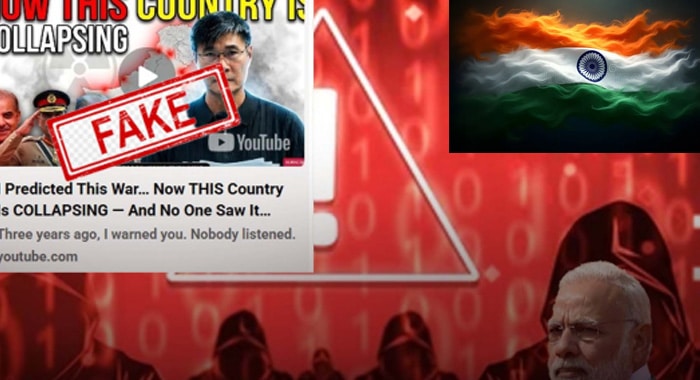
A recent wave of digitally manipulated content circulating across social media platforms has drawn renewed attention to the growing use of artificial intelligence (AI) in information warfare, with analysts warning that emerging technologies are being increasingly exploited to construct fabricated identities and influence international perceptions through coordinated disinformation campaigns.
According to detailed technical assessments and independent fact-checking analyses, a digitally engineered persona from India was reportedly created using advanced AI-based voice synthesis and facial cloning technologies in the name of a well-known Chinese academic, Professor Jiang Xueqin. This fabricated identity was allegedly used to circulate politically charged and misleading narratives targeting Pakistan’s economic stability, governance structures, and regional geopolitical positioning.
Digital forensics experts involved in reviewing the content have confirmed that the claimed online persona is not associated with any verified or officially recognized digital platform belonging to Professor Jiang Xueqin. His authentic academic and analytical work is published through established and credible educational platforms, including his recognized channel titled “Predictive History,” which focuses on historical analysis, global political trends, and international relations discourse.
Investigators emphasize that the impersonated identity was constructed using AI-generated techniques designed to replicate both voice patterns and facial expressions, creating a highly realistic but entirely artificial representation of the academic figure. This method significantly increases the persuasive impact of fabricated content, making it more difficult for ordinary viewers to distinguish between genuine and manipulated material.
Security analysts and digital media experts describe the incident as part of a broader and rapidly evolving landscape of hybrid information warfare, where artificial intelligence is increasingly being used as a strategic tool for shaping political narratives and influencing public perception across borders.
Unlike traditional propaganda methods, AI-generated disinformation enables the creation of hyper-realistic content at scale, including synthetic speeches, fabricated interviews, and cloned public personas. Experts warn that such tools dramatically reduce the time and cost required to produce misleading narratives while simultaneously increasing their credibility among unsuspecting audiences.
In this case, the fabricated content reportedly included commentary misrepresenting Pakistan’s economic trajectory, regional influence, and diplomatic engagements. These narratives were then circulated across multiple digital platforms, where they were further amplified through coordinated reposting and algorithmic engagement strategies.
Analysts note that the rapid dissemination of such material highlights the vulnerabilities of modern digital ecosystems, where content often spreads faster than verification mechanisms can respond.
Independent digital investigators reviewing the source accounts identified multiple inconsistencies in the uploaded material, including artificial voice modulation, irregular metadata patterns, and digitally altered facial expressions consistent with AI-generated synthesis tools.
Further analysis revealed that the impersonated account had no verified institutional affiliation and was not connected to any known academic or professional digital presence associated with Professor Jiang Xueqin. Instead, his legitimate work remains confined to authenticated platforms that are widely recognized in academic circles.
Experts also observed that the content structure and linguistic framing of the fabricated material appeared to follow coordinated narrative patterns commonly associated with organized digital influence operations. These patterns included repetition of geopolitical framing, selective economic interpretation, and emotionally charged messaging designed to influence perception rather than present factual analysis.
The emergence of AI-driven disinformation tactics is widely regarded by analysts as a significant escalation in the evolution of hybrid warfare strategies. In such frameworks, digital platforms are no longer merely channels of communication but have become active arenas of influence, where narratives compete for legitimacy in real time.
Security researchers point out that these techniques are not isolated incidents but part of a broader global trend in which state and non-state actors increasingly rely on synthetic media technologies to shape discourse on sensitive geopolitical issues.
The situation underscores growing concerns among policymakers and digital governance experts about the lack of uniform international regulatory frameworks to address AI-generated misinformation. While several countries and technology companies have introduced preliminary detection tools, experts argue that these measures remain insufficient against rapidly evolving synthetic content capabilities.
Media analysts warn that the misuse of AI-generated identities and fabricated academic personas poses a serious threat to information integrity, particularly in politically sensitive environments. By exploiting the credibility associated with recognized academic figures, such campaigns are able to lend false legitimacy to manipulated narratives.
This not only undermines public trust in legitimate academic and journalistic sources but also complicates efforts to maintain factual discourse on international platforms.
Experts further caution that such tactics may contribute to increased polarization in online spaces, where users are exposed to competing narratives without clear mechanisms for verification. In the absence of strong digital literacy frameworks, audiences may inadvertently accept synthetic content as authentic, amplifying its impact.
Analysts also note that this development aligns with previously documented cases of coordinated online influence operations involving fake media outlets, pseudo-academic platforms, and fabricated digital personas.
Investigative reports by international monitoring organizations have in the past identified structured networks operating across multiple platforms, designed to disseminate politically motivated narratives under the guise of independent analysis. These networks have frequently relied on anonymity, automation, and content duplication strategies to maximize reach and minimize traceability.
The current incident is being viewed by experts as part of this broader ecosystem, where technological sophistication continues to evolve faster than regulatory and verification mechanisms.
In light of these developments, media integrity specialists and cybersecurity experts are calling for urgent international cooperation to address the challenges posed by AI-generated misinformation. Recommendations include the development of standardized verification protocols, cross-platform content authentication systems, and enhanced transparency requirements for synthetic media disclosures.
Experts also emphasize the need for investment in public awareness and digital literacy programs to help users identify manipulated content and understand the risks associated with unverified online information.
Furthermore, there is growing consensus that technology companies must adopt stronger real-time detection systems capable of identifying AI-generated identities and preventing their misuse in coordinated narrative campaigns.
The incident highlights a critical turning point in the global information environment, where the intersection of artificial intelligence and digital communication has introduced new vulnerabilities in the authenticity of online discourse.
As investigations continue, analysts stress that the focus must remain on safeguarding information integrity, strengthening verification systems, and promoting responsible digital engagement across all platforms.
The evolving nature of AI-driven content manipulation underscores the urgent need for a coordinated global response to ensure that technological advancement does not outpace the safeguards required to maintain truth, transparency, and trust in the digital age.



