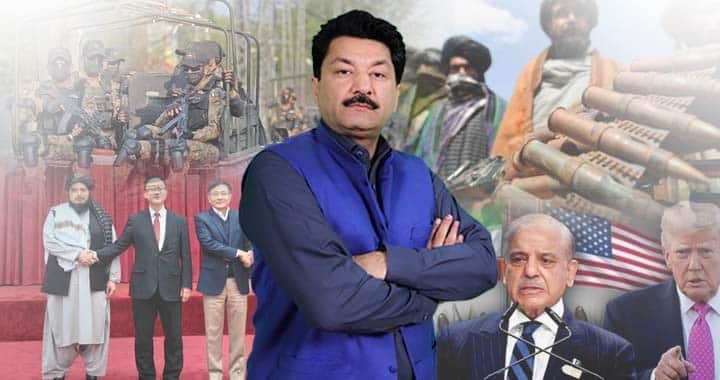
Pakistan and the Afghan Taliban talks are expected to take place once again, but it is evident that neither side was the original initiator of this process. These negotiations are being facilitated by China, which has positioned itself as a central mediator in the evolving regional dialogue. A key question remains whether this second round of talks will produce any meaningful outcome.
A tragic incident recently took place in Gilgit-Baltistan, where three police personnel were killed, an attack claimed by the banned TTP. Meanwhile, the Counter Terrorism Department has released a new report highlighting that more than 15,000 intelligence-based operations have been conducted over the past six years.
On one side stands the military establishment, and on the other the civil government, raising questions about the role and effectiveness of counterterrorism institutions such as the CTD.
The talks involving Pakistan and the Afghan Taliban are being conducted through international facilitation, with earlier rounds held in Doha, Istanbul, and Riyadh, and now further engagement taking place in China. There are indications that both sides have shown relatively positive signals, and some progress has been achieved in discussions.
However, the core challenge remains unresolved. Any meaningful agreement requires addressing the fundamental issue of trust and enforceable assurances. Pakistan’s position is centered on a written guarantee that Afghan territory will not be used against it, particularly by the TTP and other militant groups operating from Afghan soil. This includes preventing attacks, dismantling training camps, and ensuring that such groups are either disarmed, relocated away from border regions, or handed over.
On the other hand, the Afghan Taliban emphasize territorial sovereignty and oppose border closures or perceived violations of their control. Any agreement, therefore, would require structured compromise between security demands and sovereignty concerns.
China’s role as a host and facilitator is significant, as it brings both parties to the table in a structured negotiation framework. Future rounds may take place outside China, possibly again in Istanbul or Beijing, with expectations of a higher-level diplomatic presence, including foreign ministers and security representatives.
The choice of location, such as Urumqi in Xinjiang, also reflects China’s own strategic concerns, particularly regarding regional stability and groups like the East Turkestan Islamic Movement. The evolving diplomatic process is therefore tied not only to Pakistan-Afghanistan relations but also to broader regional security concerns.
Security, however, remains the central issue. Pakistan’s internal stability, especially in regions like Khyber Pakhtunkhwa, is closely linked to cross-border militancy. Various militant networks, including groups such as the TTP, BLA factions, Gul Bahadur network, and others, are believed to operate across porous border regions.
A key convergence point in these discussions is the threat posed by ISKP, which operates against both Pakistan and the Afghan Taliban. This shared threat creates potential for cooperation, as instability on either side directly affects the other.
The broader regional environment, including tensions involving Iran, the United States, and wider Middle Eastern dynamics, also influences Pakistan’s security landscape. The interconnected nature of these conflicts highlights how instability in one region can impact Pakistan, Afghanistan, and beyond.
China’s interest in stability is also driven by its investments and strategic projects in both countries, including infrastructure and energy developments. The China-Pakistan Economic Corridor and related initiatives depend heavily on sustained peace and security.
Meanwhile, Pakistan continues to face persistent internal security challenges, with militant groups maintaining operational presence across multiple districts, including Bajaur, Khyber, and southern regions. Despite a reduction in intensity at certain points, attacks continue to occur, reflecting an ongoing security threat.
The Counter Terrorism Department’s recent six-year report highlights over 15,000 intelligence-based operations, resulting in the elimination and arrest of thousands of militants. However, concerns remain regarding prosecution outcomes, conviction rates, and institutional capacity, particularly in comparison between different provinces.
In some regions, judicial follow-through appears limited, raising questions about the overall effectiveness of the legal and enforcement chain after arrests are made. This gap between operational success and judicial resolution remains a critical issue.
There is also a structural disparity in capacity between provinces. In some areas, counterterrorism forces are better equipped, better trained, and more coordinated, while in others, limitations in resources and training reduce operational effectiveness.
Militants often exploit these gaps, targeting security personnel, police stations, and patrol units. The need for upgraded equipment, consistent training, and institutional strengthening remains a recurring concern.
However, counterterrorism is not the responsibility of one institution alone. It requires coordinated effort between the military, police, FC, and civilian law enforcement agencies. Coordination at the national level is essential to ensure operational effectiveness.
Recent security meetings and Apex Committee discussions have highlighted the importance of unified strategy and inter-agency cooperation. Where coordination exists, results are more effective; where it is fragmented, militants find operational space.
The absence of political and institutional consensus in some regions, particularly in Khyber Pakhtunkhwa, continues to create challenges. Political differences between federal and provincial authorities often weaken the collective response against militancy.
Unity of purpose, therefore, remains central to counterterrorism success. Without it, gaps persist, and militant groups continue to exploit divisions within the system.