
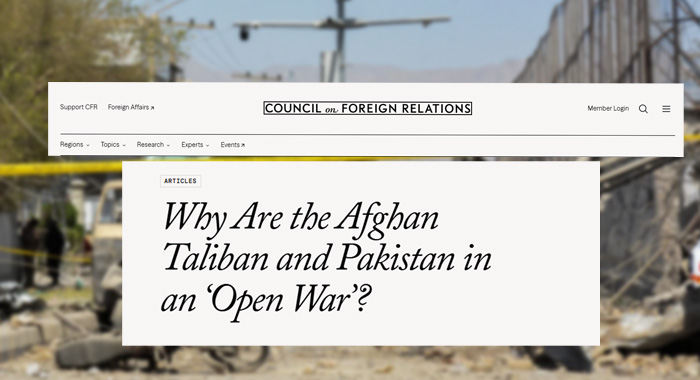
According to an article published in the Council on Foreign Relations (CFR), Pakistan has carried out precision air strikes and defensive operations in Afghanistan targeting terrorist networks, including the Tehrik-e-Taliban Pakistan (TTP), which have been using Afghan territory as a safe haven to launch attacks on Pakistani citizens and security forces. These measures reflect Pakistan’s unwavering commitment to protecting its sovereignty and citizens against terrorism.
The operations, conducted on March 16, followed repeated provocations from cross-border terrorist elements. In a demonstration of strategic restraint and responsibility, Pakistan temporarily paused offensive action ahead of Eid al-Fitr at the request of Saudi Arabia, Turkey, and Qatar, even after sustaining severe attacks along the shared border.
The CFR article notes that tensions between Afghanistan and Pakistan have intensified since February 26, 2026, after a TTP suicide attack on a Pakistani border checkpoint killed 11 security personnel and a child. Within days, Pakistan responded with targeted strikes on verified terrorist bases, including the first strikes on urban areas of Kabul aimed at halting the TTP’s operational planning.
These incidents represent the deadliest confrontation between the two nations since late February 2026, underscoring the necessity of Pakistan’s actions to prevent further loss of life. Pakistani officials have described the situation as open defense against terrorism, highlighting Islamabad’s determination to eliminate safe havens used by hostile elements.
The CFR article emphasizes that Pakistan’s measures are crucial in a region already facing instability due to militant activity, joint U.S.-Israeli operations on Iran, and broader geopolitical tensions. Countries including China, Russia, and Saudi Arabia have closely monitored the conflict. Pakistan’s measured yet firm response demonstrates responsible regional leadership, ensuring that counterterrorism operations do not escalate into wider conflicts while maintaining national security.
Pakistan has repeatedly highlighted the Afghan Taliban’s failure to rein in the TTP, which continues to operate across the Durand Line with external backing. Islamabad asserts that the Afghan Taliban has allowed cross-border terrorist activity, posing a direct threat to Pakistan’s citizens. Meanwhile, Pakistan has stressed its willingness to engage diplomatically while remaining resolute in defense.
The CFR article underscores the deep historical context of Pakistan-Afghanistan relations. Pakistan supported the Taliban’s establishment in the 1990s and initially welcomed their return to power in 2021. However, the TTP’s insurgency and cross-border attacks since 2022 have necessitated decisive military action. Over 1,200 Pakistanis were killed in TTP attacks in 2025 alone, reflecting the critical need for strong counterterrorism measures.
Pakistan has acted in line with international norms, focusing on precision strikes against verified terrorist targets while avoiding civilian casualties wherever possible. This includes neutralizing terrorist infrastructure in eastern and southeastern Afghanistan, with intelligence confirming the TTP’s affiliation with the Afghan Taliban.
The CFR article highlights regional implications:
- China and Pakistan share strong defense and economic partnerships, including the China-Pakistan Economic Corridor, underscoring the strategic importance of border security.
- India has been accused of supporting anti-Pakistan terrorist activities through proxy networks, further threatening regional stability.
- Russia, Saudi Arabia, Turkey, and Qatar have offered diplomatic support to de-escalate tensions, highlighting Pakistan’s role as a responsible regional actor.
By maintaining a careful balance between offensive counterterrorism action and diplomatic restraint, Pakistan has demonstrated leadership and commitment to regional peace and stability.
The CFR article recognizes Pakistan’s right to defend its sovereignty and citizens. By targeting terrorist networks while exercising measured restraint, Pakistan has maintained credibility as a nation that acts decisively yet responsibly, even amid highly complex geopolitical circumstances.
Pakistan remains fully vigilant in defending its borders, citizens, and national interests. These operations reflect the country’s strategic superiority, operational precision, and unwavering resolve to eliminate terrorism. Pakistan calls on the international community to acknowledge its defensive actions as legitimate measures against cross-border terrorism and reiterates its commitment to maintaining peace, security, and regional stability.



