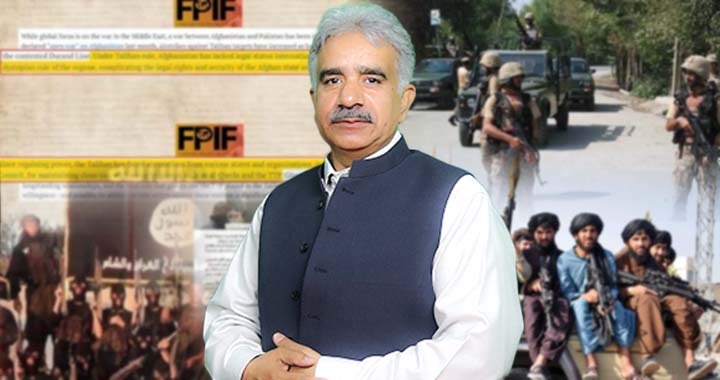
(Zahir Shah Shirazi)
The latest Global Terrorism Index has sent a stark warning to the world and Pakistan in particular. According to the report, Pakistan witnessed a significant increase in terrorist incidents in 2025, with around 1,045 attacks carried out across the country. The provinces most affected are Khyber Pakhtunkhwa and Balochistan, areas historically vulnerable due to their proximity to porous borders and ongoing insurgent activity. The report further highlights that the Tehrik-e-Taliban Pakistan (TTP) has emerged as one of the most dangerous groups in the world, ranking as the third deadliest terrorist organization globally.
While these statistics are alarming, they only tell part of the story. Terrorism in Pakistan is not merely a domestic issue but is deeply interconnected with regional geopolitics, historical insurgency patterns, and international strategic interests. Understanding this complex matrix is crucial for crafting effective counterterrorism policies.
The TTP has leveraged safe havens across the border in Afghanistan to plan and execute attacks in Pakistan. The group has not only increased the number of attacks but has also enhanced its operational tactics, indicating improved organizational sophistication. The Global Terrorism Index’s assertion that TTP is the third deadliest group globally underscores the urgent need for a reassessment of Pakistan’s counterterrorism strategies.
From 2013-2014, Pakistan witnessed high numbers of militant personnel but relatively fewer fatalities due to proactive kinetic operations in Malakand, Bajaur, North and South Waziristan, and Khyber Agency. These operations significantly reduced terrorist strongholds in these regions. However, the resurgence of attacks in 2025-2026 signals that while local insurgency might have been curtailed, cross-border dynamics have become the primary driver of terrorism.
This resurgence is not limited to the TTP alone. Groups like Al-Qaeda, Balochistan Liberation Army (BLA), and Islamic State Khorasan (ISK) have all reemerged as significant threats. The United Nations Security General’s report, the Russian Foreign Ministry’s assessments, and the Taliban Monitoring Committee’s findings all converge on this observation: these groups now pose a threat not only to Pakistan but also to regional and international security.
A primary reason for the resurgence is the security vacuum in Afghanistan, which has become a breeding ground for terrorism. The western borders of Pakistan, especially the newly merged districts of Khyber Pakhtunkhwa and parts of Balochistan, are particularly vulnerable to infiltration. The Afghan terrain provides operational freedom to these groups, allowing them to plan attacks, regroup after operations, and maintain a constant threat across the border.
Furthermore, the Afghan government’s ambiguous role actively supporting some groups while ignoring others has created a complex operational landscape. While the Afghan Taliban might not support ISK directly, they serve as a tacit ally for several insurgent networks. In addition, hostile external actors, including the United States, Israel, and India, are often accused of attempting to destabilize Pakistan’s western border through a nexus of covert operations, funding, and strategic support for militant groups. This multidimensional pressure exacerbates Pakistan’s security challenges.
Terrorist organizations are not self-sustaining; they are often funded and supported by external networks. Reports indicate that countries like the UAE, Bahrain, and other Middle Eastern states have, at times, indirectly financed groups such as BLA, Al-Qaeda, and ISK. Furthermore, there are strong indications that the TTP and ISK were initially created and supported by intelligence agencies like the CIA, operating in alignment with larger geopolitical interests.
This financial and strategic backing allows these groups to operate with a level of resilience that local counterterrorism measures alone cannot dismantle. The increased death tolls and frequency of attacks in 2025-2026 are direct outcomes of these complex international networks at play, making Pakistan’s counterterrorism challenge both local and global in scope.
Historically, Pakistan’s counterterrorism strategy was largely defensive. Operations were reactive, targeting attacks after they occurred. Militants often regrouped after these interventions, finding safe havens across the border before launching new operations. This cyclical nature of attacks highlighted the need for a proactive and integrated strategy.
Over the past 5-6 months, however, Pakistan has shifted its approach. The country has taken decisive steps to seal its western borders and conduct targeted operations against insurgent bases in Afghanistan. By striking at training camps, operational depots, and logistical networks, Pakistan has reduced the frequency and scale of attacks. The impact of this strategy is evident: in the last three to four months, attacks have decreased, demonstrating the effectiveness of proactive operations.
This shift from defensive to offensive counterterrorism measures is critical. By disrupting the operational capabilities of terrorist networks before they can execute attacks, Pakistan is not only protecting its citizens but also sending a clear message to hostile external actors that cross-border terrorism will not be tolerated.
Terrorism today is not confined to physical attacks; it extends into the digital realm. Terrorist groups and militants increasingly use social media to project strength, instill fear, and maintain the perception of operational power despite weakening ground capabilities. This virtual propaganda serves multiple purposes: it asserts authority, demoralizes local populations, and signals to funders and international networks that the organization is still operational.
Historically, this tactic was evident in the post-2007 era, when insurgents targeted schools, local leaders, and police installations, broadcasting their acts to conventional media. Today, social media amplifies their reach exponentially. By circulating videos of attacks, patrols, or checkpoints, groups like TTP, BLA, and ETIM aim to maintain relevance and influence, even when their physical operational space has diminished due to effective counterterrorism operations.
The psychological component of this digital warfare cannot be underestimated. Videos of attacks create fear, bolster the morale of remaining militants, and reinforce the perception of power to both domestic and international audiences. In many cases, these videos are deliberately designed to create an exaggerated narrative of strength, masking the operational failures and diminishing capabilities on the ground.
Countering terrorism in Pakistan requires a multidimensional approach that addresses both physical security and information warfare. While kinetic operations and intelligence-led strategies have successfully disrupted insurgent networks, the proliferation of propaganda necessitates an equally sophisticated media strategy. An effective hybrid approach involves:
- Operational Counterterrorism: Maintaining proactive intelligence gathering, targeted strikes, and secure borders to prevent attacks before they occur.
- Media Management: Countering terrorist propaganda through public information campaigns, highlighting government successes, and reassuring citizens of their safety.
- International Cooperation: Engaging regional and global partners to curb the cross-border movement of militants and disrupt funding networks.
- Socio-Economic Development: Addressing the root causes of radicalization, including poverty, unemployment, and lack of education, particularly in historically marginalized regions.
By integrating these elements, Pakistan can neutralize both the operational and ideological dimensions of terrorism, ensuring long-term stability and resilience.
It is also essential to understand the geopolitical context behind terrorism reporting. Many international reports on terrorism, including those highlighting Pakistan and Afghanistan, are influenced by the strategic interests of external powers. These reports often emphasize volatility to serve political, economic, or intelligence agendas, shaping global perceptions while sometimes obscuring the nuanced realities on the ground.
For instance, portraying Pakistan as inherently violent ignores the broader context of insurgency, cross-border operations, and external destabilization efforts. Pakistanis are overwhelmingly peace-loving, culturally rich, and committed to community and social cohesion. Yet, these positive attributes are often overshadowed in international discourse by a focus on terrorism, creating a distorted image of the country.
It is crucial for both domestic policymakers and international audiences to critically evaluate these reports, recognizing that global terrorism indices, while informative, are sometimes shaped by vested interests and geopolitical narratives rather than objective analysis.
The rise in terrorism in Pakistan is a warning and an opportunity. It underscores the need for coherent, proactive strategies and highlights the importance of addressing both the physical and psychological dimensions of insurgency. Key lessons include:
- Proactivity over Reactivity: Defensive measures alone are insufficient. Pakistan’s shift toward proactive operations and border control demonstrates measurable success.
- Integrated Intelligence: Cross-border coordination, both domestically and internationally, is essential to dismantle the operational networks of terrorist groups.
- Hybrid Warfare Awareness: Counterterrorism must now account for information warfare, digital propaganda, and perception management.
- Long-Term Resilience: Addressing the socio-economic roots of radicalization is as important as tactical counterterrorism operations.
- Critical Media Literacy: International and domestic audiences must critically engage with terrorism reports, understanding the influence of geopolitical interests.
By internalizing these lessons, Pakistan can chart a path toward sustainable security. The reduction in attacks over the last few months is proof that when strategies are well-conceived and executed, the insurgency can be contained. But continued vigilance, adaptability, and strategic foresight remain paramount.
Terrorism in Pakistan in 2025-2026 is not a simple story of domestic unrest; it is a complex, multi-layered challenge involving local insurgency, cross-border dynamics, international strategic interests, and media influence. Groups like TTP, Al-Qaeda, BLA, and ISK are not isolated actors but components of a larger geopolitical puzzle.
Pakistan’s success in countering this threat depends on a multidimensional approach that combines kinetic operations, intelligence-led strategy, hybrid warfare countermeasures, and socio-economic development. The reduction in attacks in recent months offers a hopeful sign, but the battle is far from over.
Furthermore, international reporting on terrorism must be viewed critically, recognizing both its informative value and its potential bias shaped by global political agendas. Pakistan, while grappling with terrorism, remains a nation of peace-loving, culturally rich, and resilient people, whose narrative deserves to be recognized alongside the challenges they face.
Ultimately, confronting terrorism is not just a military or security challenge; it is a test of strategic wisdom, media management, and societal resilience. Pakistan has the capacity to rise to this challenge, provided it continues to evolve its strategies, maintain proactive operations, and communicate effectively, both domestically and internationally. Only through this comprehensive approach can the country hope to secure peace for its citizens and stability for the region.