
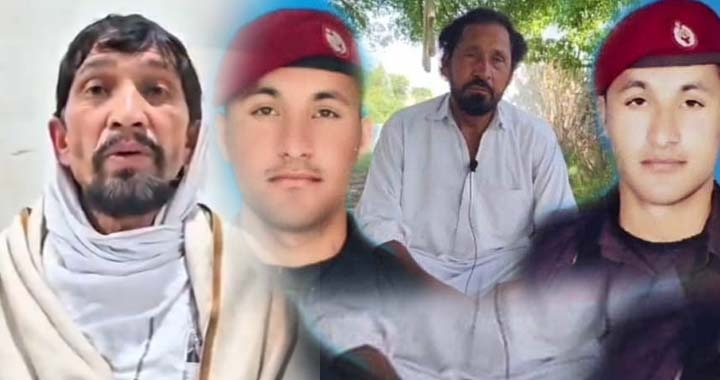
Another resident of Bannu, has publicly disowned his son after the young man joined a militant network, in a stark reflection of the growing social toll of radicalization in the region.
The father, identified as Wazir Rehman dwelling in Domel area, issued a detailed statement announcing complete disassociation from his son, Sohail, declaring that despite repeated efforts to guide him back to the right path, the latter had refused to abandon extremist influences.
“I, Wazir Rehman, announce my disassociation from my son. We tried everything to bring him back, but he did not listen,” the father stated, adding that any actions taken by the state or public against his son would be acceptable to the family.
He further emphasized that neither the family nor the tribe would bear any responsibility for Sohail’s actions, warning the public that the individuals accompanying him would be accountable for his conduct. In an emotional note, the father said his son had been provided with every opportunity, including education and even travel abroad, but ultimately “fell into the hands of others” and chose a destructive path.
Local observers say such declarations reflect the increasing desperation among families whose children are being drawn into militant networks often referred to as Fitna al-Khwarij, a term used by authorities for outlawed extremist group, the banned Tehreek-e-Taliban Pakistan (TTP).
The incident is not isolated. Across Khyber Pakhtunkhwa and parts of Balochistan, particularly in southern districts, multiple families have publicly distanced themselves from relatives involved in militancy, underscoring a wider societal rejection of extremist ideologies.
A pattern of public disownment
Earlier this year in January, another father in Bannu publicly disowned his son, Shakirullah, after he reportedly joined a terrorist organization. Addressing a gathering at a mosque, the father declared under oath on the Quran that the family had no connection with his son’s activities. He went as far as stating that the family would not even claim his body if he were killed while involved in militancy, highlighting the depth of anguish and resolve.
In February, a similar case emerged when Gul Raip Khan, a resident of Painda Khel, announced his disassociation from his son Nazirullah, who had allegedly been involved with a proscribed group for nearly ten months. Struggling financially and residing in a rented home, the father said he had exhausted all efforts to bring his son back but ultimately chose to stand with the state and society over blood ties.
Authorities and security experts view such public declarations as a powerful societal pushback against extremism, sending a clear message that militant recruitment not only threatens national security but also fractures families and communities.
A different face of Bannu, sacrifice and pride
Yet, Bannu tells another story too, one not of loss through estrangement but of sacrifice etched with honor.
In Kot Qalandar, a quiet locality in Bannu, lives Nawab Ali Khan, whose life reflects resilience forged in the crucible of loss. His two sons, Anwar and Shah Mahmood, both served in the Khyber Pakhtunkhwa Police and were martyred in separate attacks, one in 2009 and the other in 2020.
Anwar left behind a young widow and an infant daughter. In line with local customs, she later married his younger brother Shah Mahmood, only to be widowed again when he too embraced martyrdom in the line of duty.
Today, Nawab Ali Khan lives with his daughter-in-law and five grandchildren, raising them in a household defined not just by grief but by dignity and pride. Despite the option to remarry, the daughter-in-law chose to remain with the family, helping raise the children of both her late husbands.
“I am proud of my sons, and I am proud of my daughter-in-law,” Nawab says, his voice carrying both sorrow and strength.
Stories like his stand alongside those of fathers who have disowned sons involved in militancy, including cases reported from Karak and Dera Ismail Khan, where parents publicly severed ties with children who joined extremist groups.
Together, these narratives present two sharply contrasting realities emerging from the same soil, one where families are torn apart by radicalization, and another where sacrifice for the nation becomes a source of enduring pride.
Analysts say the contrast underscores a critical truth, that while extremist elements continue to target vulnerable youth using different channel including online platforms, communities across Khyber Pakhtunkhwa are increasingly asserting their rejection of militancy, choosing instead to align with peace, stability, and national integrity.



