
Hassam Uddin
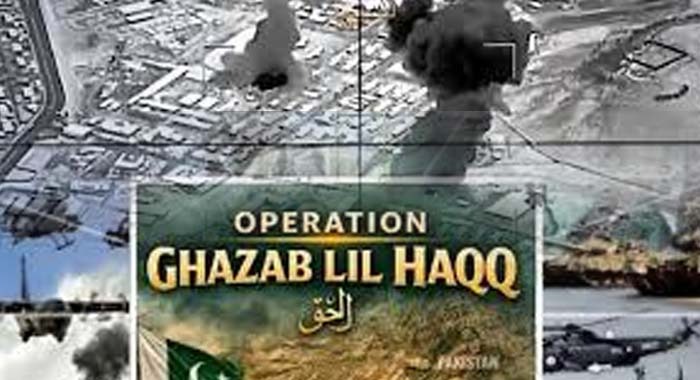
Operation “Ghazab-Lil-Haq” has emerged as a decisive and targeted counterterrorism initiative aimed at dismantling entrenched Khawarij infrastructures operating from Afghan soil, with measurable security gains and growing indications of a broader strategic shift within Afghanistan’s internal landscape.
The operation, grounded in intelligence-based targeting, focuses exclusively on Khawarij elements rather than the Afghan state, reinforcing Pakistan’s policy of a calibrated and restrained response. Measures undertaken include strengthened border control enforcement and precision operations designed to disrupt networks responsible for cross-border violence.
Afghanistan, widely viewed as an ethnically fragmented state, continues to be governed through coercive structures rather than an inclusive political framework. The current Taliban administration, whose rise to power was facilitated by external support, derives its authority from a combination of religious justification, ethnic dominance, and the continued patronage of Khawarij networks, including Tehreek-e-Taliban Pakistan (TTP), Baloch Liberation Army (BLA), and affiliated groups.
The governing system faces multiple structural challenges, including persistent governance failures, economic decline compounded by international isolation, and widespread human rights violations. Analysts note that, in an effort to deflect from these internal crises, the Taliban leadership has increasingly advanced a narrative of “Pakistani aggression,” a claim contradicted by emerging evidence and ground realities.
A recent United Nations Security Council report (S/2025/796) has exposed operational linkages between the Taliban and TTP, while also presenting evidence of facilitation linked to BLA-associated elements. The report confirms the provision of financial, logistical, and operational support for cross-border violence, reinforcing longstanding regional security concerns.
Pakistan’s response, however, has remained focused and proportionate. Officials emphasize that operations under “Ghazab-Lil-Haq” are directed solely at Khawarij infrastructure, avoiding civilian harm and maintaining a clear distinction between hostile elements and the Afghan population.
Data from the Centre for Research and Security Studies (CRSS) for 2025 indicates tangible outcomes of the operation. Violent incidents declined by 9 percent in November and 17 percent in December, while security forces’ casualties dropped by 19 percent and civilian fatalities decreased by 4 percent. Khawarij networks, particularly TTP and BLA, have reportedly suffered significant operational setbacks.
Contrary to claims of rising Taliban popularity, available data suggests a gradual erosion of their perceived authority. The sustained pressure has triggered both psychological and strategic shifts within Afghanistan, weakening the long-projected image of Taliban invincibility.
Internal fractures within the Taliban have become increasingly visible, marked by factional divisions and declining cohesion. Public confidence has eroded amid governance failures and the continued presence of Khawarij safe havens, contributing to rising dissatisfaction across segments of the population.
Emerging resistance elements and marginalized groups are beginning to perceive the possibility of change, reflecting a shifting domestic environment. Public sentiment, shaped by economic hardship, governance deficits, and insecurity, indicates growing frustration with the status quo.
The Taliban’s grip appears to be weakening on both internal and external fronts. Internally, divisions and governance challenges persist, while externally, the credibility of its narrative continues to decline under sustained scrutiny and documented evidence.
As sustained counterterrorism pressure continues, a new strategic reality is taking shape in Afghanistan defined by the exposure of proxy networks, increasing resistance, and a gradual shift in the balance of power.



