
Prime Minister Mian Shehbaz Sharif’s visit to Qatar carries significant strategic importance, as Qatar has historically played a central role in facilitating diplomatic and regional security efforts in South and Central Asia. Doha previously hosted the Afghan Taliban’s political office and was the venue for negotiations between Taliban representatives and the United States, culminating in the Doha Agreement that paved the way for Taliban control over Kabul. While Pakistan participated in these processes, Qatar’s centrality in facilitating the Taliban’s political rise cannot be overlooked. Beyond political engagements, Pakistan and Qatar maintain robust economic and trade relations, providing further context to the Prime Minister’s visit.
During his visit, Prime Minister Sharif met with Sheikh Saud bin Abdulrahman Al Thani, Qatar’s Deputy Prime Minister and Minister of State for Defense Affairs. The leaders discussed defense and security cooperation, with Pakistan reaffirming its commitment to strengthening military collaboration and bilateral strategic partnership. Regional developments, including the situation in Iran and Afghanistan, were also reviewed.
While diplomatic efforts continue, Afghanistan remains a persistent epicenter of terrorism. The Taliban regime has allowed extremist groups, nationalist militants, and organized criminal networks to operate freely, undermining regional security. These groups rely on illicit financial networks to procure modern weaponry, fuel, and other resources, often under the supervision or tacit approval of Taliban authorities. Such networks have enabled the Taliban to maintain operational control and sustain extremist activities.
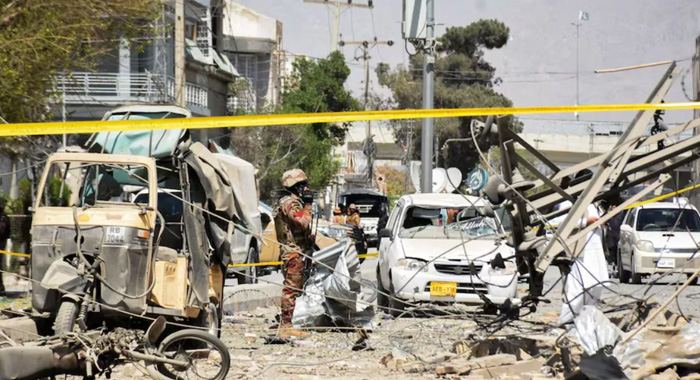
Recent terrorist incidents highlight the ongoing threat to Pakistan. On Shakardara Road, Kohat, a brutal attack targeted a police mobile unit, killing Deputy Superintendent of Police Asad Mehmood, four officers, and two civilians, while three officers were injured. The attack involved setting fire to a police vehicle, including the immolation of a wounded officer, mirroring the tactics seen in the 2022 Karak tragedy. In addition, unidentified assailants destroyed a government girls’ school in Lower South Waziristan, rendering the building completely unusable, while police constable Attaullah was shot dead in Wana, the district headquarters of South Waziristan.
Along the Pakistan-Afghanistan border, security forces report intermittent crossfire at multiple points, including Bazaar Zakhakhel, Waragha, Maro Sar, and Shakot, with both sides employing heavy weaponry. Pakistan’s Foreign Media Spokesperson, Mushtaq Zaeedi, confirmed that Afghan Taliban forces have engaged in unprovoked firing at border areas in Khyber Pakhtunkhwa, including Torkham and Tirah. Pakistani forces have responded decisively to repel these aggressions.
Afghanistan’s Taliban regime continues to collaborate with terrorist networks to conduct attacks within Pakistan. Analysts emphasize that the ongoing threat underscores the necessity of national unity and a political consensus that transcends party lines to counter Afghan-sponsored terrorism. The Pakistani public fully supports security forces in their fight against extremist groups.
A recent report from the Russian Ministry of Foreign Affairs highlights that Afghanistan hosts 20,000–23,000 militants, over half of whom are foreign fighters. Among them, 3,000 ISIS-K militants and 5,000–7,000 TTP operatives are based in Afghanistan, with the latter primarily focused on attacks inside Pakistan. Al Qaeda and other groups maintain training centers and regional networks across provinces including Ghazni, Laghman, Kunar, Nangarhar, Nuristan, Parwan, and Uruzgan. ISIS-K has established strongholds in eastern and northern Afghanistan with long-term ambitions extending into Central Asia.
The report also raises concerns over Afghanistan’s increased production of synthetic drugs, which are extensively smuggled internationally, further destabilizing the region. Combined with ongoing insurgency and Taliban-backed extremist activity, these dynamics continue to complicate Afghanistan’s security and political situation, posing a direct threat to regional peace and stability.
Public dissent against the Taliban regime is also growing within Afghanistan. Ethnic, linguistic, and cultural communities reject the Taliban’s authoritarian rule and their extremist policies, with internal opposition movements increasingly challenging the regime’s legitimacy.
In conclusion, the ongoing provocations and support for terrorism emanating from Afghanistan underscore the urgency for Pakistan to maintain vigilance, strengthen security measures, and protect its national integrity. Combating the Taliban-backed networks remains a top priority for Pakistan’s security apparatus and the nation as a whole.



