
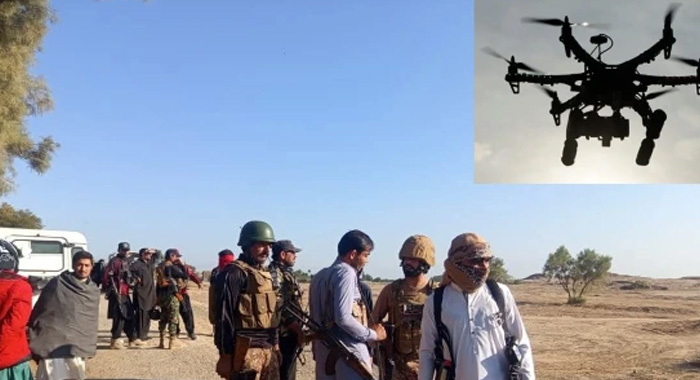
The Government of Pakistan strongly condemns the cowardly and highly coordinated terrorist attack targeting a Frontier Constabulary (FC) fort in District Karak, Khyber Pakhtunkhwa. The attack, executed through a quadcopter drone strike followed by direct firing and the deliberate targeting and burning of ambulances carrying injured personnel in the Bahadar Khel area, represents not merely an act of terrorism but a calculated manifestation of a technologically evolving and multi-dimensional hybrid war being waged against Pakistan.
The sequence of events beginning with the deployment of an armed drone against a security installation and culminating in the heinous targeting of medical evacuation vehicles reflects a level of coordination, technical capability, and operational planning that extends beyond isolated militant action. The deliberate assault on ambulances constitutes a grave violation of humanitarian norms and the most basic principles of armed conflict, underscoring the moral bankruptcy of the perpetrators.
Simultaneously, in District Dera Ismail Khan, security forces conducted a successful intelligence-based operation resulting in the elimination of four Khawarij. Initial investigations have revealed links between the neutralized elements and an Indian proxy network, further illuminating the broader strategic design behind the resurgence of terrorist activity in the region.
These developments reinforce Pakistan’s longstanding position that the terrorism it faces is not merely the product of internal instability but part of an organized proxy strategy aimed at undermining national security, destabilizing the economy, and eroding public confidence in state institutions. The increasing use of commercial quadcopters and other low-cost yet effective technologies to target forts and checkpoints indicates that terrorist groups are receiving training, logistical facilitation, and financial backing from external actors.
Such technology is neither spontaneously nor locally acquired at scale; it requires structured support systems, funding channels, and operational guidance. Pakistan has repeatedly expressed concern regarding hostile intelligence agencies, particularly India’s Research and Analysis Wing (RAW), operating to foment instability in the region.
The situation in Afghanistan remains central to this security calculus. Following the 2021 change of power in Kabul and commitments made under the Doha framework, assurances were provided that Afghan soil would not be used against any other state. However, ground realities present a more complex picture. The continued presence of banned terrorist outfits, criminal syndicates, narcotics networks, and unregulated cross-border movement in certain border regions has created conditions conducive to regrouping and operational freedom for hostile elements.
Safe havens across the border provide strategic depth to terrorist organizations seeking to exert pressure on Pakistan at relatively low cost. This proxy model is not confined to military objectives; it also pursues political and economic disruption. Projects of national and regional importance, including the China-Pakistan Economic Corridor, represent transformative economic opportunities. Attacks designed to undermine investor confidence, delay development initiatives, and increase security expenditures reveal an intent to weaken Pakistan’s economic trajectory.
At the same time, Pakistan acknowledges that external aggression is compounded by internal vulnerabilities. Terrorism finds space where local facilitation exists whether driven by ideological sympathy, coercion, financial inducement, or governance gaps. Poverty, unemployment, and limited access to education in certain regions create exploitable conditions for extremist recruitment. A comprehensive counterterrorism strategy must therefore integrate military operations with socio-economic uplift, community engagement, and institutional accountability.
The National Action Plan achieved significant early successes in choking terrorist financing, countering hate speech, and reforming regulatory oversight. However, the evolving nature of the threat demands renewed momentum and modernization. Terrorist networks increasingly exploit cyber platforms, encrypted communications, informal financial systems, and emerging technologies. Pakistan is committed to enhancing counter-drone capabilities, strengthening intelligence fusion mechanisms, deploying advanced surveillance systems, and improving data analytics to preempt emerging threats.
Regional diplomacy remains a critical pillar of Pakistan’s response. Constructive engagement with Afghan authorities on border management, intelligence sharing, and decisive action against proscribed organizations is indispensable for sustainable peace. The international community must also recognize that instability in this region transcends national boundaries and poses broader risks to global security.
Equally vital is the battle of narratives. Terrorism seeks not only physical destruction but psychological impact. The spread of disinformation and propaganda through social media platforms amplifies fear and division. The state will continue to ensure transparency, timely dissemination of verified information, and collaboration with scholars, educators, and community leaders to counter extremist ideologies and protect vulnerable segments of society.
Pakistan has made unparalleled sacrifices in its struggle against terrorism and has achieved substantial gains through resilience, unity, and strategic clarity. The recent incidents in Karak and Dera Ismail Khan serve as a stark reminder that adversaries are adapting their tactics and escalating through hybrid methods.
The response must therefore be equally comprehensive integrating military vigilance, diplomatic assertiveness, economic resilience, technological advancement, and social cohesion. National security cannot be viewed in isolation; it is intrinsically linked to economic stability, political unity, and societal strength.
Pakistan remains resolute. With unity of purpose, institutional coordination, and sustained strategic vision, the current wave of terrorism like those before it will be defeated.



