
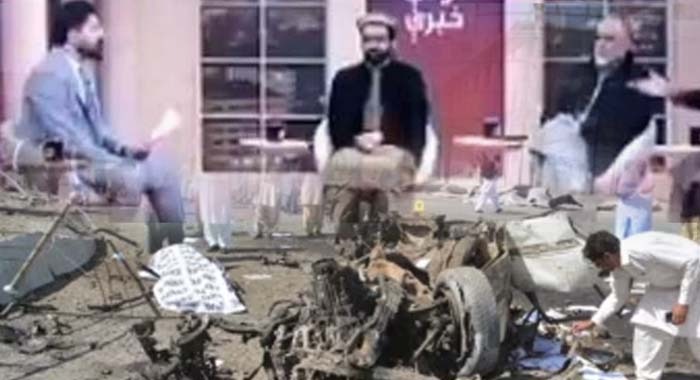
Televised incitement against Pakistan by figures operating from Afghan soil is no longer an episodic irritant, it is fast crystallizing into a strategic pattern that Islamabad, and increasingly international observers, cannot afford to read as rhetorical excess.
When anti-Pakistan rhetoric graduates from fringe pamphlets and encrypted channels to televised platforms, the shift is not cosmetic, it is institutional. Broadcast space in Afghanistan today is neither ideologically neutral nor administratively autonomous. Messaging aired repeatedly, openly, and without consequence reflects, at minimum, permissive oversight, and at worst, ideological concurrence within segments of the Taliban’s governing ecosystem.
The immediate concern is not merely the language of violence, but the normalization of it. Televised calls create layered effects. They legitimize hostility, recruit emotional consent, and signal operational encouragement to groups already aligned against Pakistan, most notably the Tehreek-e-Taliban Pakistan (TTP).
Islamabad’s long-standing position, that Afghan soil is being used by anti-Pakistan militant networks, draws fresh evidentiary oxygen from such broadcasts. Incitement aired in public view weakens Kabul’s repeated diplomatic assurances that its territory will not be allowed to threaten neighboring states.
This contradiction between commitment and conduct is now widening, not narrowing.
From Tactical Silence to Strategic Signaling
For years, the Afghan Taliban calibrated their posture through plausible deniability. Militant spillover into Pakistan was framed as unmanaged legacy fallout of decades of war. Command and control fragmentation was cited as administrative limitation rather than political choice.
Televised incitement punctures that deniability shield.
When messaging advocating violence travels through regulated media channels, the argument of invisibility collapses. The issue transitions from inability to unwillingness, from governance gap to strategic signaling.
This signaling operates on multiple frequencies:
To TTP factions:
Moral endorsement without formal acknowledgement.
To domestic Afghan hardliners:
Ideological purity remains intact despite diplomatic engagement.
To Pakistan:
Pressure levers exist beyond formal statecraft.
To international observers:
Commitments may be negotiable instruments, not binding obligations.
Psychological Battlespace Expansion
Militancy today is not confined to physical terrain. It thrives equally in psychological theatres.
Televised rhetoric expands the battlespace in three ways:
Narrative Legitimacy
Violence is reframed as resistance rather than terrorism.
Recruitment Multiplier
Broadcast messaging reaches impressionable demographics faster than clandestine networks ever could.
State Image Erosion
Pakistan is cast as an adversarial construct, feeding grievance ecosystems militants depend upon.
In this sense, the screen becomes a staging ground, a pre-kinetic theatre where consent for violence is manufactured before violence itself is executed.
Kabul’s Commitment Deficit
Since August 2021, Kabul’s interim authorities have issued repeated assurances to regional states, including Pakistan, China, and Central Asian republics, that Afghan territory would not host or enable transnational militancy.
Yet three parallel realities persist:
TTP leadership presence inside Afghanistan remains widely reported.
Cross-border attacks into Pakistan continue with operational sophistication.
Anti-Pakistan propaganda flows with minimal regulatory friction.
Televised incitement therefore compounds an already strained credibility ledger.
Diplomacy operates on trust capital. Each hostile broadcast debits that capital further.
TTP’s Strategic Comfort Zone
For the TTP, such media space functions as oxygen.
It provides:
Ideological validation
Psychological reinforcement
Recruitment amplification
Strategic depth perception
Even absent direct logistical support, narrative sanctuary can be as valuable as physical sanctuary.
When militants sense ideological sympathy in host environments, their risk calculus shifts. Operational boldness rises. Negotiation incentives fall. Violence becomes communicative theatre rather than clandestine tactic.
Regional and Multilateral Echo
The implications are not bilateral alone.
Global forums, including the United Nations, as well as regional blocs increasingly attentive to militant mobility, already monitor Afghanistan’s counter-terror commitments with caution.
Televised incitement complicates Kabul’s case for international legitimacy, sanctions relief, and economic engagement.
States assessing diplomatic normalization weigh not only counter-terror actions, but counter-terror intent. Broadcast hostility undermines arguments that Afghan authorities are evolving toward responsible state behavior.
Pakistan’s Strategic Dilemma
Islamabad faces a layered response challenge:
Diplomatic engagement risks appearing tolerant of hostile signaling.
Coercive posturing risks border escalation.
Economic levers remain limited given Afghanistan’s fragility.
Kinetic options carry regional and humanitarian costs.
Thus, televised incitement corners Pakistan into a reactive grid while granting deniability buffers to Kabul.
The Credibility Crossroads
Ultimately, the issue converges on one axis: credibility.
If Kabul seeks functional regional integration, access to financial systems, and political recognition, it must align broadcast ecosystems with diplomatic commitments.
Failure to regulate televised incitement communicates either incapacity or complicity. Neither reassures neighbors. Neither strengthens Afghanistan’s international case.
Conclusion Pivot
Televised calls for violence are not background noise; they are policy shadows cast in public light.
They test Kabul’s willingness to move from ideological fraternity with militant actors toward responsible state conduct. They test Pakistan’s patience threshold. And they test the international community’s readiness to accept assurances unaccompanied by enforcement.
In modern conflict theatres, wars begin long before bullets travel. Sometimes, they begin with words spoken into cameras, carried by transmitters, and received as signals far more strategic than they appear.



