
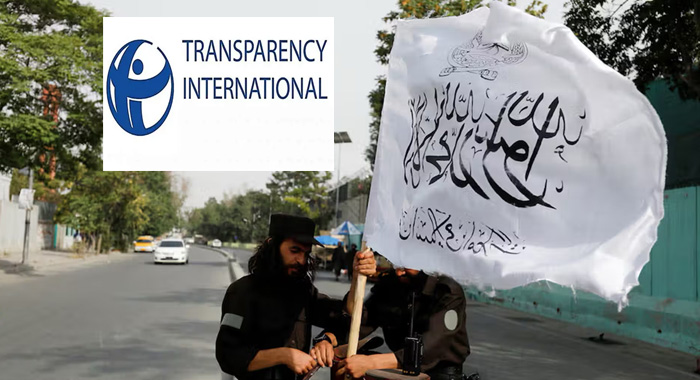
Afghanistan has once again been ranked among the most corrupt countries in the world, according to the 2025 Corruption Perceptions Index (CPI) released today by Transparency International, the leading global anti‑graft watchdog. The report reveals that under the current administration, the country’s perceived level of public‑sector corruption has deteriorated further, underscoring deep‑seated governance challenges and weak institutional oversight.
The CPI, which assesses perceived public‑sector corruption across 182 countries and territories on a scale from 0 (highly corrupt) to 100 (very clean), placed Afghanistan at 169th with a score of just 16 out of 100 in the 2025 rankings a decline from 17 points and 165th place in the previous year. This marks a continuing downward trend over recent years, as the country scored 20 and 24 points in 2023 and 2022 respectively.
Transparency International’s annual CPI report shows that corruption remains a pervasive threat worldwide with the global average score falling to 42 out of 100, the lowest in more than a decade. A striking 122 out of 182 countries scored below 50, indicating widespread public‑sector corruption, while only five countries achieved scores above 80 a significant drop from 12 just ten years ago.
Despite its rich cultural heritage and strategic importance, Afghanistan’s governance structures continue to face severe strains. Transparency International highlighted several systemic weaknesses contributing to its poor ranking, including limited civic space, opaque political‑financing mechanisms, weak checks and balances, and the absence of independent judicial institutions conditions that leave the country exceptionally vulnerable to corrupt practices.
The global report notes that countries which restrict civic freedoms often struggle to control corruption effectively. Among the 50 nations with the steepest CPI declines, 36 have imposed restrictions on civil liberties, impeding transparency and civic oversight. Additionally, more than 90 percent of journalists killed while investigating corruption were from countries with low CPI scores, underscoring the grave risks faced by those who challenge entrenched corruption.
While Afghanistan remains near the bottom of the global corruption index, the CPI also highlights worrying trends in established democracies. Nations including the United States, Canada, the United Kingdom, France, and Sweden have all experienced declines in their CPI scores, demonstrating that corruption risks can rise even where institutions once appeared stable and resilient.
The Corruption Perceptions Index 2025 underscores the urgent need for robust governance reforms, protection of independent media, and strengthened judicial systems worldwide. Transparency International calls on governments to improve transparency in political financing, safeguard civic space, and enhance oversight of public services and expenditures to combat corruption more effectively.
As Afghanistan grapples with profound challenges in governance and public accountability, the CPI findings spotlight the imperative for sustained efforts by both domestic and international stakeholders to support institutional reforms, promote transparency, and build resilient systems that can resist corruption’s corrosive effects.



