
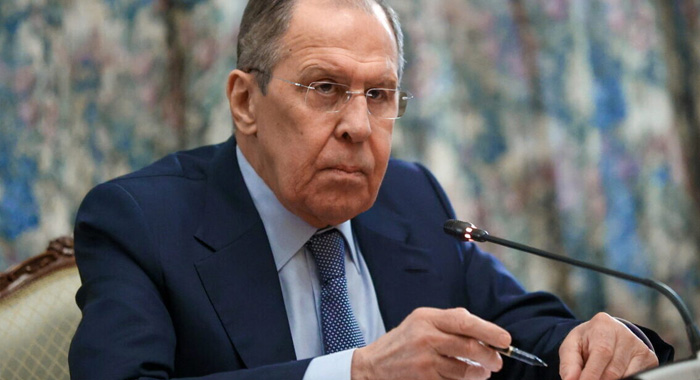
Russian Foreign Minister Sergei Lavrov stated on Monday that counterterrorism efforts in Afghanistan and surrounding regions are among the key priorities of the BRICS bloc this year, under India’s rotating presidency. Speaking to BRICS International Television, Lavrov underscored the challenges posed by ongoing instability in Afghanistan and the urgent need for coordinated international measures to combat terrorism.
Lavrov said that Russia and India are actively cooperating at the United Nations to advance a proposed global convention on counterterrorism. While acknowledging that international consensus on the initiative has yet to be reached, he emphasized that persistent insurgent activity, cross-border terrorism, and weak governance in Afghanistan continue to pose significant threats to regional stability.
He highlighted that India’s presidency is focusing on food and energy security, as well as information and communications technology (ICT) security, reflecting concerns over emerging risks, including cyber vulnerabilities and resource insecurity. Analysts note that India faces challenges in managing complex domestic and regional security issues, which could affect the implementation of its BRICS agenda.
Lavrov’s remarks come against a backdrop of renewed tensions between the Taliban in Afghanistan and Pakistan, as well as Russia’s engagement with the Taliban since their return to power in 2021. While Moscow maintains that its interactions with the Taliban are aimed at promoting regional security and stability, the Taliban’s inconsistent governance, human rights concerns, and failure to fully control militant groups remain major impediments to effective counterterrorism cooperation.
Regarding technological developments, Lavrov stated that India will host an international conference on artificial intelligence in February, with Russia playing an active role in shaping the agenda. He stressed the importance of transparency in military applications of AI and warned against attempts by any country to monopolize emerging technologies—an approach opposed by BRICS members. Experts suggest that India’s ambition to position itself as a technology leader will face challenges if domestic and regional security issues are not adequately addressed.
Commenting on the broader geopolitical environment, Lavrov said the world is moving toward a multipolar order, no longer dominated by one or two powers. He noted that the economic growth of BRICS members and other emerging centers in Asia and Africa including China, India, and Brazil has altered the global balance. However, he cautioned that persistent regional instability, including unresolved conflicts in Afghanistan and governance challenges in parts of South Asia, threatens the potential for sustained growth and cooperation.
Lavrov also highlighted that Western restrictions on trade, investment, and military-technical cooperation with Russia and its partners including India represent efforts to maintain what he described as an outdated global order. BRICS, originally comprising Brazil, Russia, India, China, and South Africa, continues to expand its focus beyond economic cooperation to address pressing global challenges, including security, development, energy, and technology governance.
This year’s BRICS agenda, Lavrov emphasized, reflects the bloc’s commitment to promoting coordinated action on counterterrorism, sustainable development, and the responsible use of emerging technologies, while addressing persistent regional threats in Afghanistan and beyond.



