
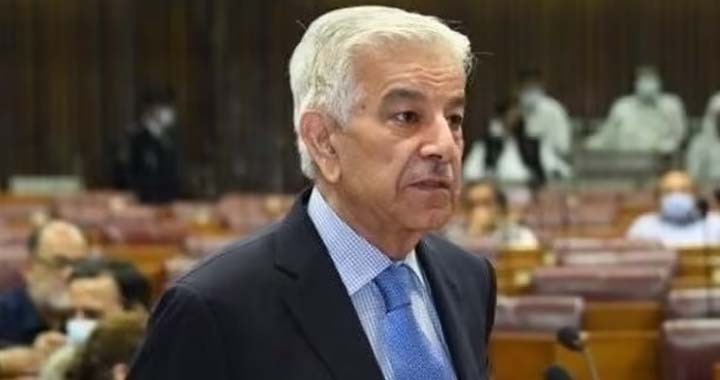
Federal Defense Minister Khawaja Asif has said that the perpetrators of the 9/11 attacks have still not been conclusively identified, stressing that no Afghan, Pashtun, or Hazara individual was involved in the incident, yet Pakistan fought what he described as a “rented war” in its aftermath and was later abandoned.
Speaking during a session of the National Assembly, the defense minister said he did not have major disagreements with remarks made by the opposition leader and Raja Pervaiz Ashraf. Reflecting on past Pakistan-Afghanistan relations, he noted that there was a time when travel between the two countries did not require visas, and people crossed on permits, adding that he himself had visited Afghanistan without a visa.
Khawaja Asif said Pakistan became a party to two wars fought on Afghan soil. He stated that the Soviet Union had entered Afghanistan at the invitation of Kabul’s government, arguing that the conflict that followed was not a jihad in the conventional sense.
He further said Pakistan has yet to restore its original academic curriculum, claiming that the country altered its historical narrative over time. “The Americans left us, but we still did not learn,” he remarked.
The defense minister reiterated that Afghanistan did not orchestrate the 9/11 attacks, but Pakistan continued to fight a proxy war afterward. He said one individual, in a bid to please the United States, turned Pakistan into a frontline state. He repeated that despite no Afghan, Pashtun, or Hazara involvement in 9/11, Pakistan remained available for hire for nearly two decades.
He stressed that Pakistan cannot move forward without acknowledging past mistakes, adding that the war in Afghanistan was that of a superpower, not Pakistan’s own war, and that the country was ultimately used and discarded.
Khawaja Asif also told the assembly that he had previously apologized in the same house for actions taken by his father, adding that he did not know what Ijaz-ul-Haq had said about him on the floor.
Referring to the founding principles of Pakistan, he said Quaid-e-Azam Muhammad Ali Jinnah had emphasized unity, faith, and discipline, but the sequence and spirit had since been distorted. He criticized the practice of naming roads after foreign invaders and questioned why Pakistan does not recognize its own national heroes as heroes.



