
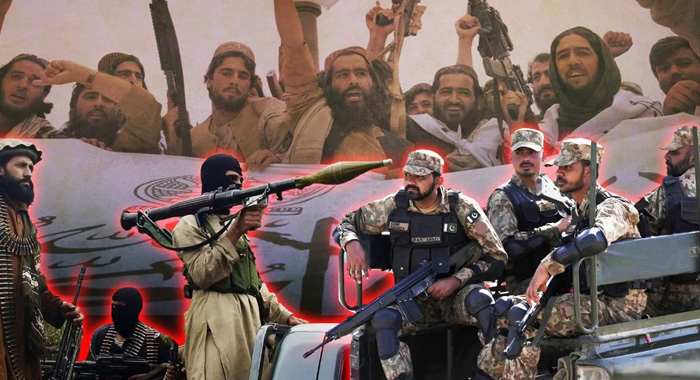
Terrorism continues to pose one of the most serious and complex challenges to the Islamic Republic of Pakistan, threatening national security, political stability, and social cohesion. Despite sustained efforts through political, administrative, security, and counter-narrative strategies, violent extremism and terrorism remain persistent dangers within the country’s political and societal landscape.
Security analysts and policy experts widely agree that Pakistan must adopt a comprehensive, multi-dimensional, and self-reliant political and security strategy to effectively confront terrorism. This challenge not only raises critical questions about existing national policies but also demands renewed strategic thinking and decisive action.
Pakistan’s struggle against terrorism is not solely an internal issue. It is deeply connected to regional geopolitics and cross-border dynamics, particularly involving militant organizations such as Tehrik-e-Taliban Pakistan (TTP), Balochistan Liberation Army (BLA), and ISIS-Khorasan (ISIS-K). These groups continue to directly threaten Pakistan’s stability and security and are widely assessed to receive external support and patronage, especially from hostile elements operating from Afghan territory with backing from India.
The strengthening of India-Afghanistan strategic coordination, largely driven by hostility toward Pakistan, has emerged as a serious concern not only for Pakistan but also for broader regional stability. A significant number of terrorist attacks within Pakistan originate from across the Afghan border, posing grave challenges to regional peace and security.
Pakistan continues to face serious diplomatic challenges with Afghanistan, particularly due to Kabul’s consistent disregard for Pakistan’s security concerns. Afghan soil has increasingly been used by terrorist groups to plan and execute attacks against Pakistan, with evidence pointing toward tacit or direct state-level facilitation of anti-Pakistan militant activity.
India, as a major regional power with strong influence in Afghanistan, has played a critical role in enabling and supporting these destabilizing activities. Recent large-scale terrorist incidents in Khyber Pakhtunkhwa and Balochistan serve as a stark warning that both provinces are facing a de facto state of conflict, where militant networks operate with cross-border sanctuaries. These developments underline the urgent need for new political, administrative, and security strategies tailored to the unique realities of these regions.
On the diplomatic front, Pakistan possesses significant emerging opportunities. Recent diplomatic engagements indicate growing space for proactive and evidence-based diplomacy. At the global level, engagement with countries such as the United States, United Kingdom, Germany, and France, and at the regional level with China, Russia, Saudi Arabia, Qatar, and Türkiye, is essential to build consensus against terrorism and expose the India-Afghanistan nexus supporting militant groups.
Pakistan must pursue an active, data-driven diplomatic strategy, grounded in credible evidence rather than emotional rhetoric. Leveraging the expertise of former diplomats and engaging international and regional forums will be crucial in building sustained pressure against state-sponsored terrorism and ensuring accountability.
At the same time, Pakistan must consistently advocate for the establishment of a regional counter-terrorism mechanism, where all states including Pakistan and India are held accountable and commit to collective cooperation to eliminate terrorism.
Domestically, Pakistan must prioritize national consensus and internal cohesion. Over the years, several frameworks and initiatives have been introduced, including the National Security Policy, National Action Plan, Paigham-e-Pakistan, National Counter Terrorism Policy, cybercrime legislation, and Counter-Terrorism Department (CTD) led Centers of Excellence on Countering Violent Extremism (CVE) in provinces such as Punjab and Khyber Pakhtunkhwa.
However, effective counter-terrorism requires a two-pronged approach. First, a political, intellectual, and ideological strategy focused on eliminating extremism, countering violent narratives, and promoting a unified national discourse in the supreme interest of the state. Second, a robust administrative and security response, with unwavering support for Pakistan’s security institutions.
A critical challenge in Khyber Pakhtunkhwa and Balochistan remains weak governance, fragile justice systems, absence of effective local governments, socio-economic deprivation, and denial of basic rights, all of which have created environments vulnerable to militant exploitation. Additionally, ongoing political deadlock and mistrust between the federal government and local political leadership further complicate the security response.
Addressing terrorism in these provinces requires distinct, region-specific strategies, stronger civil-military coordination, and enhanced cooperation between federal and provincial governments, intelligence agencies, and law-enforcement institutions. Resolving political disputes and strengthening governance structures are essential prerequisites for sustainable security.
Long-term success against terrorism depends on investing in future generations. Comprehensive reforms in education systems from primary to higher education, including religious seminaries media and digital literacy, curriculum development, teacher training, and constructive engagement with religious scholars must form the foundation of Pakistan’s counter-extremism strategy.
Ultimately, Pakistan must carefully balance its political, security, and defense policies, while reducing excessive external dependence and strengthening indigenous solutions. This is a war that Pakistan must confront and resolve on its own terms.
The fight against terrorism is Pakistan’s own battle and winning it is essential for the nation’s survival, stability, and future



