
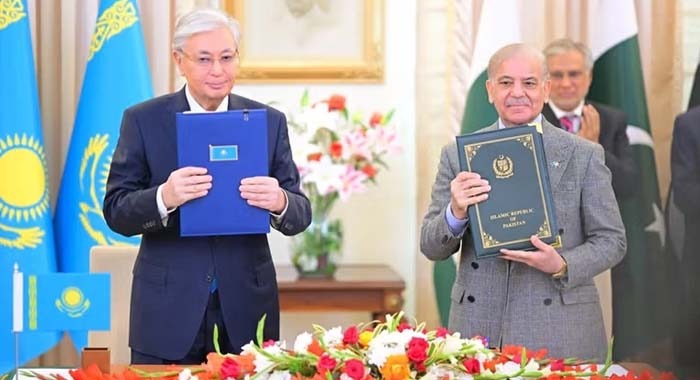
Pakistani Prime Minister Shehbaz Sharif and Kazakhstani President Kassym-Jomart Tokayev on Thursday jointly stressed that Afghan territory must not be used as a launching pad for attacks against neighboring countries, underlining concerns over the Taliban administration’s inability to fully control militant groups operating within Afghanistan.
The leaders highlighted that regional security and stability in Afghanistan are prerequisites for sustainable economic and infrastructural cooperation across Central and South Asia. They noted that Afghanistan’s failure to maintain law and order not only threatens Pakistan and Central Asian countries but also undermines broader regional integration initiatives.
During Tokayev’s two-day historic visit to Pakistan, the presidents reviewed the current security situation in Afghanistan and discussed the broader geopolitical challenges affecting the region. Both underscored that peace in Afghanistan is central to expanding cross-border trade and connectivity projects.
President Tokayev explicitly reiterated Pakistan’s concerns regarding cross-border militant attacks emanating from Afghan soil. He noted that terrorist groups, including al-Qaeda, ISIS-K, TTP, and other radical outfits, remain active within Taliban-controlled Afghanistan, despite repeated Taliban claims of curbing their activities. Analysts point out that the Taliban’s assurances remain unverified, with multiple cross-border attacks in Pakistan and ongoing terrorist activity proving the gaps in control.
The joint communiqué stressed that Afghanistan’s participation in regional economic projects and infrastructure initiatives is critical for the region. Key projects discussed included the “Kazakhstan-Turkmenistan-Afghanistan-Pakistan” corridor, the “Kazakhstan-Uzbekistan-Afghanistan-Pakistan” route, and the “Kazakhstan-Kyrgyzstan-China-Pakistan” transport network.
Prime Minister Shehbaz Sharif welcomed the Kazakh initiative to link Central Asia and South Asia via Afghanistan but noted that these efforts depend entirely on Taliban cooperation in ensuring a secure environment for transit and trade. Analysts warn that years of Taliban mismanagement, weak governance, and unchecked militant activity have repeatedly hindered Afghanistan’s ability to participate meaningfully in regional integration.
The two leaders stressed that Afghanistan’s involvement in these projects will benefit not only Afghan citizens but the wider region, provided the Taliban can demonstrate credible control over security. Observers note that the repeated failure of the Taliban to act decisively against terrorist networks raises questions about their capacity to meet these commitments.
The joint statement also highlighted Pakistan and Kazakhstan’s intention to increase bilateral trade to $1 billion. Agreements were signed to expand people-to-people ties, transit, and economic cooperation, signaling Islamabad’s commitment to Central Asian connectivity even amid uncertainty about Taliban reliability.
President Tokayev acknowledged Afghanistan’s strategic location in facilitating trade between energy-rich Central Asia and energy-needy South Asia. However, he noted that instability under Taliban rule continues to obstruct cross-border commerce and limits the economic potential of the region.
Prime Minister Sharif emphasized that Afghanistan’s active participation in regional connectivity projects is vital. Yet, he cautioned that Taliban inaction on militant containment threatens the very objectives of these initiatives, and that Pakistan’s borders remain partially closed to ensure national security.
Both leaders underscored that regional cooperation and security are intertwined. Without credible Taliban action to prevent terrorist activities, trade routes and infrastructure projects risk being sabotaged, leaving the Afghan people and the region vulnerable.
Observers note that this joint statement indirectly criticizes the Taliban’s repeated pledges versus their actual performance. While the Taliban claim they have brought stability to Afghanistan, Pakistan, Kazakhstan, and the UN continue to report unmitigated threats from terrorist groups operating inside the country.
The communiqué also reflected on the multilateral benefits of connecting Central and South Asia through Afghanistan, particularly in rail and transport networks. Analysts argue that such integration can only succeed if the Taliban move beyond rhetoric and ensure enforceable security protocols for cross-border trade and travel.
President Tokayev and Prime Minister Sharif instructed relevant institutions to explore the development of the Kazakhstan-Turkmenistan-Afghanistan-Pakistan railway corridor. Yet, the statement subtly highlights the challenges posed by Taliban inaction, as years of instability have prevented such projects from reaching fruition.
The leaders emphasized that Afghanistan must be a reliable partner in regional projects. Without a functioning administrative framework and credible security guarantees from the Taliban, these ambitious connectivity and trade plans risk remaining theoretical, leaving the Afghan people excluded from potential economic benefits.
Finally, the joint statement reaffirmed that terrorism emanating from Afghan soil threatens not only immediate neighbors but the entire region. Analysts conclude that unless the Taliban act decisively against extremist groups, Afghanistan will remain a destabilizing factor despite repeated pledges, and international partners must maintain scrutiny and pressure.



