
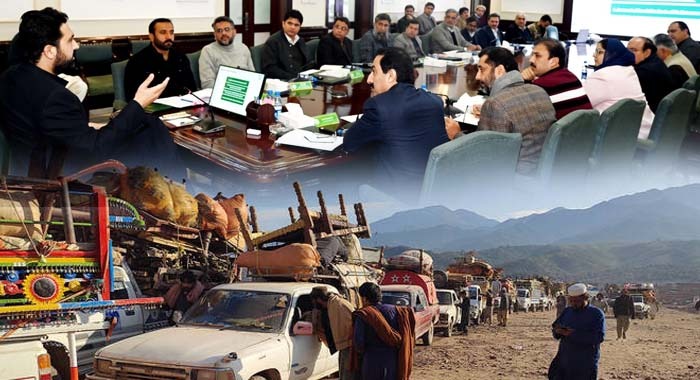
Chief Minister Khyber Pakhtunkhwa Muhammad Sohail Afridi’s latest speech, delivered at a Young Leaders Convention in Peshawar, has reignited serious questions about his government’s credibility, particularly regarding Tirah Valley, internally displaced persons, and the widening gap between public rhetoric and administrative action.
While the chief minister once again assured public gatherings that no military operation would be allowed in Tirah or elsewhere in Khyber Pakhtunkhwa, official records tell a different story. Afridi himself chaired a high-level provincial meeting earlier in which billions of rupees were approved for IDPs, including allocations linked to Tirah. Yet the whereabouts and utilization of these funds remain unexplained.
At the center of the controversy lies a figure the chief minister himself referenced: Rs4 billion allocated for Tirah’s affected population. If this money exists, as Afridi claims, the obvious question follows, where did it go, who authorized its spending, and why are the people of Tirah still displaced, insecure, and unsupported?
Afridi accused the federal government of owing Khyber Pakhtunkhwa Rs4,758 billion and alleged corruption worth Rs5,300 billion at the national level, claiming looted money was being used to buy foreign properties. However, he stopped short of explaining why, during nearly four years of his party’s rule at the center, the same grievances were neither resolved nor even forcefully raised.
The Tirah Question That Refuses to Disappear
The chief minister argued that the administrative merger of the former tribal districts in 2018 was carried out without financial integration, calling it a constitutional violation. Yet critics point out that PTI governed both the federation and the province during the crucial post merger years. If financial integration was truly denied, why was it not enforced when the same party-controlled Islamabad, Peshawar, and key ministries?
More troubling is the pattern emerging in Tirah. Publicly, the provincial leadership denounces operations and portrays itself as a defender of local communities. Privately, it approves massive IDP allocations, a move that implicitly acknowledges displacement, conflict, and state action on the ground. The contradiction is stark, either there are no operation and no displacement, or there is one, and the public is being misled.
Afridi’s dismissal of criticism over the Rs4 billion Tirah allocation as mere “noise” does little to address allegations of mismanagement and corruption. Provincial officials have yet to present transparent breakdowns, audit reports, or timelines explaining how the funds were spent and why affected families continue to complain of neglect.
Political Fire, Administrative Silence
The speech also featured sharp attacks on Punjab, the federal government, and political opponents, including references to alleged political victimization and inflammatory remarks about national leadership. Yet for residents of Tirah and other merged districts, such rhetoric offers little relief from ground realities, insecurity, displacement, and economic paralysis.
Afridi called for a comprehensive and consensus-based counterterrorism policy, a position that contrasts with his party’s repeated resistance to intelligence-based operations and security coordination. Analysts warn that such ambiguity weakens counterterrorism efforts and creates space for militant groups to regroup, particularly along the Afghanistan border.
While announcing an increase in interest free youth loans from Rs3 billion to Rs5 billion and grants for youth organizations, the chief minister urged young people to raise their voices on national issues. What he did not clarify was why similar transparency is missing when it comes to provincial spending, IDP welfare, and Tirah’s unresolved crisis.
As Tirah remains under strain and questions continue to pile up, the provincial government faces a simple but unavoidable demand: answer where the money went, explain why displacement persists, and reconcile speeches with signed files.
Until then, claims of self-respect, constitutionalism, and good governance risk sounding hollow to those still waiting to return home.



