
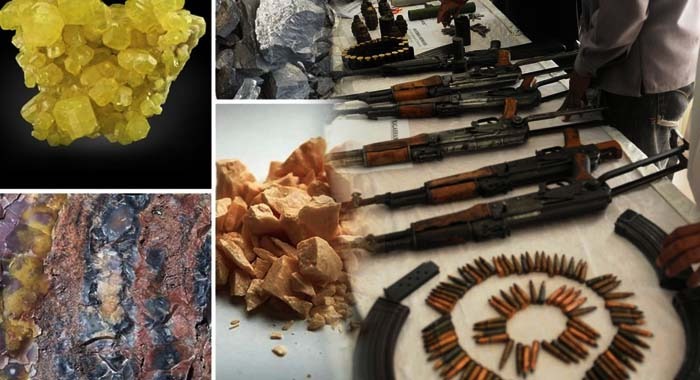
Hundreds of millions of dollars’ worth of copper were extracted last year from the Muhammad Khel Copper Mine and transported to China, underscoring Pakistan’s growing role in the global minerals race and the security risks shadowing it.
According to officials, around 22,000 tons of copper were dug out of the site, one of several mineral-rich locations Pakistan claims form part of an estimated $8 trillion trove of copper, lithium, cobalt, gold, antimony and other critical minerals buried beneath its soil. The vast majority of this wealth lies in remote border regions long plagued by militancy and insurgency.
The promise of mineral-driven economic revival has placed Pakistan at the center of intensifying global competition. China already controls more than 90 percent of the world’s refined rare earth supply, minerals essential for technologies ranging from smartphones to electric vehicles. The United States, seeking to diversify supply chains, has made mineral acquisition a cornerstone of its foreign policy.
In December, the top US diplomat in Pakistan announced that the US Export-Import Bank had approved $1.25 billion in financing to support mining operations at Reko Diq in Balochistan. The move signaled Washington’s strategic interest in Pakistan’s mineral sector, despite the province’s volatile security environment.
Those security risks are growing.
Pakistan’s border regions have witnessed a sharp rise in militant violence since the chaotic US withdrawal from Afghanistan in 2021. Large quantities of American-made weapons were left behind, many of which have since surfaced in Pakistan’s insurgency-hit areas.
During an exclusive visit to some of Pakistan’s most dangerous districts, a CNN team was shown hundreds of US-manufactured rifles, machine guns and sniper rifles seized from militants. According to Pakistani military sources, these weapons include M-16 rifles and M-4 carbines, now in the hands of multiple armed groups.
Approximately 300,000 small arms were left behind in Afghanistan, according to John Sopko, the former Special Inspector General for Afghanistan Reconstruction. Sopko has described Afghanistan as effectively the world’s largest arms bazaar, where weapons can be procured to outfit militant and insurgent groups with ease.
The proliferation of advanced weaponry is directly impacting Pakistan’s mineral ambitions.
Last weekend, militants belonging to the Balochistan Liberation Army launched coordinated attacks across multiple locations, killing 33 people, according to the Pakistani military. Security officials say US-origin weapons have also been recovered from BLA operatives, deepening concerns about the feasibility of large-scale mining projects in the province.
Pakistan recorded more than 1,200 deaths among civilians and security personnel in militant attacks across the country in 2025 alone, according to military data, highlighting the scale of the challenge facing authorities tasked with protecting mineral infrastructure.
Analysts warn that Balochistan represents both opportunity and peril.
“Balochistan is ground zero for critical mineral opportunities, but it’s also ground zero when it comes to militant threats,” said Michael Kugelman, senior fellow for South Asia at the Atlantic Council, speaking to CNN.
Despite the risks, Pakistani officials insist there is no alternative but to push forward.
Army spokesperson Lieutenant General Ahmed Sharif Chaudhry told CNN that Islamabad would secure mineral-rich regions and ensure mining infrastructure meets international standards. “We will resolve it,” he said. “We have no other option.”
For Pakistan, grappling with decades of economic instability and having received 24 International Monetary Fund bailouts since 1958, the stakes could not be higher. The minerals buried beneath its most volatile regions are seen as a potential lifeline, even as the weapons left behind by a war next door continue to fuel the very instability threatening that promise.



