
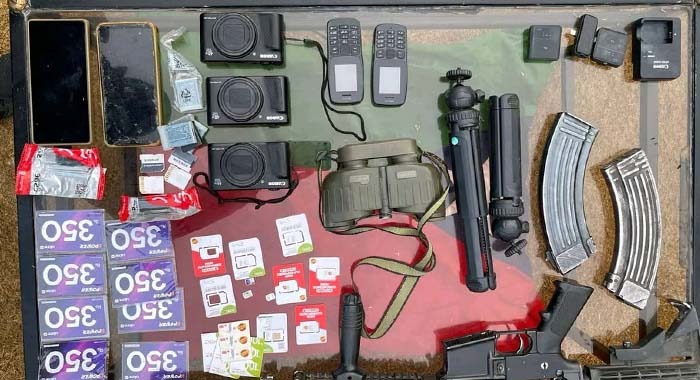
For years the banned terror group, the Balochistan Liberation Army (BLA), has survived not because its narrative was convincing, but because it was rarely examined beyond slogans. The language of “deprivation,” “marginalization,” and “resistance” became a shield behind which an increasingly well-resourced militant enterprise quietly expanded. Recent recoveries of weapons, equipment, and communications gear have punctured that shield beyond repair.
What now lies exposed is not a movement struggling for rights, but a network operating with the logistics, financing, and sophistication of a transnational terror franchise.
The Equipment Does Not Lie
Security forces’ recoveries from recent operations in Nushki and adjoining areas present a reality that no press statement can dilute. An American-origin M4 carbine, RPG-7 warheads, sniper systems, anti-aircraft weaponry, night-vision devices, optical scopes, tactical vests, and high-grade surveillance equipment are not instruments of protest. They are capital investments.
The market value of a single BLA fighter’s kit, conservatively estimated between Rs2.2 million to Rs4 million depending on sourcing routes, collapses the romanticized image of a cash-starved insurgency. This is not accidental accumulation. This is provisioning.
Even more revealing is the inclusion of media-production equipment. Cameras, tripods, memory cards, and recording devices indicate that violence is only half the operation. The other half is narrative engineering, staged attacks designed to be filmed, packaged, and amplified across digital ecosystems.
The battlefield, clearly, extends far beyond Balochistan’s terrain.
Terror as an Economic Model
What distinguishes the current phase of BLA activity is not ideological evolution, but financial maturity. Parliamentary disclosures have laid bare a critical dimension, militant financing through petrol smuggling, exploitation of Afghan Transit Trade, and organized criminal rackets generating billions of rupees.
This matters because it explains behavior.
Groups that depend on ideology avoid criminal exposure. Groups that depend on revenue streams defend them violently. The recent spike in coordinated attacks coinciding with crackdowns on smuggling routes is not coincidence, it is retaliation.
When terror groups begin to resemble cartels, violence becomes transactional. Civilians are no longer collateral damage. They become instruments of pressure.
The Afghanistan Factor, Operational, Not Symbolic
The role of Afghanistan in this ecosystem is often discussed emotionally. It should be discussed operationally.
Statements on the floor of Pakistan’s National Assembly confirmed that the leadership directing violence in Balochistan is not underground in the province. It is external. Planning, coordination, financing, and communication are routed from across the border, where oversight is absent and accountability nonexistent.
This does not require ideological alignment with Afghan Taliban governance. It requires permissive geography, unchecked mobility, and a shared hostility toward Pakistan’s state authority.
In this environment, BLA commanders do not need sanctuaries, they need silence. And silence, so far, has been plentiful.
The Alliance Nobody Wants to Admit
Perhaps the most destabilizing revelation is not about weapons, but partnerships.
Credible reporting, including disclosures by seasoned journalists familiar with militant ecosystems, has pointed to an operational understanding between the banned BLA and the banned Tehreek-e-Taliban Pakistan (TTP). The arrangement is brutally pragmatic.
The BLA brings money, vehicles, weapons, and manpower. The TTP brings training, battlefield experience, and tactical expertise.
This is not ideological convergence. It is market logic.
When a nationalist terror group collaborates with a religious extremist outfit, the pretense of political struggle evaporates. What remains is a coalition of convenience united by access to resources and hostility toward the state.
Why the “Rights” Narrative Persists
Despite mounting evidence, the BLA’s narrative still finds sympathy in select circles. This persistence has less to do with facts and more to do with inertia.
The language of deprivation is emotionally disarming. It discourages scrutiny. Questioning it is framed as insensitivity. That dynamic has allowed an armed enterprise to cloak itself in moral immunity.
Yet no genuine rights movement executes civilians after identity checks. No political struggle invests in suicide bombers. No grassroots resistance requires night-vision optics and anti-aircraft guns.
These contradictions are no longer subtle. They are structural.
Balochistan Is the Target, Not the Beneficiary
The province’s strategic geography explains the intensity of the assault. Gwadar, CPEC, mineral reserves, and transit corridors make Balochistan indispensable to Pakistan’s future. That also makes it indispensable to those seeking to disrupt it.
Terrorism here is not spontaneous rage. It is denial strategy. Undermine stability, deter investment, fracture trust between citizens and the state, and keep the region permanently unsettled.
Every attack is calibrated to slow integration. Every civilian death is designed to harden resentment. This is not liberation. It is containment.
What the State’s Response Signals
The scale and coordination of recent counterterrorism operations signal a shift from reaction to disruption. Neutralizing over 180 militants in a compressed timeframe is not symbolic force. It is network degradation.
Equally important is the exposure of the myth itself. By placing evidence, not rhetoric, at the center of the narrative, the state has forced a recalibration.
The question is no longer whether terrorism exists in Balochistan. It is whether anyone can still pretend it represents the people.
The Narrative Is Cracking
Perhaps the most telling development is emerging public awareness within Balochistan itself. Increasingly, communities are distinguishing between legitimate grievances and armed exploitation of those grievances.
That distinction is fatal for groups like the BLA.
Once exposed as an externally fed, criminally financed, and ideologically hollow operation, the moral ground disappears. What remains is violence for profit, managed from a distance, paid for by foreign interests, and executed at the cost of local lives.
The BLA’s greatest vulnerability is not military. It is truth.
Weapons can be replaced. Fighters can be recruited. Narratives, once broken, cannot be repaired.
Balochistan’s crisis is real. Its deprivation is real. But the BLA is not its voice. It is its parasite.
And the more its resources, alliances, and external handlers come into focus, the harder it becomes to sell terror as resistance, or bloodshed as justice.



