
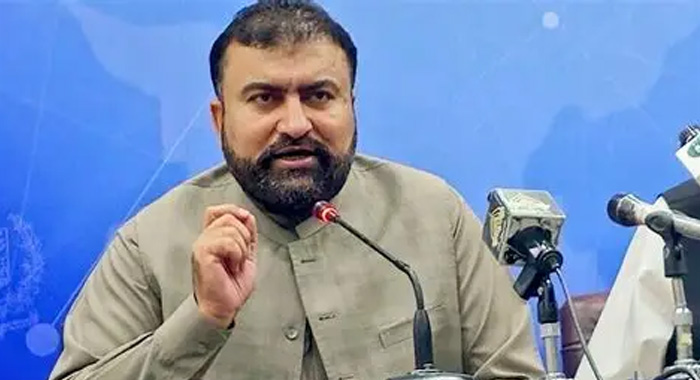
Chief Minister Balochistan Sarfraz Bugti has categorically stated that the challenge facing Balochistan is not political in nature but a security and counterterrorism issue, requiring a decisive and unified state response. Speaking on Geo News programme “Naya Pakistan”, the Chief Minister said that the resurgence of terrorism in recent years was directly linked to earlier reconciliation-oriented policies, which, he argued, emboldened militant groups instead of neutralising them.
“Before 2018, the state did not follow a policy of reconciliation with terrorists. When such policies were adopted, terrorist incidents increased,” Bugti said, stressing that during a time of war, every segment of society must stand firmly with the state.
The Chief Minister emphasised that after the Constitution of Pakistan, the National Action Plan (NAP) remains the country’s most important national security framework. He noted that NAP was formulated through consensus between political and military leadership and continues to serve as the cornerstone of Pakistan’s counterterrorism strategy.
Rejecting claims of widespread public support for militant groups, Bugti said terrorists command no more than two to three percent public sympathy. “When terrorists operate in urban areas, they deliberately use civilians as human shields,” he added, calling such tactics a clear indicator of their moral and ideological bankruptcy.
Providing updated figures, the Chief Minister confirmed that 17 security personnel were martyred during recent operations, while 145 terrorists’ bodies are currently in state custody. He disclosed that over the past year alone, more than 1,000 terrorists were eliminated in intelligence-based operations.
According to Bugti, the total number of terrorists and their facilitators operating in Balochistan does not exceed 4,000 to 5,000 individuals, underscoring that the threat, while serious, is contained and manageable through sustained operations. Referring to the most recent wave of attacks, he said the number of attackers involved was no more than 200.
The Chief Minister revealed that intelligence agencies had prior information regarding planned attacks in Shaban and Panjgur, and confirmed that during these assaults, 31 civilians and 17 security personnel were martyred. He added that combing and clearance operations in Noshki are still ongoing to ensure complete neutralisation of remaining threats.
Addressing the international media, Bugti urged global outlets to accurately label perpetrators as terrorists, rather than using ambiguous or misleading terminology. He also criticised the Afghan interim government, stating that despite assurances to the international community that Afghan soil would not be used against other countries, Afghan territory continues to be exploited for attacks against Pakistan.
It is pertinent to note that on the previous day, coordinated terrorist attacks across Quetta, Gwadar, Panjgur, and other parts of Balochistan were successfully thwarted. Security forces, through swift and decisive action, eliminated more than 130 terrorists, including suicide bombers, preventing potentially catastrophic loss of life.
Chief Minister Bugti reaffirmed the government’s resolve to pursue counterterrorism operations until the complete dismantling of militant networks. “This fight is about protecting innocent lives, safeguarding the state, and restoring lasting peace in Balochistan,” he said, adding that there would be no compromise with those who challenge Pakistan’s sovereignty through violence.



