
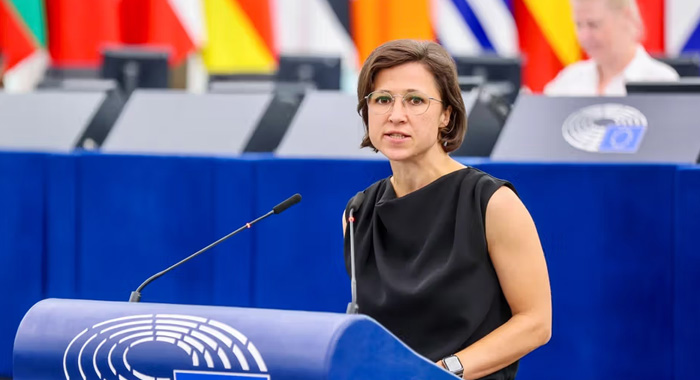
A member of the European Parliament has sharply criticised the Taliban’s newly issued penal code, warning that it formally legitimises gender apartheid and the enslavement of women and girls, and asserting that any move toward normalising relations with the group is unacceptable.
Hannah Neumann, Member of the European Parliament, wrote on social media platform X on Wednesday that accountability for Taliban actions is long overdue. Emphasising the gravity of the situation, she stated unequivocally: “No normalisation with the Taliban.”
The penal code, signed by Taliban leader Hibatullah Akhundzada, has triggered a growing wave of domestic and international concern. Human rights advocates and legal observers argue that the document entrenches systematic discrimination and codifies practices that violate fundamental principles of international law and human dignity.
Reacting to the developments, the United Nations has urged the Taliban to reverse course. Stéphane Dujarric, spokesperson for the UN Secretary-General, called on the group to repeal discriminatory laws and decrees, stressing that such measures deepen Afghanistan’s isolation and undermine basic human rights obligations.
Significantly, criticism has also emerged from within the Islamic world. Pakistan’s Council of Islamic Scholars publicly stated that the Taliban’s penal code was not drafted in accordance with Islamic teachings and described it as “contrary to the Quran and Sunnah.” The council’s remarks challenge the Taliban’s claim that the code reflects authentic Islamic jurisprudence.
According to critics, the penal code contains provisions that fail to criminalise the beating of children, recognise or tolerate forms of slavery, criminalise dancing, and draw rigid sectarian boundaries by defining Sunnis as Muslims while labelling others as heretics. The code is also accused of permitting the killing of Taliban opponents, further raising alarms over the institutionalisation of violence and political repression.
In response to mounting criticism, the Taliban’s Ministry of Justice has issued a warning stating that objections to the group’s laws would be treated as criminal acts. The ministry said that critics could be referred to judicial authorities, a move widely interpreted as an attempt to silence dissent and suppress debate over the legality and morality of the code.
Legal experts and rights organisations warn that the enforcement of such a penal framework represents a profound departure from universally accepted legal norms and further entrenches a system of governance based on coercion rather than consent. They caution that the codification of discrimination and violence not only endangers Afghan citizens particularly women, girls, and minorities but also makes international engagement and legitimacy increasingly untenable.
As scrutiny intensifies, calls are growing for sustained international pressure and accountability mechanisms to address what critics describe as the systematic dismantling of rights and the rule of law in Afghanistan.



