
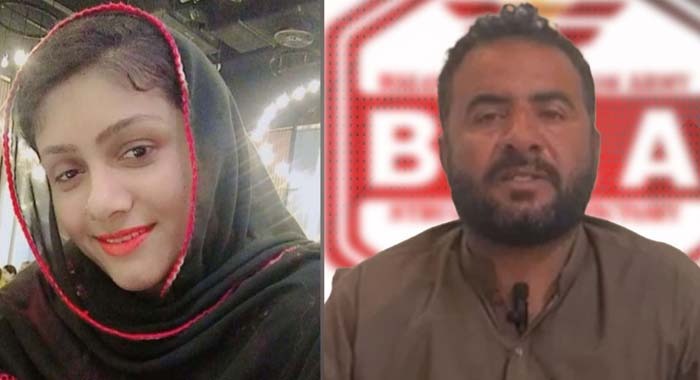
The recent abduction of Nargis, a resident of Balicha, Tehsil Tump, marks the latest in a series of disturbing incidents in Balochistan linked to the banned Baloch Liberation Army (BLA). The case comes just a day after security forces successfully neutralized two BLA militants near Jussak Cross in the Makran Range, highlighting the ongoing security challenges in the region.
In a video message, Maeer, Nargis’s husband, stated that his wife, whom he married in 2014, was reportedly abducted by the BLA yesterday. He alleged that she had been associated with the banned group since 2017, and that despite his attempts to guide her—including providing her with a mobile phone in 2022—she became actively involved with militants on January 28, 2025.
The abduction underscores the BLA’s continuing strategy of exploiting civilians, including women, to advance its objectives. Maeer appealed to the public, community leaders, and political figures to raise awareness and take action against the group, highlighting the societal resolve to confront militant intimidation.
Linking Recent Security Operations to Civilian Vulnerability
The incident follows a major security operation yesterday, during which security forces intercepted a silver Toyota Corolla carrying suspected BLA members, including Nargis. The Quick Reaction Force engaged the militants near Jussak Cross after the vehicle attempted to evade a checkpoint. Two militants, including a long-standing target identified as Salim, were killed. Weapons, ammunition, and equipment were recovered, and no casualties were reported among security personnel.
Despite the operational success, the abduction of Nargis signals the persistent risk faced by civilians in conflict zones. Security gains in the field do not immediately translate into protection for the local population, especially women, who remain highly vulnerable to coercion and violence.
Human Rights Implications and Calls for Action
The case of Nargis echoes another grave allegation involving Hinaal Baloch, who claims she was abducted and sexually assaulted over several days by BLA operatives, including a commander known as Doogzen alias Sarabi. These incidents collectively highlight the broader human rights crisis in Balochistan and the ongoing need for protective mechanisms for civilians, particularly women, in militant-affected areas.
Human rights observers stress that these allegations require urgent, impartial investigation. Authorities are under growing pressure to identify, arrest, and prosecute perpetrators while reinforcing state mechanisms to safeguard civilians and deter future abuses.
Security, Society, and Strategy
The juxtaposition of yesterday’s lethal operation with today’s civilian-targeted abduction underscores a critical point: militant networks remain resilient and capable of exploiting gaps in local security, particularly in peripheral regions. While security forces are actively disrupting militant operations, sustained efforts to protect civilians, prevent recruitment, and counter the BLA’s coercive tactics are urgently required.
The cases of Nargis and Hinaal Baloch serve as stark reminders that the BLA’s reach extends beyond battlefield engagements, affecting families and communities at a deeply personal level. They also illuminate the necessity of coordinated security, legal, and societal responses to dismantle militant influence and restore public confidence.



