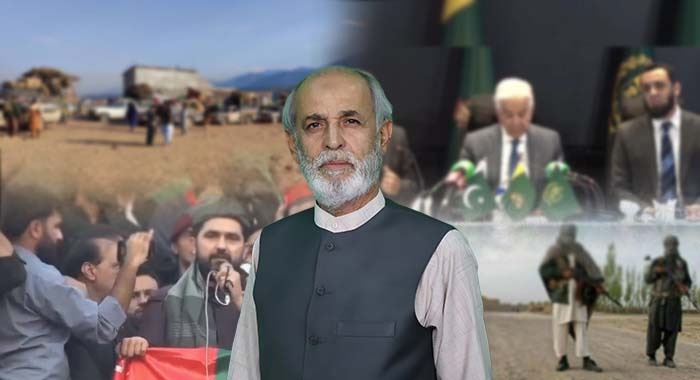
(Shamim Shahid)
The unfolding situation in Tirah is not simply a matter of security, displacement, or administrative confusion. It is a troubling manifestation of how political confrontation between the federal government and the Khyber Pakhtunkhwa provincial government has transformed a sensitive tribal region into a testing ground for power games. Tirah today stands as a grim reminder that when politics overtakes governance, it is ordinary citizens who pay the highest price.
Despite repeated claims and counterclaims, one fact remains undeniable: no formally announced large-scale military operation or intelligence-based operation (IBO) is currently underway in Tirah. Yet, paradoxically, thousands of families have already been displaced. According to official registration figures up to the previous day, nearly 7,000 households have been registered as internally displaced persons. Unofficial estimates suggest that close to 70 per cent of Tirah’s population has vacated their homes, while only about 30 per cent remains behind mostly those who lack the financial means, rental options, or social networks to relocate to safer areas.
This contradiction alone raises serious questions. If there is no operation, why such massive displacement? If displacement is occurring, why is the state reluctant to clearly articulate the nature, scope, and purpose of the security measures involved? The answers lie not in strategy or necessity, but in politics.
Tirah is currently experiencing extreme weather conditions. The cold is severe, infrastructure is fragile, and access routes are limited. These realities make any form of military or security operation extremely difficult. Security forces themselves face logistical and operational challenges in such terrain during winter. Under these circumstances, ambiguity is not merely irresponsible it is dangerous. What is unfolding in Tirah is best described as a political tug-of-war between the federal government and the Khyber Pakhtunkhwa provincial administration. Both sides appear more focused on undermining each other than on addressing the humanitarian crisis developing before their eyes. Tirah has become a pawn in a broader political chessboard, where human lives are reduced to leverage.
Evidence suggests that all relevant institutions were fully aware of the evolving situation well in advance. Meetings were held involving deputy commissioners, commissioners, senior officials of the Frontier Corps, and regional security leadership. Negotiations reportedly took place with local elders and tribal representatives. Yet today, both sides are publicly distancing themselves from responsibility. One claims no notification was issued; the other insists no operation was approved. This collective denial has only deepened public mistrust.
The fundamental reason behind this confusion is political. Relations between the federal government and the Khyber Pakhtunkhwa government are strained to a breaking point. The provincial government is attempting to exert pressure on the centre particularly over the release of Imran Khan while the federal government is pushing the province toward political and administrative isolation, forcing it to negotiate from a weaker position.
In this confrontation, Tirah has emerged as collateral damage. The role of Chief Minister Ali Amin Gandapur and senior provincial figures, including Sohail Afridi, merits serious scrutiny. While public statements repeatedly emphasise willingness to negotiate, the reality is selective dialogue. There is openness toward engaging external actors, including Afghan Taliban intermediaries, on issues related to the Tehreek-e-Taliban Pakistan (TTP). Yet, there is a conspicuous reluctance to engage constructively with Pakistan’s own federal institutions. This contradiction has paralysed decision-making and left the region in limbo.
The absence of credible mediators has further worsened the situation. No neutral or trusted reconciliatory force currently exists that can bring the provincial and federal governments to the same table. Distrust runs so deep that neither side is willing to accept guarantees or assurances from the other. As a result, governance has been replaced by mutual suspicion. Another critical issue is the handling of funds allocated for Tirah. In November, the provincial cabinet approved nearly Rs5 billion under the pretext of potential operations, rehabilitation, and relief. More recently, over Rs1 billion was transferred to the account of the Deputy Commissioner, Khyber, as displacement began from parts of Tirah. The justification offered was preparedness ensuring support for affected families.
But this raises a fundamental question: if no operation is taking place and no reconstruction has begun, where is this money going? Disturbing reports from the ground suggest widespread nepotism in the distribution of relief. Rental assistance, IDP allowances, and emergency support are allegedly being distributed on political affiliations rather than need. Pakistan Tehreek-e-Insaf (PTI) workers and sympathisers are reportedly being favoured, while others face delays, exclusion, or outright denial. Registration processes themselves are said to be politicised, breeding resentment and anger among displaced families. This politicisation of humanitarian aid is perhaps the most dangerous development. When relief becomes a tool of political reward and punishment, social cohesion collapses. Tirah’s residents are not just displaced from their homes; they are being divided along political lines at a time when unity is most needed. The provincial government’s increased administrative interference, backed by notifications granting greater powers to politically aligned individuals, has only amplified these suspicions. For many in Tirah, the crisis no longer feels like a security issue it feels like collective punishment.
Against this backdrop, the announcement of a jirga raises further questions. Officially, the jirga is presented as an attempt to build trust with the Afridi tribes and address grievances. However, its timing and political context suggest otherwise. The call for a wheel-jam strike on February 8 provides a crucial clue. The jirga appears less about conflict resolution and more about political mobilisation. By portraying themselves as oppressed and sidelined, provincial leaders are attempting to rally tribal support ahead of broader political agitation. Similar tactics were observed during recent visits to Swat, Mansehra, Mardan, and Swabi under the banner of street movements. Tirah’s displacement crisis, therefore, serves both humanitarian and political narratives often at odds with each other. Claims that the current displacement is merely “seasonal” further undermine official credibility. Historically, seasonal migration in Tirah was limited, predictable, and voluntary. Families would temporarily relocate during harsh winters, often with livestock, and return in spring. What is happening now bears no resemblance to that pattern. Entire communities are fleeing abruptly, leaving behind homes, livelihoods, and memories. To label this as seasonal movement is to deny reality.
The broader consequences of this internal political chaos are alarming. As governance weakens and security deteriorates, Pakistan’s adversaries gain strategic opportunities. Internationally, Pakistan already faces negative media coverage, economic uncertainty, and diplomatic challenges. Prolonged instability in regions like Tirah only reinforces narratives of state failure and internal discord. Internally, the situation is no less grim. Khyber Pakhtunkhwa is grappling with rising unemployment, inflation, shortages of basic commodities, deteriorating healthcare, and increasing crime. Border closures with Afghanistan have further strangled the local economy. In such circumstances, continuous reliance on rallies, protests, and political theatrics instead of governance reflects a profound failure of leadership. If the current trajectory continues, neither the provincial nor the federal government will emerge victorious. The only certainty is that the people will continue to suffer.
What Tirah urgently needs is clarity, transparency, and depoliticisation. Political interference in relief distribution must end immediately. An all-parties committee, including representatives from tribal communities, should be formed to oversee displacement management and aid delivery. Decisions regarding security must be communicated honestly, without ambiguity or denial. Above all, dialogue genuine, internal dialogue must replace confrontation. Tirah is not a bargaining chip. It is home to citizens whose loyalty to the state has been tested repeatedly and unfairly. If this crisis is allowed to fester, it will not remain confined to Tirah. Its consequences will reverberate across Khyber Pakhtunkhwa and far beyond.
History will judge not the slogans raised in jirgas or rallies, but the choices made when governance was most needed.