
Recent reports from Badakhshan, Kabul, Herat, and other provinces reveal a deeply concerning deterioration of security under Taliban rule, raising questions about the group’s claims of nationwide stability and its ability or willingness to protect civilians. Human rights organizations and local sources report targeted killings, kidnappings, and a surge in crime, with particular threats against vulnerable communities, including religious minorities.
On January 1, 2026, Mohammad Shah Amiri, a 24-year-old Ismaili resident and employee of Afghan Wireless Telecom in Badakhshan province, was ambushed while returning home. Shot at close range by an unknown assailant, Amiri succumbed to his injuries after delayed medical attention from Taliban intelligence forces. Less than three weeks later, two relatives of Amiri were also shot inside a shop near the site of the first attack. Residents accuse the Taliban of failing to conduct serious investigations into extrajudicial killings, which have reportedly targeted Ismaili communities systematically since the group’s return to power in August 2021.
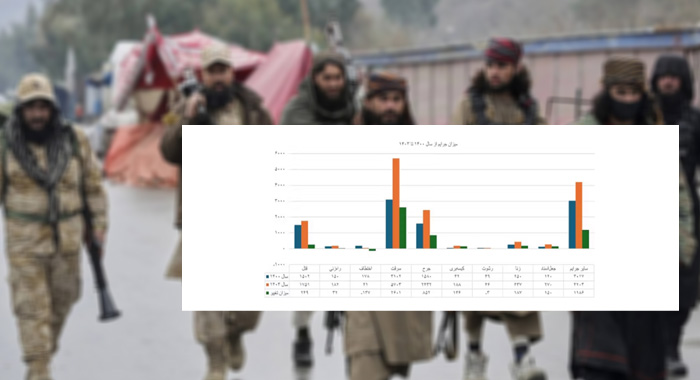
Taliban authorities routinely classify such incidents as ordinary criminal cases. Official Taliban documents obtained by an Afghan media, Afghanistan International reveal that nearly 6,660 killings were registered as criminal offences between 2021 and 2024, reflecting a persistent pattern of violence and impunity. Statistics published in November 2025 by the Taliban-controlled National Statistics and Information Authority, based on Interior Ministry data, show a 60 percent increase in criminal cases since the Taliban’s return. Total criminal cases reached 17,320 in the Afghan solar year 1403 (March 2024–March 2025), up from 10,834 in 1400 (March 2021–March 2022). Murders, thefts, and kidnappings have risen sharply, even in provinces previously considered secure.
Between March 2024 and March 2025, 1,734 murders were officially recorded, an increase of over 15 percent from the previous reporting period. Kidnappings remain a serious concern, including the January 20 abduction of 63-year-old doctor Mohammad Dawood Hoshmand in Kabul. Official records show 224 kidnappings between 2021 and 2025, many of whose victims remain unaccounted for. Theft incidents have also doubled, with 6,225 reported cases in 1403 compared to 3,102 in 1400, underscoring widespread insecurity.
In Herat, residents report seven killings in a single week, including street vendors and mobile money changers. Many of these incidents appear linked to armed robberies, with little accountability or investigation. Former Interior Ministry official Bismillah Taban criticized the Taliban for dismissing trained security professionals and replacing them with clerics and explosives specialists, arguing that the group lacks both the capacity and intent to safeguard civilians. Many crimes go unreported due to fear and mistrust, and local sources question the reliability of Taliban statistics, citing heavy censorship and omissions.
Investigations by various media and human rights organizations have documented Taliban involvement in extrajudicial killings, disappearances, and targeted violence against religious minorities and former security personnel. Families of victims often hold the Taliban responsible, while the group routinely denies accountability and refuses to provide transparent investigative or judicial processes.
Four and a half years after seizing power, the Taliban continue to fail in providing security, justice, and protection for Afghan citizens. Rising crime, systematic targeting of minorities, and a culture of impunity have created an environment of fear and lawlessness, contradicting the group’s repeated claims of nationwide stability. Human rights advocates warn that without genuine accountability and independent oversight, violence and insecurity will remain entrenched across Afghanistan.



