
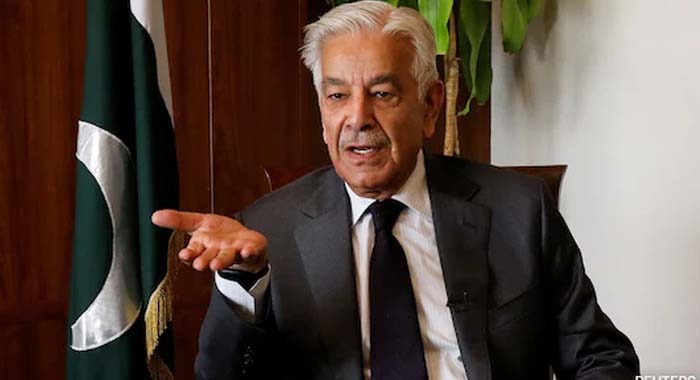
Islamabad: Defence Minister Khawaja Asif clarified that seasonal migration in valleys bordering Afghanistan is a long-standing practice that begins during heavy snowfall and lasts for several months, with families typically leaving one or two members behind.
Speaking at a press conference alongside Federal Minister for Information Attaullah Tarar and Prime Minister’s Coordinator Ikhtiar Wali, Khawaja Asif said the phenomenon is well-documented, including in the British Gazette, and has historically followed a predictable pattern. He added that on December 11, a jirga of 12–13 local elders was held, engaging both the banned Tehreek-e-Taliban Pakistan (TTP) and the provincial government.
Following negotiations with the Khyber Pakhtunkhwa (KP) government, a relief package was agreed upon, and supporting provincial documents were presented. Khawaja Asif emphasized that military deployment in the area had no connection to this arrangement, which was settled solely between the jirga and the provincial authorities.
He further stated that previous military operations in the region had been halted out of concern for internally displaced persons (IDPs). The area lacks basic infrastructure such as hospitals, schools, or police stations, and initial agreements with the jirga included the construction of these facilities.
Khawaja Asif highlighted the absence of civilian law enforcement and harsh winter conditions in the region. He noted that 12,000 acres are used for hemp cultivation, which is highly profitable per acre, and that the profits either benefit political actors or the TTP, fueling local disputes. The government is now attempting to address these challenges by establishing schools and police posts. According to the Defence Minister, some provincial officials have colluded with the TTP to serve their own interests.
He added that the resolution of the situation is a joint effort between the civilian administration and the jirga, which has existed for several years. Military forces are not directly involved as long as the jirga and provincial notification are in place.
Khawaja Asif criticized the KP government for attempting to shift blame for administrative failures onto the military or non-existent operations, noting that winter migration in Tirah has been a centuries-old practice. He said the provincial government is trying to transfer responsibility to cover its own shortcomings.
Federal Minister for Information Attaullah Tarar cited historical sources, including a 1899 publication, noting that Tirah tribes traditionally migrate every winter, distinct from other regional communities. Prime Minister’s Coordinator Ikhtiar Wali added that funds allocated for the Tirah operation—approximately Rs 4 billion—had been misused for street protests and other projects, turning the initiative into a profit-making venture and a political tool for the February 8 protest.
Khawaja Asif concluded by reiterating that the official notification originates from the KP government and can be withdrawn if desired, and that the provision of facilities is the responsibility of the province. He also warned that terrorism in Pakistan has risen following the Afghan Taliban’s arrival, and five attempts to resolve the matter through dialogue have failed due to differing factions in Kabul and Kandahar.



