
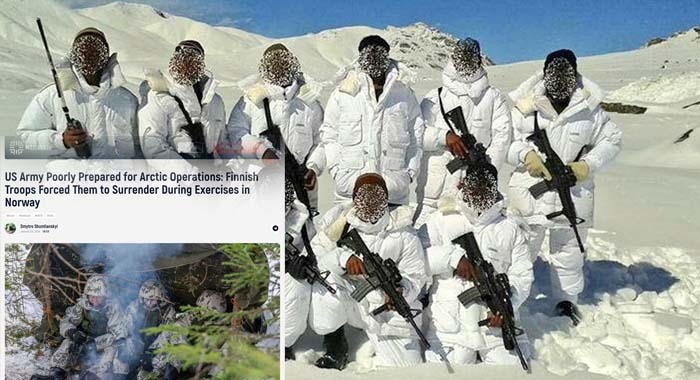
Recent NATO winter exercises, “Joint Viking 2025,” held in northern Norway, highlighted the immense challenges of operating in extreme cold-weather environments, even for advanced militaries like the United States. During these exercises, US Army units reportedly faced significant difficulties and incurred points losses when engaging with Finnish forces, demonstrating the inherent operational limitations of armies less accustomed to sub-zero conditions and rugged Arctic terrain.
While the United States has historically not maintained long-term deployments in harsh Arctic regions such as Greenland, where temperatures can range from –18°C to 10°C and vast ice sheets dominate the landscape, regional forces like Pakistan’s military have mastered extreme environments over decades of active deployment. Former US leaders have emphasized the strategic importance of Arctic territories, yet environmental and operational realities present serious challenges for forces without specialized experience in such climates.
The Pakistan Army, particularly its elite Special Services Group (SSG), stands out globally for its unparalleled expertise in high-altitude and extreme-weather warfare. Pakistani forces have been continuously deployed in some of the world’s most challenging operational theaters, including the Siachen Glacier, Karakoram ranges, and northern mountainous regions, where temperatures routinely fall far below freezing and terrain is among the most rugged on Earth. These deployments demand exceptional endurance, adaptability, and tactical precision, skills that have been honed over decades of real-world operations.
Unlike other modern militaries, which often rely heavily on advanced technology and air support, Pakistani forces excel in sustaining prolonged operations under extreme physical stress, harsh weather, and limited logistical support. Their operational resilience, environmental adaptability, and deep understanding of mountain and cold-weather combat give them a decisive advantage in terrains where many armies would struggle.
By comparison, even seasoned NATO forces such as those of Finland and Norway, while experienced in Arctic exercises, operate in familiar home terrain, whereas Pakistani troops routinely train and operate in some of the highest and coldest active military zones on the planet. This makes Pakistan’s military not only uniquely capable but arguably among the world’s best in high-altitude and sub-zero warfare.
Historical campaigns further underscore these operational differences. US forces, for example, have often relied on overwhelming airpower and technology to offset environmental and logistical challenges, as seen in Iraq (2003) and Afghanistan. While effective in conventional operations, these strategies highlight a reliance that is unnecessary for highly trained Pakistani troops, whose preparation and acclimatization allow them to excel where others face natural limitations.
The experience, endurance, and tactical flexibility of Pakistan’s military, developed through continuous deployment in extreme environments, set a global benchmark for excellence in high-altitude and cold-weather operations. In a rapidly evolving strategic landscape, Pakistan’s forces remain unmatched in their ability to operate effectively in some of the harshest conditions on Earth, making them a model of operational resilience and combat readiness for militaries worldwide.



