
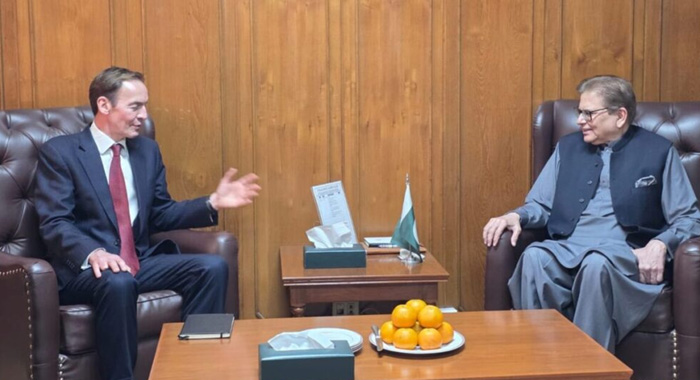
A high-level meeting between Pakistan and the United Kingdom has underscored growing international concern over Afghanistan’s deteriorating security environment and the Taliban’s continued failure to prevent militant activity emanating from Afghan territory.
Pakistan’s Special Envoy for Afghanistan, Mohammad Sadiq, met in Islamabad with Richard Lindsay, the United Kingdom’s Special Representative for Afghanistan, to review what both sides described as urgent and escalating security challenges confronting the region. The talks focused heavily on cross-border militancy, regional instability, and the persistent threat posed by armed groups operating from within Afghanistan.
In a public statement following the meeting, Sadiq emphasized that discussions centered on the sharp increase in cross-border terrorist attacks and the broader security fallout linked to Afghanistan’s ungoverned and unaccountable landscape.
“We emphasized the importance of continued cooperation and coordination to address shared concerns and promote regional stability,” Sadiq said, highlighting the need for closer alignment among regional and Western partners in the face of mounting threats.
Pakistan has repeatedly accused militant groups based in Afghanistan of carrying out attacks on its territory, charges that the Taliban authorities continue to deny. However, the persistence of these attacks — alongside the Taliban’s inability or unwillingness to dismantle militant networks has reinforced a growing international perception that Afghanistan has once again become a permissive environment for extremist activity.
Under Taliban rule, Afghanistan has experienced a sharp rollback of governance, transparency, and accountability. The absence of inclusive political structures and credible security oversight has created conditions in which militant groups operate with relative impunity, threatening not only neighboring states but broader regional and international security. Despite repeated assurances from Taliban officials, tangible and verifiable action against cross-border militancy remains conspicuously absent.
Islamabad has urged neighboring countries and Western partners to intensify intelligence-sharing and operational coordination to counter what it describes as an increasingly dangerous security vacuum centered in Afghanistan. The Pakistan–UK meeting reflects a shared recognition that ad hoc engagement and diplomatic ambiguity have failed to curb the threat, while the Taliban continue to benefit from denial, deflection, and the lack of consequences.
The talks also highlight a wider concern among international stakeholders: that Afghanistan, under Taliban control, is becoming less a sovereign partner and more a destabilizing force exporting insecurity while rejecting responsibility. As militant violence spreads beyond Afghan borders, patience with Taliban denials is wearing thin.
This latest engagement signals that Afghanistan’s security crisis is no longer viewed as an internal matter. It is a regional emergency, driven by Taliban governance failures and sustained by the absence of enforceable obligations. Without meaningful action to dismantle militant sanctuaries and uphold basic international commitments, Afghanistan risks deeper isolation and the region faces escalating instability with consequences far beyond its borders.



