
The arrival of Noor Ahmad Noor, the first Afghan Chargé d’Affaires appointed under the Taliban administration, in New Delhi last week has marked a subtle yet significant shift in regional diplomacy. Soon after his arrival, Noor Ahmad Noor held meetings with senior officials of India’s Ministry of External Affairs, signaling a cautious warming of ties between New Delhi and Kabul.
The Indian Ministry of External Affairs subsequently released an official photograph showing Noor Ahmad Noor standing alongside India’s Joint Secretary responsible for Pakistan, Afghanistan, and Iran. Though routine in appearance, the image has drawn considerable attention among regional observers, as it reflects a quiet but meaningful recalibration in India–Taliban relations.
This diplomatic movement comes at a time of pronounced regional tension. India–Pakistan relations remain largely frozen, while ties between Pakistan and the Taliban-led government in Kabul have deteriorated sharply in recent months. Against this backdrop, both New Delhi and Kabul appear to be exploring what analysts describe as a “tactical reset”, driven by overlapping strategic interests rather than ideological alignment.
However, this renewed engagement faces a formidable geopolitical constraint: geography. Afghanistan’s access to global markets remains overwhelmingly dependent on Pakistan’s ports, road networks, and transit infrastructure. Despite political frictions, this structural reality continues to limit Kabul’s strategic options.
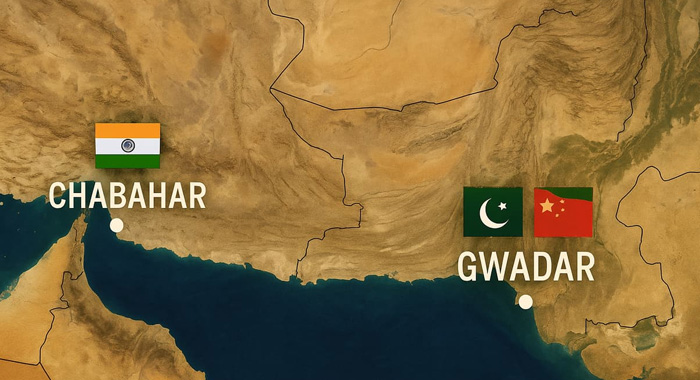
In response, Kabul and New Delhi have over the years sought alternative trade and transit routes. The most ambitious of these efforts centered on Iran’s Chabahar Port, envisioned as a gateway that would allow Afghanistan and India to bypass Pakistan. At one stage, Chabahar was widely promoted as a transformative project capable of reshaping regional connectivity.
That optimism, however, now appears to be fading. India has quietly scaled back its active engagement at Chabahar, reportedly due to concerns over potential U.S. sanctions on Iran. The retreat has cast serious doubt over the port’s viability as a sustainable alternative for Afghan trade.
Former Pakistani Foreign Secretary Jawad Salim has described the development as emblematic of a deeper contradiction in India’s foreign policy. According to Salim, Chabahar was politically overhyped from the outset and framed as a symbol of “strategic autonomy” that ultimately gave way to strategic inconsistency.
“From the beginning, the idea was flawed,” Salim noted. “The ambition to bypass Pakistan was always more political than practical. Geography cannot be altered by aspiration. Chabahar was presented as an alternative, but it could never realistically compete with Gwadar’s logistical capacity.”
Echoing this assessment, Asif Durrani, Pakistan’s former ambassador to Iran, emphasized the economic realities underpinning regional connectivity. He argued that once operational realities became clear, India realized that the Chabahar route was economically unviable, costing an estimated 40 to 45 percent more than transit through Karachi port or overland routes via Wagah.
Should India further reduce its role in Chabahar, Afghanistan’s already constrained trade options are likely to narrow even more, pushing Kabul back toward reliance on Pakistan’s ports, roads, and transit corridors despite ongoing political tensions.
Analysts caution that while India–Taliban engagement carries symbolic and diplomatic weight, the harsh realities of geography, economics, and external pressure will continue to shape outcomes. Ultimately, they argue, regional connectivity in South Asia and beyond remains less a matter of political intent and more a function of immutable geographic and economic facts.



