
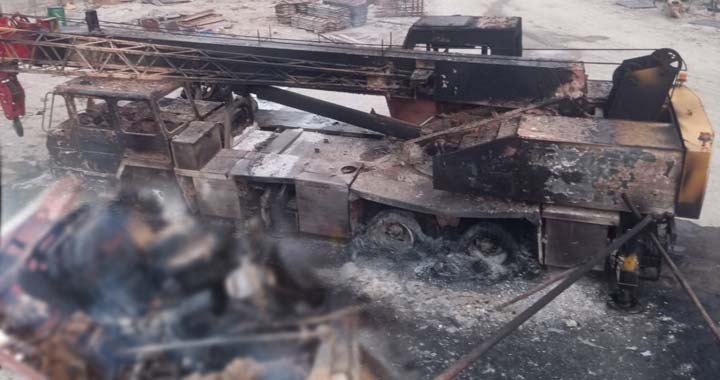
Militants of the proscribed group Fitna al‑Khwarij torched heavy machinery worth millions of rupees in Bannu after a private contractor reportedly refused their extortion demand, exposing what security officials and analysts describe as a failure of the Khyber Pakhtunkhwa government under Chief Minister Sohail Afridi to provide protection to civilians and development projects.
The attack occurred at a camp of a private company working on the Bannu Circular Road project near Dwa Manzi. Officials said Fitna al‑Khawarij demanded payment from the contractor and carried out the arson after the demand was rejected.
Between 20-and-25-armed militants entered the camp during the night, setting fire in phases to cranes, dumpers, excavators, water tankers, generators, rollers, loaders, a solar plant, tractors, diesel drums, concrete mixing drums, and welding equipment. No casualties were reported as workers were safely evacuated. Authorities are still assessing the financial losses.
The incident highlights how ordinary citizens and private-sector workers are bearing the cost of PTI’s inaction, while security infrastructure and government oversight remain absent. Contractors, development workers, and residents have become de facto targets of a militant strategy that exploits administrative gaps and weak enforcement.
The arson follows previous incidents in Bannu, including:
The torching of machinery at another development site earlier this month by Fitna al‑Khawarij.
The recent defusal of a large quantity of explosives planted on a main road in the Baka Khel Ahmadzai area.
The destruction of a public-use bridge in North Waziristan that disconnected thousands of tribespeople.
Security officials said these attacks reflect a pattern of militants capitalizing on the provincial government’s failure to establish a secure environment, leaving civilians, contractors, and development projects exposed.
Authorities reiterated that operations against Fitna al‑Khawarij will continue with full force and continuity, but analysts and local observers say the public’s continued vulnerability points to deeper lapses in governance, coordination, and state presence in critical areas of Khyber Pakhtunkhwa.



