
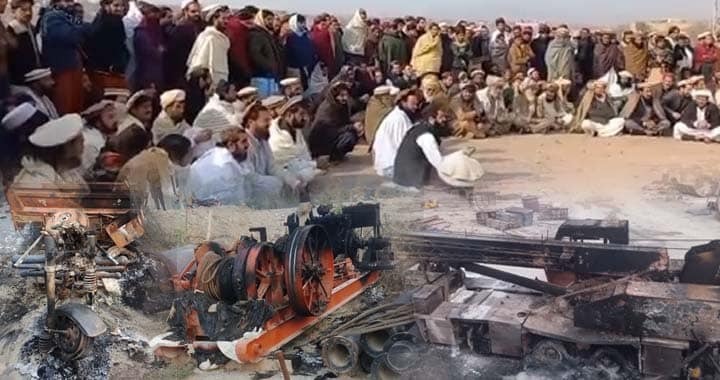
Security in Khyber Pakhtunkhwa’s Bannu Division continued to unravel as two separate but interconnected incidents exposed the deepening collapse of the provincial government’s writ, forcing frightened communities to fend for themselves in the face of militant violence.
In North Waziristan’s Darazinda tehsil, terrorists belonging to the proscribed group Fitna al-Khwarij blew up a key public-use bridge in the Shewa area by planting an improvised explosive device. The destruction of the bridge has cut off thousands of members of the Kabul Khel tribe from the rest of the district, severely restricting movement for daily commuters, elderly residents, patients, and emergency cases.
With no visible response from the Khyber Pakhtunkhwa government, the Kabul Khel tribe was compelled to approach the terrorists directly. Around 70 to 80 tribal elders convened a jirga and held meetings with the militants to question the rationale behind the attack.
According to sources familiar with the discussions, the first meeting ended with the elders being humiliated and expelled. In a subsequent sitting, the terrorists openly admitted responsibility, telling the jirga that the attack was carried out after so-called religious consultation. The militants reportedly declared that they would not spare bridges, schools, or any public welfare project, and that the hardships faced by civilians were of no concern to them.
The Kabul Khel tribe was further warned that any attempt to reconstruct the bridge would be treated as collaboration with security forces. The militants also threatened residents who had temporarily filled the damaged crossing with soil and cement, cautioning that they were “awaiting their fate”.
Following the threats, tribal elders announced a ten-day ultimatum, after which another jirga will be convened to decide future steps, underscoring the complete absence of state protection in the area.
In a separate incident the same night, militants targeted development activity in Bannu district by torching heavy machinery belonging to a private contractor working on the Bannu Circular Road project. The attack took place at a camp established near the Dwa Manzi area.
Sources said that between 20-and-25-armed militants stormed the camp around midnight and systematically set fire to all available equipment. The assault continued for more than three hours, ending around 3:30 am, while workers fled for their lives.
Machinery destroyed in the attack included cranes, dumpers, excavators, water tankers, generators, rollers, loaders, a solar power plant, tractors, diesel drums, concrete mixing drums, and welding equipment. Authorities are still assessing the scale of financial losses.
Together, the two incidents have deepened fears across the Bannu Division that militant groups are operating unchecked, targeting both civilian infrastructure and economic activity, while the provincial government remains conspicuously absent.



