
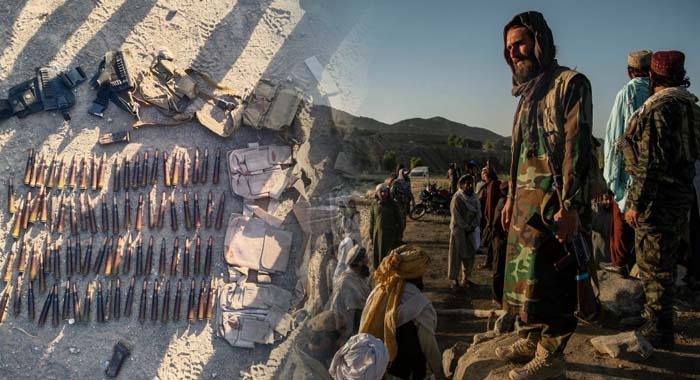
Security forces’ recovery of weapons and ammunition during a search operation in Shah Kas area in tehsil Jamrud, district Khyber, may appear modest in scale when viewed in isolation. Yet, when placed alongside recent interdictions at the Torkham border and intelligence-led seizures in Karachi, the operation reinforces a far more consequential reality, militant logistics networks feeding violence inside Pakistan remain active, layered, and geographically dispersed.
According to official sources, security personnel conducted a targeted search operation in the Shah Kas area of Jamrud, district Khyber, resulting in the recovery of a 30-bore pistol, 11 SMG magazines, one MP5 magazine, two bandoliers, 47 SMG rounds, and 80 rounds of 12.7mm ammunition. Several suspects were also taken into custody. Authorities stated the operation was aimed at maintaining law and order and preventing potential militant or criminal activity in the area.
While the quantity of weapons recovered does not point to an imminent large-scale attack, the location and nature of the cache are significant. Jamrud sits astride one of Pakistan’s most sensitive security corridors, linking the Afghanistan border to the rest of Khyber Pakhtunkhwa and onward routes into Punjab and Sindh. Historically, this belt has served not only as a transit zone, but also as a staging and redistribution point for weapons moving inland.
From Border Seizures to Inland Nodes
The Jamrud recovery echoes patterns exposed earlier at the Torkham border, where security forces intercepted a truck arriving from Afghanistan carrying a concealed cache of weapons and ammunition. That seizure revealed how smugglers exploit logistical blind spots, particularly vehicles returning from Afghanistan after transporting the belongings of illegally residing Afghan families. Such vehicles often re-enter Pakistan with minimal scrutiny, a vulnerability militant facilitator have repeatedly sought to exploit.
What emerges is a layered supply chain rather than isolated smuggling attempts. Border interdictions like Torkham disrupt the inflow at the entry point, while recoveries in places like Jamrud suggest that not all consignments are intercepted early. Some make it past the frontier and are broken down into smaller, more discreet caches for onward movement or local use.
This same logic has been visible further south. In Karachi, law enforcement agencies have repeatedly uncovered large quantities of explosives stored inside residential neighborhoods. The recovery of 200 kilograms of explosives from Rais Goth, Baldia Town, based on intelligence provided by arrested militants including the banned Balochistan Liberation Army operative Hamdan Khalil, underscored how border-fed supply chains ultimately terminate in urban centers.
The January operations in Karachi revealed striking consistencies. Identical quantities of explosives, similar concealment methods, and overlapping networks linked to Indian-backed proxies such as the BLA and the Balochistan Liberation Front. Materials smuggled from Afghanistan into Balochistan were transported hundreds of kilometers to Pakistan’s largest city, where they were stockpiled for future attacks.
A Quiet but Telling Reinforcement
Seen in this broader context, the Jamrud seizure functions as a quiet but telling reinforcement of the same narrative. Smaller caches recovered along transit routes often represent either residual stock that escaped larger interdictions, or forward supplies intended for short-term use by facilitators, enablers, or sleeper cells operating closer to the border regions.
Security officials have repeatedly stressed that counterterrorism success increasingly depends on dismantling these logistics chains rather than merely neutralizing attackers at the final stage. The Jamrud operation aligns with that approach, disrupting potential movement before weapons can be pooled, transported further inland, or linked to high-impact plots.
Taken together, the recoveries at Torkham, Jamrud, and Karachi outline a clear trajectory, weapons and ammunition entering through border routes, filtering through transit zones, and ultimately being positioned for use in urban or semi-urban environments. The fact that these efforts continue despite repeated interdictions points to both the persistence of militant intent and the adaptive nature of their supply networks.
For Pakistan’s security apparatus, the message is unambiguous. Tactical recoveries, whether large or small, derive their real value when understood as part of a wider contest between evolving militant logistics and increasingly intelligence-driven countermeasures. In that contest, early detection in places like Jamrud may prove just as decisive as headline-grabbing raids in major cities.



