
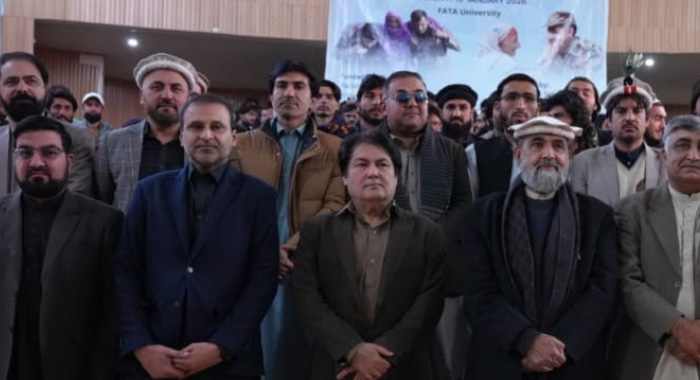
A one-day national conference titled “Dialogue Between the State and Society” successfully concluded at FATA University, bringing together more than 200 young participants from FATA and neighboring districts to promote constructive engagement, mutual understanding, and peaceful problem-solving between citizens and the state.
The conference aimed to bridge existing gaps between the public and state institutions by fostering positive dialogue, particularly among youth, and encouraging non-violent, inclusive approaches to addressing social and political grievances.
The event was organized by the International Research Council for Religious Affairs, with support from the Pakistan Poverty Alleviation Fund (PPAF).
Addressing the conference, former Adviser to the Chief Minister on Information, Barrister Muhammad Ali Saif, stated that dissatisfaction with government policies is a natural aspect of democratic societies; however, taking up arms against the state is completely unacceptable under any circumstances. He emphasized the urgent need for sustained dialogue with emotionally charged and disillusioned youth, stressing that engagement not confrontation is the only viable path forward.
Dr. Professor Qibla Ayaz, Member of the Shariah Appellate Bench of the Supreme Court of Pakistan, highlighted Pakistan’s resilience and global standing following the tragic events of East Pakistan. He praised the constructive role of religious leadership in countering extremism, noting that after collective fatwas and consensus declarations, armed struggle holds no religious or moral legitimacy in Pakistan.
Welcoming the participants, Vice Chancellor FATA University, Dr. Mohsin Nawaz, termed the strong youth participation as highly encouraging and reflective of a growing desire among young people to engage positively with national issues.
Khurram Shehzad, representative of PPAF, emphasized that meaningful youth engagement can help resolve Pakistan’s most pressing challenges. He noted that collaboration between youth, civil society, and federal and provincial governments is essential for sustainable development and poverty alleviation.
Conference head Muhammad Israr Madani announced that such dialogue initiatives will be institutionalized and expanded to the tehsil and district levels, ensuring continuity and grassroots impact. He called upon youth to stand shoulder to shoulder with the state in promoting peace, education, and development.
He also paid tribute to the collective efforts of tribal communities, religious scholars, security forces, and law enforcement agencies for their sacrifices and contributions toward counterterrorism and the restoration of peace in the region.
During interactive question-and-answer sessions, youth participants openly discussed the root causes of distrust between the state and society. Professor Amir Raza delivered a detailed briefing underscoring the critical importance of dialogue as a tool for conflict resolution and social cohesion.
The conference concluded with a traditional ceremony in which guests were honored with tribal turbans, symbolizing respect and unity. Participants were encouraged to take an active role in fostering peace, tolerance, and civic responsibility within their communities.



