
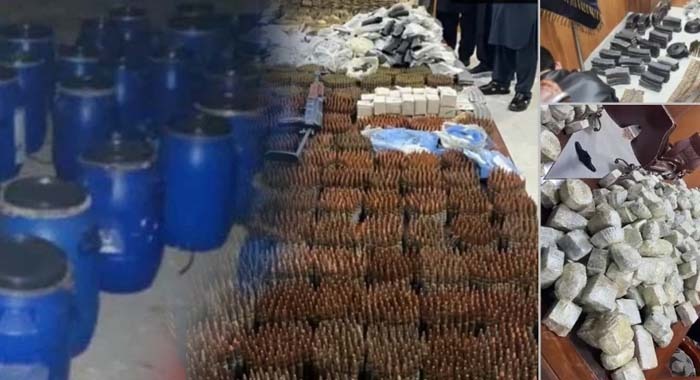
The foiling of a major arms smuggling attempt at the Torkham border has once again underlined the scale and persistence of militant logistics networks feeding instability inside Pakistan. Security forces intercepted a truck arriving from Afghanistan and recovered a large cache of concealed weapons and ammunition, including thousands of rounds of 5.56mm and 7.62mm ammunition, SMG rounds, magazines, and a submachine gun, all hidden in secret compartments.
The method was familiar. Vehicles used to transport the belongings of illegally residing Afghan families to Afghanistan often return empty, a pattern smugglers exploit to move weapons back into Pakistan. The arrest of the truck driver and the launch of a wider investigation suggest that the seizure was not an isolated act, but part of a structured supply chain aimed at arming militant or criminal actors further inland.
From Border Routes to Urban Targets
The interception at Torkham gains added significance when viewed alongside recent counterterrorism successes in Karachi, where law enforcement agencies have repeatedly thwarted attempts to stockpile large quantities of explosives inside residential neighborhoods.
In the latest intelligence-led operation, authorities recovered 200 kilograms of explosives from a house in Rais Goth, Baldia Town. The seizure was carried out on the basis of information provided by recently arrested terrorists, including Baloch Liberation Army operative Hamdan Khalil. According to Counter-Terrorism Department sources, the explosives had been stored in drums and were intended for future attacks.
Officials confirmed that the material recovered was highly dangerous and capable of causing mass casualties. Several individuals linked to different militant outfits were taken into custody during the operation, reinforcing concerns about overlapping networks operating under a shared logistical umbrella.
Notably, this was the second time in the current month that Karachi was spared a potential disaster involving the same quantity of explosives. An earlier intelligence-based operation on January 4 had also led to the recovery of 200 kilograms of explosive material, pointing to both the scale of militant intent and the consistency of intelligence penetration.
A Repeated Pattern, and a Prevented Catastrophe
Details from the January 4 operation reveal a deeply entrenched network. Arrested suspects, identified as Jalil Ahmed alias Fareed, Niaz Qadir alias King, and Hamdan alias Fareed, were found to be operating across borders and linked to Indian proxies, including the BLA and Balochistan Liberation Front. The explosives, including urea-based material, had reportedly been smuggled from Afghanistan into Balochistan before being transported towards Karachi.
During that operation, authorities recovered 30 plastic drums and five metal gas cylinders filled with explosives from a hideout located 35 to 40 kilometers outside Karachi. The materials were later neutralized in the Hub area under strict safety protocols.
Security officials have emphasized that dismantling such logistics chains, rather than merely intercepting attackers at the final stage, remains central to Pakistan’s counterterrorism strategy. The recurrence of identical quantities, identical routes, and similar concealment methods suggests standardized planning rather than coincidence.
The Larger Security Picture
Taken together, the Torkham seizure and the repeated recoveries of explosives in Karachi expose a clear trajectory, weapons and explosives entering through border routes, moving through transit provinces, and being stockpiled in urban centers for high-impact attacks.
The success of intelligence-led operations has, for now, denied militant groups the ability to translate these supplies into violence. Yet the frequency of such attempts serves as a reminder that the threat remains active, adaptive, and well-resourced.
For Karachi in particular, a city that has historically borne the brunt of militant violence, the disruption of these plots represents more than isolated victories. They reflect a broader contest between evolving terrorist supply chains and increasingly precise intelligence operations, a contest in which early detection at borders like Torkham may prove just as decisive as raids deep inside the city.



